Key Takeaways
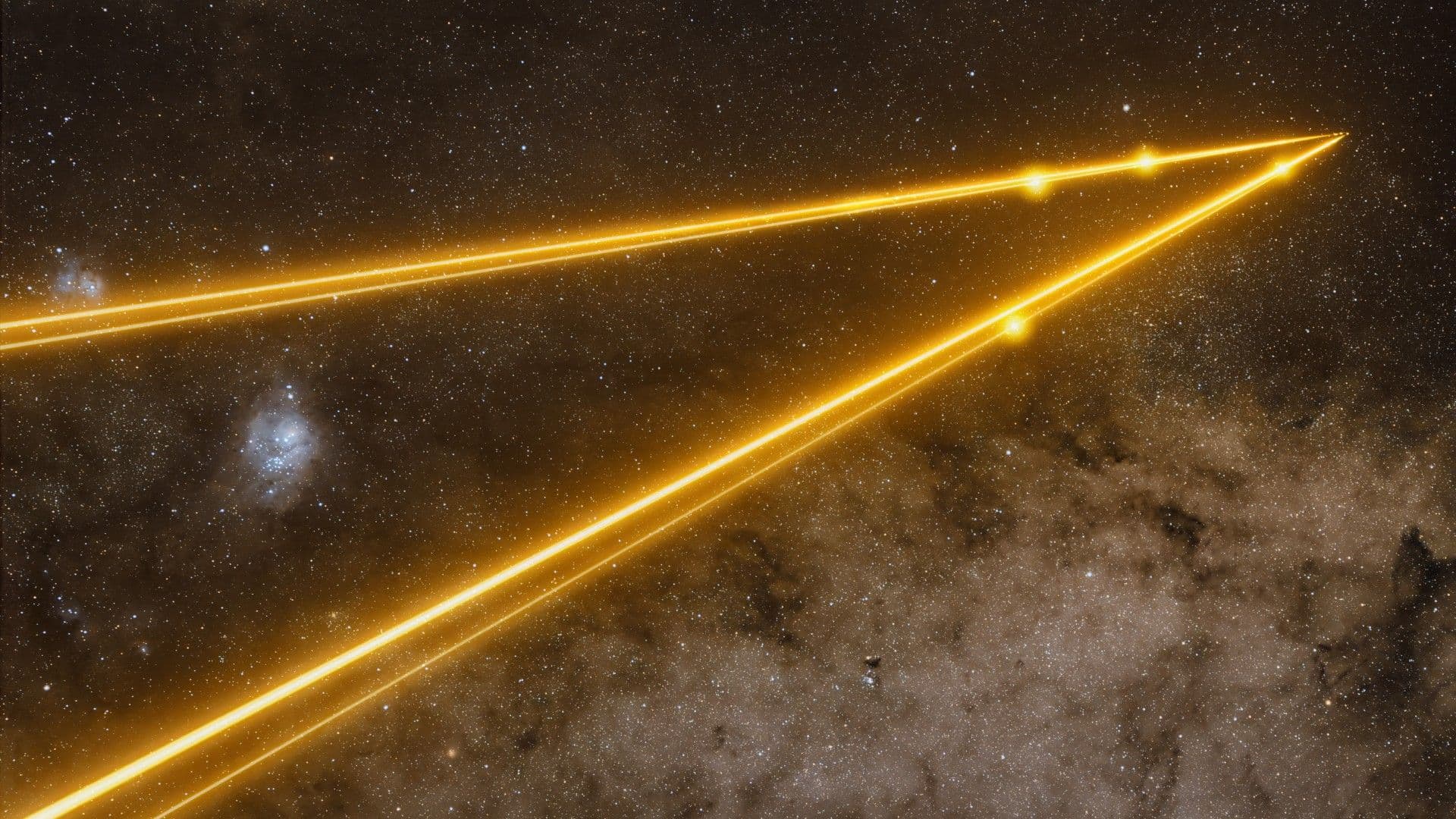
- Four lasers from ESO's Very Large Telescope create artificial reference stars 90 kilometers above Earth
- The 2026 GRAVITY+ upgrade now allows all four main telescopes to use lasers simultaneously
- Clouds passing through the beams created unexpected glowing orbs that became part of the photo's appeal
Four yellow beams of light slice through the night sky above Chile's Atacama Desert, appearing to pierce the heart of our galaxy. The image, captured by ESO astronomer Anthony Berdeu, shows the European Southern Observatory's Very Large Telescope doing something that looks like science fiction but serves a practical purpose: creating artificial stars to see the universe more clearly.
Why Fire Lasers at the Sky
Earth's atmosphere constantly shifts and ripples, distorting light from distant objects. This is why stars twinkle. For astronomers trying to study something as faint and distant as the supermassive black hole at the Milky Way's center, that distortion is a serious problem.
The VLT's solution is to create its own reference points. The telescope fires lasers into the atmosphere about 56 miles (90 kilometers) above Earth's surface. At that altitude, the beams excite sodium atoms left by meteors, causing them to glow. These glowing points become artificial stars with a known position and brightness.
By watching how those artificial stars shimmer and blur, the telescope's adaptive optics system can calculate exactly how the atmosphere is distorting incoming light at any given moment. The system then adjusts the telescope's mirrors hundreds of times per second to compensate.
The GRAVITY+ Upgrade Changes Everything
The VLT consists of four giant Unit Telescopes that can work together as an interferometer, combining their light to achieve resolution that would otherwise require a mirror 130 meters across. Until recently, this technique only worked when observing objects near a bright natural star that could serve as a reference.
The 2026 completion of the GRAVITY+ upgrade changed that limitation. All four main telescopes now have laser guide systems, which means the VLT can point anywhere in the Southern sky and still achieve sharp images.
“By creating our own reference stars, we can now probe the physics of the supermassive black hole at the center of the Milky Way with unprecedented clarity, effectively turning the entire Southern sky into our laboratory.”
— Dr. Elena Rossi, Senior Research Astronomer at ESO
This expansion to 100% sky coverage for high-precision interferometry opens new research possibilities. Astronomers can now study faint objects that happen to sit in regions of sky without convenient bright stars nearby.
The Happy Accident in the Photo
Look closely at Berdeu's image and you'll notice four glowing orbs along the laser beams, positioned about two-thirds of the way up toward the point where they converge. These aren't part of the system's design. They're clouds.
Thin clouds drifted through the beams while Berdeu was photographing, and the lasers lit them up. The result is a visual echo of the four telescopes on the ground, repeated in the sky. Even tinier dots appear at the very top where the beams seem to meet.
"For me, this image is an accomplishment," Berdeu said in a statement. "The first night the lasers were shined to point at the galactic center, I had to be on the VLT platform to take a picture."
The astronomy community has embraced the image. Discussions on r/space noted how the cloud formations created what amounts to a cross-section view of modern ground-based interferometry, showing both the deliberate engineering and the unpredictable elements that make each observation unique.
What the VLT Is Looking At
The target of these four beams is Sagittarius A, the supermassive black hole at the center of our galaxy. Located about 26,000 light-years from Earth, Sagittarius A has a mass equivalent to roughly 4 million suns. It's surrounded by stars orbiting at tremendous speeds, and studying those orbits helped confirm the black hole's existence.
With the upgraded laser guide system, the VLT can track subtle changes in light from material swirling around the black hole and measure the positions of nearby stars with extreme precision. This data helps test predictions from Einstein's general relativity in one of the most extreme gravitational environments we can observe.
Logicity's Take
Frequently Asked Questions
Why does the Very Large Telescope use lasers?
The lasers create artificial reference stars in the upper atmosphere. By measuring how those points shimmer, the telescope calculates atmospheric distortion and adjusts its mirrors to compensate, producing sharper images.
What are the glowing orbs in the laser beam photo?
Thin clouds passed through the laser beams during the exposure. The lasers illuminated the clouds, creating the glowing orbs visible in the image.
What is GRAVITY+ and why does it matter?
GRAVITY+ is an upgrade completed in 2026 that equipped all four of the VLT's main telescopes with laser guide systems. This allows the telescope to observe any part of the Southern sky with full adaptive optics, not just areas near bright natural stars.
How high up do the lasers create artificial stars?
About 56 miles (90 kilometers) above Earth's surface, in a layer of the atmosphere containing sodium atoms deposited by meteors.
More night sky observation guides
Need Help Implementing This?
Source: Latest from Space.com
Huma Shazia
Senior AI & Tech Writer
Produced with AI assistance and reviewed by the Logicity editorial team. Learn more in our Editorial Policy.