Key Takeaways

- ITAM goes beyond inventory to track compliance, security posture, and cost-effectiveness of every tech asset
- The average data breach now costs $4.88 million, often triggered by unmanaged or forgotten assets
- Integrating ITAM with FinOps can cut AI and SaaS expenses by 30% according to industry estimates
Most teams don't think about IT asset management until a laptop vanishes, a forgotten license auto-renews, or someone from compliance starts asking very specific questions in a very calm tone. Then the panic spiral begins.
Who had it last? What data was on it? Why is the serial number living only in someone's memory? Which account is still tied to it? Did anyone ever mark it as assigned, replaced, or retired?
Organizations treat tech purchases as one-and-done transactions. In reality, every device and license has a lifecycle that needs tracking. This guide breaks down what IT asset management is, how it works, and how to set it up before the next laptop goes missing.
What Is IT Asset Management (ITAM)?
IT asset management is the process of tracking, managing, and optimizing all of an organization's technology assets across their entire lifecycle. The goal: ensure they are used efficiently, remain cost-effective, and comply with policies and regulations.
ITAM covers identifying, recording, and controlling hardware, software, licenses, and digital resources from acquisition through deployment, maintenance, and eventual retirement or disposal.
Good ITAM pulls inventory, financial, contract, and risk data together. Organizations can see what IT resources they have, where they are, who's using them, and whether each asset is delivering value or just adding cost and risk.
ITAM vs. Simple Inventory Tracking
ITAM represents a layer of oversight distinct from simple inventory tracking. Inventory provides a static record of what IT assets exist. ITAM asks harder questions.
- Compliance: Is the software legally licensed and up to date?
- Security: Is the operating system patched and correctly configured?
- Cost-effectiveness: Is this asset delivering value or draining budget?
- Utilization: Is anyone actually using this?
- Assignment: Which employee or department owns it?
- Lifecycle status: Should it be renewed, retired, or replaced?
“ITAM is the foundation of the digital enterprise. Without it, you are flying blind into a storm of audits, security vulnerabilities, and wasted spend.”
— Stephen White, Senior Director Analyst at Gartner
Types of IT Assets
IT assets aren't just the laptops stacked in the corner. They include everything your organization owns, licenses, or relies on. Physical or not. If you want to manage them well, break them into clear categories.
Otherwise, everything gets lumped into one vague mental bucket called "tech stuff." That's how teams end up managing a security platform and a broken keyboard with the same level of precision.
| Asset Type | Examples | ITAM Focus |
|---|---|---|
| Hardware | Laptops, servers, phones, printers, network equipment | Inventory, lifecycle, depreciation |
| Software | Operating systems, desktop apps, on-prem licenses | License compliance, deployment counts, version control |
| Cloud/SaaS | Subscriptions, cloud infrastructure, API services | Spend tracking, user counts, renewal dates |
| Digital assets | Domain names, SSL certificates, digital media | Expiration monitoring, ownership records |
The IT Asset Lifecycle
Every IT asset moves through predictable stages. Understanding this lifecycle is the foundation of effective ITAM.
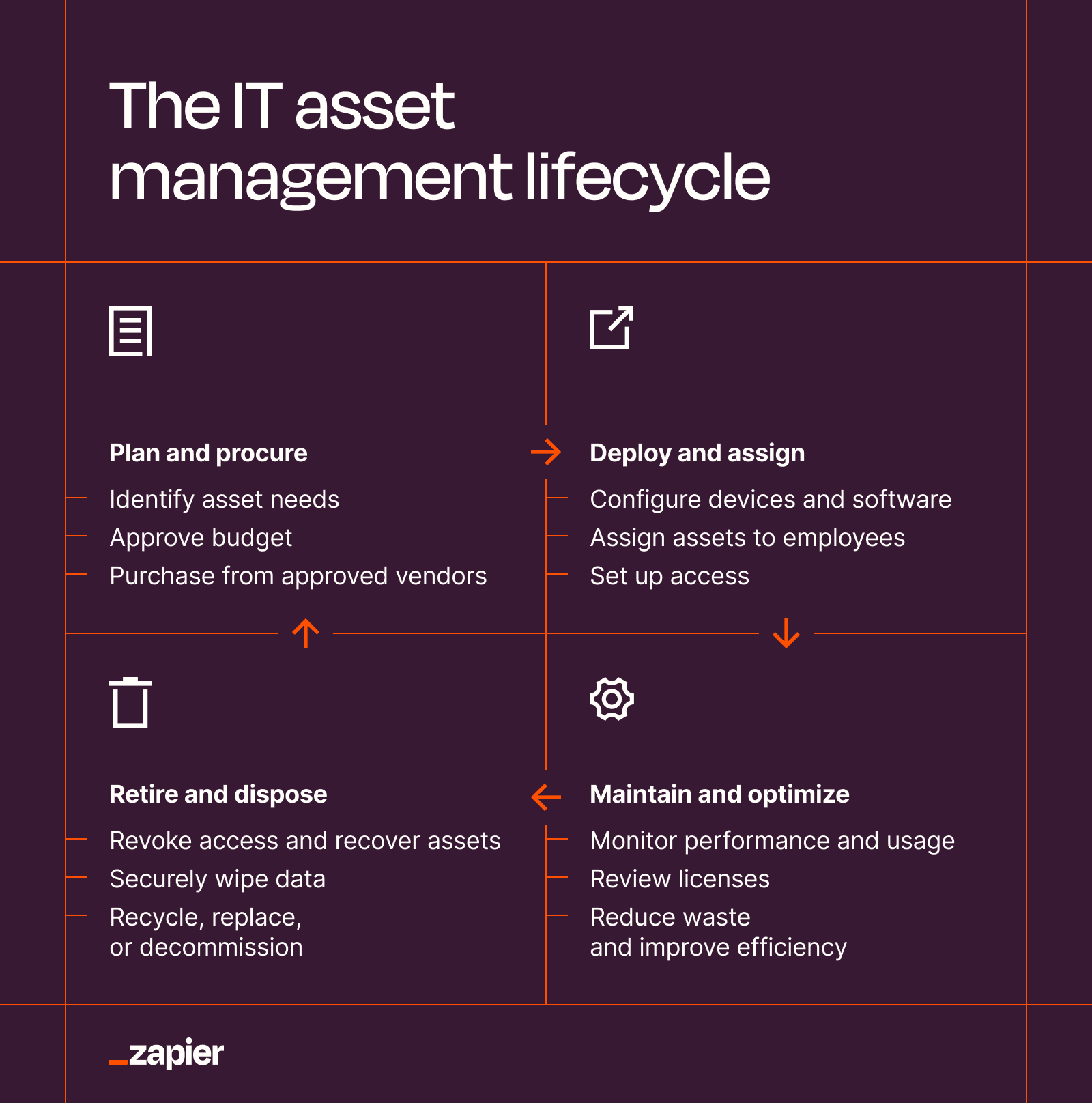
- Request and approval: Someone identifies a need. Budget gets allocated. Procurement starts.
- Acquisition: The asset is purchased, leased, or subscribed to. Contract terms are recorded.
- Deployment: The asset is configured, assigned to a user or department, and put into production.
- Maintenance: Regular updates, patches, repairs. Performance monitoring. License renewals.
- Retirement: The asset reaches end-of-life. Data is wiped. Hardware is disposed of or recycled.
Each stage creates data. ITAM systems capture that data so nothing falls through the cracks. The laptop that was assigned to an employee who left three years ago? ITAM should have flagged it for retrieval at offboarding.
Why ITAM Matters: The Real Benefits
ITAM isn't just about knowing where your laptops are. It directly impacts security posture, compliance risk, and the budget.
Security
Unmanaged assets are attack vectors. A forgotten server with outdated patches. An ex-employee's account still tied to active software. Shadow IT apps that bypass security controls.
The average cost of a breach involving "shadow data" (untracked IT assets) hits $5.27 million. That's higher than the overall average because attackers exploit what defenders can't see.
Compliance
Software audits happen. When they do, you need to prove every installation is properly licensed. ITAM tracks license counts against deployments automatically. No more scrambling through spreadsheets when the vendor calls.
Cost Control
Organizations routinely pay for licenses nobody uses. Subscriptions that auto-renewed and were forgotten. Hardware sitting in closets that could be redeployed instead of buying new.
Industry analysts estimate that integrating ITAM with FinOps practices can reduce AI and SaaS expenses by 30% by 2028. That's not theoretical. It's the result of visibility into what you're actually spending on.
“Sometimes governance is a dirty word, but it is the key to transforming IT from a cost center to a value center.”
— Shannon Gath, CIO at Teradyne
ITAM Use Cases
Here's where ITAM shows up in daily operations.
- Employee onboarding: Assign laptop, software licenses, and access credentials. Track it all in one place.
- Offboarding: Retrieve hardware, revoke licenses, wipe data. Generate an audit trail.
- License audits: Prove compliance instantly when vendors come knocking.
- Budget planning: Know exactly what you're paying for and what's underutilized.
- Security incident response: Identify which assets are affected and who has access.
- Hardware refresh cycles: Plan replacements based on age, warranty status, and performance data.
ITAM vs. Other Systems
ITAM often gets confused with related but distinct systems. Here's how to think about them.
- CMDB (Configuration Management Database): Focuses on how assets relate to each other and to services. More about dependencies than lifecycle.
- ITSM (IT Service Management): Manages incidents, requests, and changes. ITAM feeds ITSM with asset data.
- SAM (Software Asset Management): A subset of ITAM focused specifically on software licenses and compliance.
- MDM (Mobile Device Management): Manages mobile devices specifically. ITAM is the umbrella that includes MDM data.
Good ITAM integrates with all of these. It's the single source of truth that other systems pull from.
Getting Started With ITAM
You don't need enterprise software to start. Many teams begin with spreadsheets. That works until it doesn't. Once you hit a few hundred assets, or a few dozen employees, manual tracking breaks down.
Start With an Audit
Before picking tools, know what you have. Walk the office. Check purchase orders. Look at active subscriptions. Interview department heads. You'll find forgotten assets in every corner.
Define Ownership
Every asset needs an owner. Not just a department. A person. Someone who's responsible for updates, for returning it at offboarding, for flagging when it needs replacement.
Choose Your Tools
ITAM software ranges from free open-source tools like Snipe-IT to enterprise platforms from ServiceNow and IBM. Pick based on your scale and integration needs.
Automate the Tedious Parts
Connect your ITAM system to HR, procurement, and helpdesk tools. When someone joins, their asset assignments should flow automatically. When they leave, the retrieval process should trigger without manual intervention.
Logicity's Take
ITAM has evolved from a back-office inventory task to a frontline security and financial control. The shift to remote work and SaaS sprawl made this inevitable. Organizations that still track assets in spreadsheets aren't saving money. They're hiding risk until the next audit or breach forces them to confront it.
The Human Problem
Here's what the tools can't solve: people. Community discussions on Reddit's r/sysadmin describe ITAM as "detective work." The hardest part isn't the software. It's HR not updating records. Managers not reporting hardware returns. Employees hoarding old laptops in drawers.
The best ITAM programs build processes that make compliance the path of least resistance. Onboarding checklists. Offboarding sign-offs. Automated reminders. The goal is to make it harder to forget than to comply.
Frequently Asked Questions
What is the difference between ITAM and asset inventory?
Inventory tracks what assets exist. ITAM goes further, tracking compliance status, security posture, cost-effectiveness, assignment history, and lifecycle stage for each asset.
How often should IT assets be audited?
Most organizations conduct a full physical audit annually, with automated tracking providing continuous visibility. High-turnover environments may need quarterly checks.
What happens to IT assets when an employee leaves?
Proper ITAM triggers an offboarding workflow: hardware retrieval, license revocation, data wiping, and updating the asset record to show it's available for reassignment.
Can small businesses benefit from ITAM?
Yes. Even companies with 20 employees can save money by tracking software licenses and hardware assignments. Free tools like Snipe-IT make it accessible without enterprise budgets.
What are the biggest ITAM mistakes?
Treating it as a one-time project instead of an ongoing process. Not assigning individual ownership to assets. Relying on manual tracking that breaks down at scale.
Explores open-source alternatives, relevant for teams considering free ITAM tools
Need Help Implementing This?
Setting up ITAM from scratch can be overwhelming. If you're evaluating tools, building workflows, or trying to clean up years of tracking debt, we'd love to hear your questions. Reach out to the Logicity team for guidance on getting started.
Source: The Zapier Blog
Manaal Khan
Tech & Innovation Writer
Produced with AI assistance and reviewed by the Logicity editorial team. Learn more in our Editorial Policy.