Key Takeaways
- ESO 490-017 is a dwarf irregular galaxy located 23 million light-years from Earth
- At 12,000 light-years across, it is roughly one-tenth the size of the Milky Way
- The observation is part of Hubble's research into 'cosmic flow' and how galaxies move through space
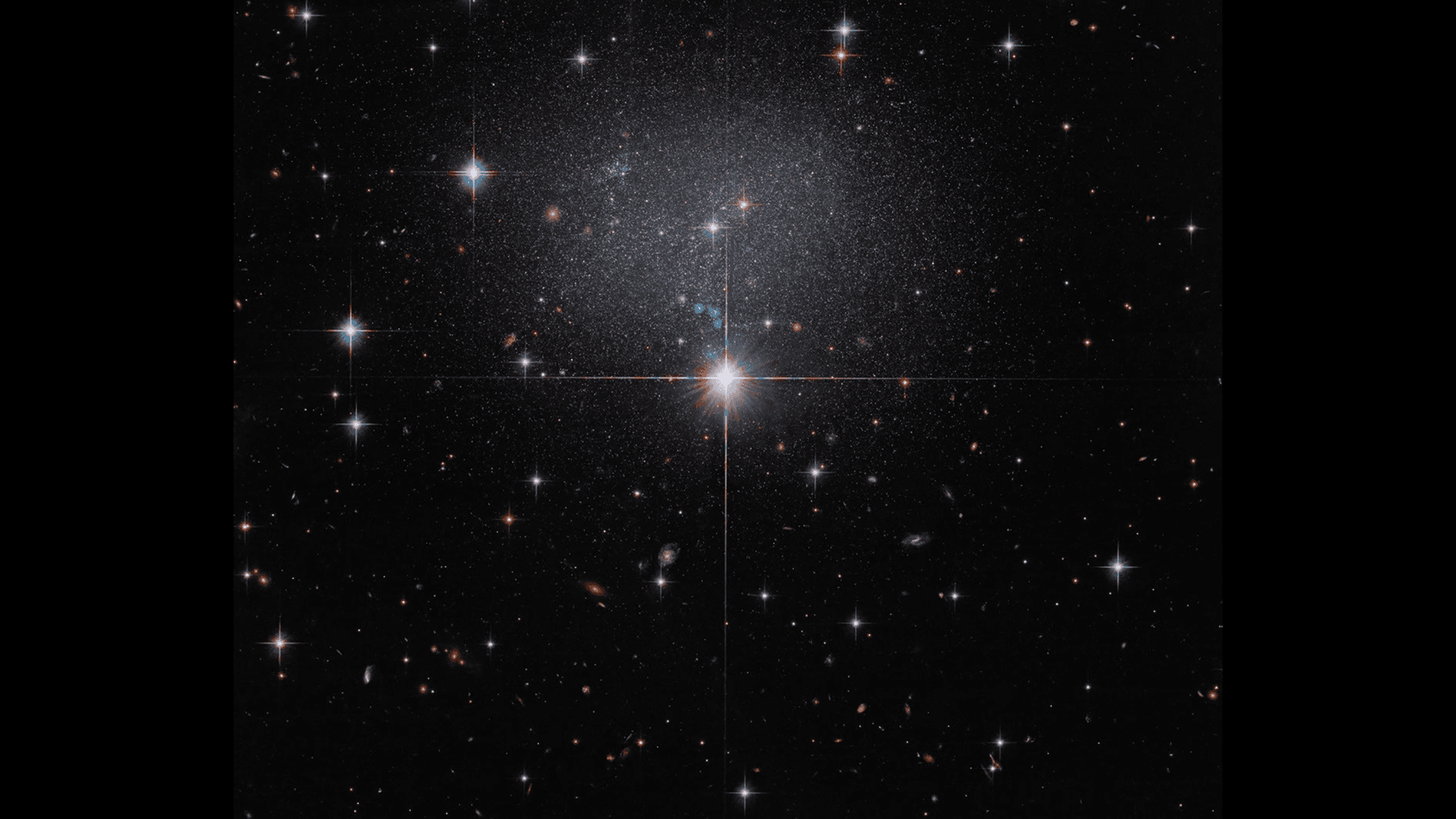
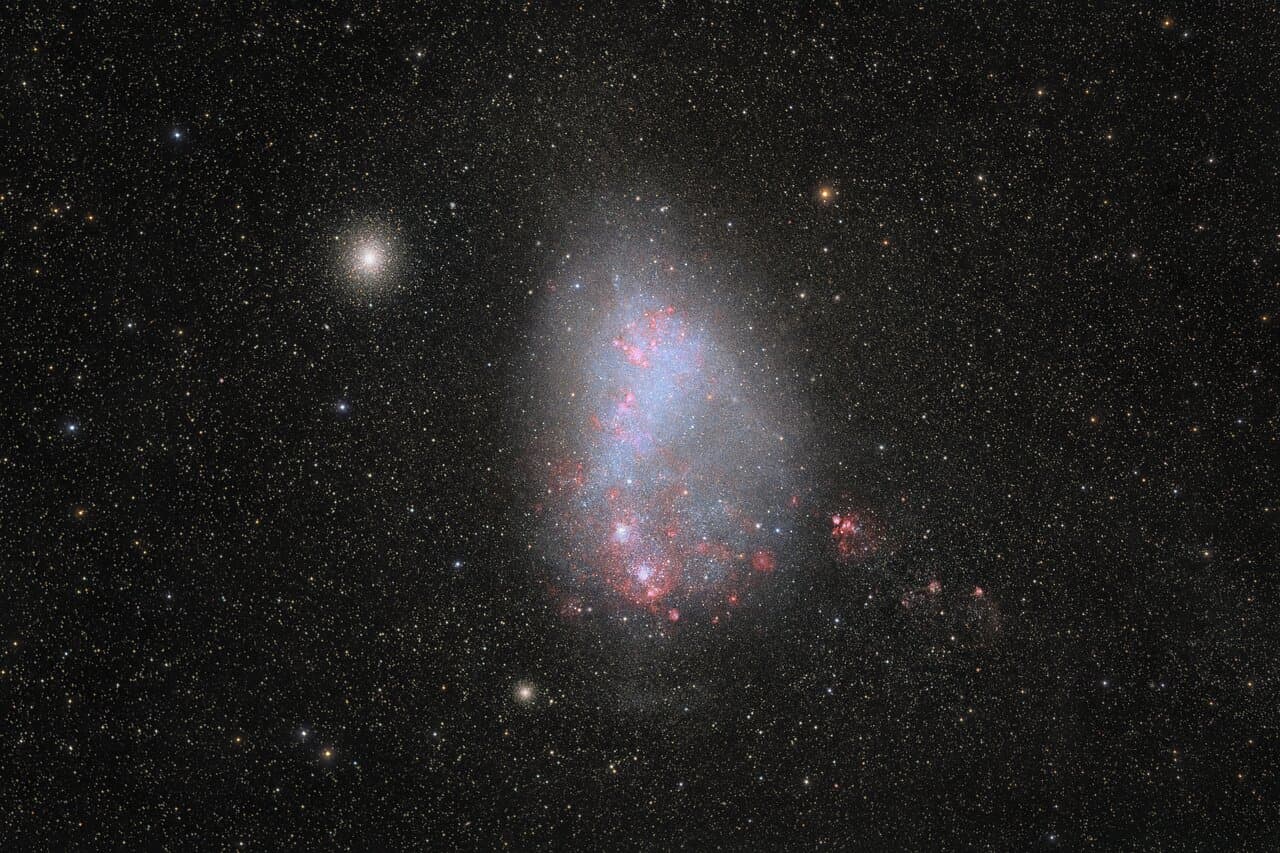
NASA's Hubble Space Telescope has turned its lens toward a faint, distant target: ESO 490-017, an irregular dwarf galaxy sitting 23 million light-years from Earth. The result is a striking portrait that captures the galaxy's scattered stars alongside a cosmic backdrop dotted with even more distant galaxies.
The galaxy, located in the constellation Canis Major, spans about 12,000 light-years. That sounds enormous until you consider that the Milky Way stretches at least 100,000 light-years across. ESO 490-017 is roughly one-tenth our galaxy's size.
What Makes This Galaxy 'Irregular'
Unlike spiral galaxies with their sweeping arms or elliptical galaxies with their smooth, rounded shapes, irregular dwarf galaxies lack any defined structure. ESO 490-017 appears as a diffuse swarm of stars, almost mist-like in Hubble's image. Its low surface brightness means the galaxy's stars appear faint and hazy compared to foreground stars from our own Milky Way.
Those foreground stars are immediately recognizable in the image. They display Hubble's characteristic diffraction spikes, the cross-shaped beams of light caused by the telescope's internal structure. The brightest star at the photo's center is not part of ESO 490-017 but rather a Milky Way star that happens to sit along the same line of sight.
Why Scientists Study Faint Galaxies
This image is part of a larger Hubble observing program that studies how galaxies and galaxy clusters move through the universe. Galaxies are not static. They drift, pulled by gravitational forces from dark matter and other massive structures.
“Dwarf galaxies like ESO 490-017 are vital for understanding the 'cosmic flow,' acting as test sites for the gravitational influence of dark matter across local space.”
— Dr. R. Tully, Astronomer at the University of Hawaii
Dwarf irregular galaxies are particularly useful for this research. Their simple composition and relatively small size make them easier to analyze than massive, complex spiral galaxies. They also resemble conditions found in the early universe, offering a window into how the first galaxies may have formed and evolved.
More Than Meets the Eye
Look past the central star and the hazy stellar population of ESO 490-017, and you will notice something else: red, orange, and beige spots scattered throughout the background. These are not colorful stars. They are other galaxies, far more distant than ESO 490-017 itself, captured in the same frame.
This depth is part of what makes Hubble observations valuable. A single image can contain data about objects at vastly different distances, all recorded simultaneously. Scientists can study the target galaxy while also cataloging background objects for future research.
The constellation Canis Major, where ESO 490-017 resides, is home to Sirius, the brightest star in Earth's night sky. But the galaxy itself is invisible to the naked eye and requires powerful telescopes to observe.
Community Response
Space enthusiasts on Reddit's r/space community have noted the contrast between the galaxy's "mist-like" appearance and the sharp, spiked foreground stars. Several users pointed out that such visually unassuming galaxies play an outsized role in mapping large-scale gravitational currents that govern galactic motion across the cosmos.

Logicity's Take
Frequently Asked Questions
How far away is ESO 490-017?
The dwarf galaxy is located 23 million light-years from Earth, in the constellation Canis Major.
What is an irregular dwarf galaxy?
An irregular dwarf galaxy lacks a defined shape like a spiral or ellipse. It appears as a diffuse collection of stars without clear structure.
Why is this galaxy important for research?
Dwarf galaxies like ESO 490-017 help scientists study 'cosmic flow,' the large-scale movement of galaxies through space driven by dark matter and gravity.
Is the bright star in the center part of ESO 490-017?
No. The bright star with diffraction spikes is a foreground star in our Milky Way that happens to be along the same line of sight.
Need Help Implementing This?
Source: Latest from Space.com
Manaal Khan
Tech & Innovation Writer
Produced with AI assistance and reviewed by the Logicity editorial team. Learn more in our Editorial Policy.