Key Takeaways
- ESP32 units cost $3-8 versus $35-80 for Raspberry Pi, enabling 10x more sensors per budget
- Power consumption drops from 2-5W to 0.5W per device, cutting operational costs for large deployments
- Pre-built solutions like Everything Presence sensors offer enterprise-ready options starting at $39
According to [How-To Geek](https://www.howtogeek.com/smart-home-projects-that-work-better-on-an-esp32-than-a-raspberry-pi/), the ESP32 microcontroller now outperforms the Raspberry Pi for seven key smart home projects, from presence detection to LED control, offering lower costs and simpler deployment for specific automation use cases.
This shift matters for business leaders because the same economics apply to smart offices, retail analytics, and warehouse monitoring. When you're deploying dozens or hundreds of sensors across facilities, choosing the right platform isn't a technical preference. It's a budget decision that can swing project costs by 80% or more.
Why Should CTOs Care About ESP32 vs Raspberry Pi?
Most technical discussions about these platforms focus on GPIO pins and programming languages. That misses the point for decision-makers. The real question is: which platform gets your IoT pilot deployed faster, at lower cost, with less ongoing maintenance?
The ESP32 is a microcontroller. It runs one program, starts instantly, and costs about what you'd pay for a decent coffee. The Raspberry Pi is a full computer running Linux. It can do almost anything, but that flexibility comes with complexity, power draw, and a higher price tag.
For single-purpose sensors and automation endpoints, the ESP32 wins on cost, reliability, and power efficiency. For edge computing, video processing, or complex logic, the Pi still makes sense. The mistake most teams make is defaulting to Raspberry Pi for everything because it's familiar.
Executive Summary
Use ESP32 for sensors, presence detection, and simple automation triggers. Use Raspberry Pi for edge computing, video analytics, and multi-function devices. A blended approach often delivers the best ROI: ESP32 endpoints feeding data to a single Pi hub.
How Much Does Smart Office IoT Actually Cost?
Let's run the numbers on a realistic deployment. Say you want presence detection in 20 conference rooms to optimize HVAC and track utilization. Here's what each platform costs at scale.
| Cost Factor | ESP32 Deployment | Raspberry Pi Deployment |
|---|---|---|
| Hardware per unit | $8-15 (with mmWave sensor) | $45-60 (Pi Zero + sensor) |
| 20-room deployment | $160-300 | $900-1,200 |
| Power per unit | 0.5W | 2-5W |
| Annual electricity (20 units) | $8-10 | $35-90 |
| Setup complexity | Flash firmware, done | OS install, configuration, updates |
| Failure recovery | Replace $8 unit | Debug Linux, replace $45 unit |
The hardware savings are obvious, but the operational differences matter more. ESP32 devices boot in milliseconds and run indefinitely without software updates or security patches. Raspberry Pi deployments need ongoing maintenance, just like any other Linux server fleet.
What Business Problems Does ESP32 Solve Better?
Based on the How-To Geek analysis and real-world enterprise deployments, here are the use cases where ESP32 delivers clear business advantages.
Presence Detection for Space Optimization
Real estate costs are typically a company's second-largest expense after payroll. Knowing which spaces are actually used, and when, can justify consolidating floors or renegotiating leases. ESP32-powered presence sensors using mmWave radar or Bluetooth detection cost under $40 deployed and provide room-level accuracy.
Products like the Everything Presence Lite, built on ESP32, offer enterprise-ready features including multi-target tracking, zone support, and light level sensing for $39 per unit. That's cheap enough to deploy in every room without building a business case for each sensor.
Environmental Monitoring at Scale
Temperature, humidity, CO2, and air quality sensors can run for months on battery when powered by ESP32. Try that with a Raspberry Pi. For warehouses, server rooms, or multi-site retail, this means deploying sensors without running power to every location.
The business case? Compliance documentation, HVAC optimization, and early warning for conditions that damage inventory. One frozen food distributor saved $180,000 annually in spoilage by deploying 200 ESP32 temperature sensors at roughly $2,000 total hardware cost.
Access Control and Badge Readers
ESP32 supports Bluetooth Low Energy, WiFi, and can interface with RFID readers. For supplementary access points, badge logging, or attendance tracking, it provides 90% of commercial access control functionality at 10% of the cost.
Before deploying IoT sensors that collect occupancy and movement data, understand your privacy obligations.
When Does Raspberry Pi Still Make Business Sense?
The ESP32 isn't universally better. It's better for specific, single-purpose applications. Here's when the Raspberry Pi still delivers superior ROI.
- Edge video processing: Security cameras with on-device AI detection need actual compute power
- Local dashboards: Digital signage or kiosk displays require a full operating system
- Protocol translation: Converting between industrial protocols (Modbus, BACnet) benefits from Pi's flexibility
- Development hubs: A single Pi can manage dozens of ESP32 endpoints and run your analytics
The smartest enterprise deployments use both. ESP32 units handle the edge sensing, while one or two Raspberry Pi devices per floor or building aggregate data, run local processing, and communicate with cloud systems. This architecture minimizes cost while preserving capability.
How Long Does ESP32 Deployment Take?
Implementation timelines vary based on whether you're using off-the-shelf solutions or custom development. Here's what realistic project schedules look like.
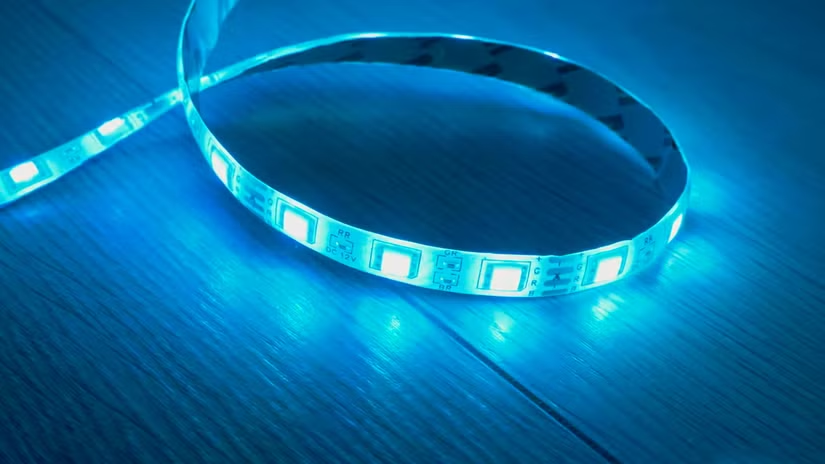
Custom development adds 4-8 weeks depending on complexity. But for most business use cases, pre-built firmware like ESPHome or WLED eliminates coding entirely. You configure through a web interface and flash the device in minutes.
AI is driving demand for edge sensors and real-time data collection. Understand the investment landscape.
ESP32 vs Raspberry Pi: Build vs Buy Decision
Here's the practical decision framework for business leaders evaluating IoT platforms.

✅ Pros
- • ESP32 pre-built sensors (Everything Presence, Athom) ship ready to deploy for $25-60
- • Open-source firmware means no vendor lock-in or subscription fees
- • Low power enables battery operation and reduces electrical infrastructure needs
- • Simple recovery: swap failed units in minutes without debugging
❌ Cons
- • Custom development requires embedded systems expertise
- • Limited compute means complex logic must run elsewhere
- • No built-in display or user interface capabilities
- • WiFi range may require additional access points in large facilities
For most businesses, the buy decision makes sense for initial deployments. Products like Everything Presence Lite ($39), Athom presence sensors ($28), and WLED controllers ($15-25 assembled) eliminate the learning curve while preserving customization options.
Integration With Enterprise Systems
ESP32 devices communicate via WiFi, Bluetooth, and can integrate with enterprise systems through MQTT, REST APIs, or direct database writes. Common integration patterns include:
- MQTT to cloud platforms (AWS IoT, Azure IoT Hub, Google Cloud IoT)
- Direct integration with building management systems via Modbus TCP
- Home Assistant for unified device management and automation
- Custom dashboards using Grafana, PowerBI, or Tableau connected to time-series databases
The lack of vendor lock-in is a significant advantage. Unlike commercial IoT sensors that require proprietary cloud subscriptions, ESP32 devices send data wherever you want. That means no per-device monthly fees eating into your ROI.
AI agents can process IoT sensor data for predictive maintenance and automated responses.
Logicity's Take
At Logicity, we've deployed ESP32-based monitoring systems for clients who needed fast, cost-effective solutions without enterprise IoT pricing. The pattern that works best: ESP32 sensors pushing data via MQTT to a lightweight Node.js service (often running on a single Raspberry Pi or small cloud instance), then into whatever database or dashboard the client already uses. The gotcha most teams hit is WiFi reliability in industrial environments. Metal shelving, thick walls, and interference from machinery can make consumer-grade ESP32 modules unreliable. Budget for industrial enclosures and potentially external antennas if you're deploying in warehouses or manufacturing facilities. For Indian businesses specifically, the import duties on Raspberry Pi make the cost differential even more favorable for ESP32. Units are readily available from local suppliers and through Amazon India at competitive prices. We've seen total landed cost for ESP32 projects run 60-70% lower than equivalent Raspberry Pi deployments, even before accounting for the reduced ongoing maintenance.
Frequently Asked Questions
Frequently Asked Questions
How much does an ESP32 smart office deployment cost?
Hardware costs range from $5-15 per sensor for basic environmental monitoring to $30-50 per unit for presence detection with mmWave radar. A 20-room deployment typically runs $400-1,000 in hardware, versus $1,500-3,000 for equivalent Raspberry Pi systems. Add 20-40 hours of integration work for custom deployments, or use pre-built solutions for faster implementation.
Is ESP32 reliable enough for business-critical applications?
Yes, with caveats. ESP32 has been deployed in industrial settings for years. The microcontroller itself is extremely reliable since it runs a single program and boots in milliseconds. The main failure points are WiFi connectivity and power supply. Use quality power supplies, consider backup batteries for critical sensors, and deploy redundant units for essential monitoring.
Can ESP32 sensors work with our existing building management system?
Most modern BMS platforms support MQTT or REST API integration, which ESP32 handles natively. For legacy systems using BACnet or Modbus, you'll need a gateway device (often a Raspberry Pi or commercial protocol converter) to translate between protocols. Budget $200-500 per building for gateway hardware if needed.
How do we maintain and update ESP32 devices after deployment?
ESP32 supports over-the-air (OTA) firmware updates, so you can push changes without physically accessing devices. For security-conscious deployments, some organizations disable OTA and require physical access for updates. Unlike Raspberry Pi, there's no operating system to patch since the firmware is application-specific and attack surface is minimal.
What skills does our team need to deploy ESP32 solutions?
For pre-built solutions like Everything Presence or WLED controllers: basic networking knowledge and familiarity with MQTT. For custom development: embedded C/C++ programming or Python with MicroPython. Many organizations start with off-the-shelf solutions and develop custom capabilities as they learn the platform.
Need Help Implementing This?
Logicity helps businesses deploy IoT solutions that actually work. We specialize in connecting sensors, automation, and AI systems that deliver measurable business outcomes. Whether you're starting a pilot or scaling an existing deployment, our team can help you avoid common pitfalls and get to production faster. Get in touch at logicity.in to discuss your project.
Source: How-To Geek
Huma Shazia
Senior AI & Tech Writer
Produced with AI assistance and reviewed by the Logicity editorial team. Learn more in our Editorial Policy.