Key Takeaways
- OpenClaw lets non-programmers automate business workflows without writing code
- 2 million visitors in one week signals massive enterprise interest in personal AI agents
- Jensen Huang's endorsement positions OpenClaw as the next platform shift after ChatGPT
According to [Tech-Economic Times](https://economictimes.indiatimes.com/tech/startups/the-lobster-is-loose-and-its-not-going-back-peter-steinberger-on-building-openclaw-at-ted-2026/articleshow/130348262.cms), Peter Steinberger's OpenClaw AI agent has achieved viral adoption with over 100,000 GitHub stars and 2 million visitors in a single week, earning a comparison to ChatGPT from Nvidia CEO Jensen Huang.
Read in Short
OpenClaw is an open-source AI agent that automates routine business tasks without requiring programming skills. It went from a WhatsApp experiment to 100,000 GitHub stars in months. Nvidia's Jensen Huang calls it 'the next ChatGPT.' For business leaders: this signals a shift where employees can deploy AI assistants themselves, bypassing IT bottlenecks entirely.
What Is OpenClaw and Why Should CEOs Care?
OpenClaw isn't another chatbot. It's what founder Peter Steinberger calls an 'operating system' for personal AI. These agents run continuously in the background, handling communication, automating routine work, and acting on your behalf without constant prompting.
The business case is straightforward: your employees spend hours daily on repetitive tasks. Email sorting. Meeting scheduling. Data entry. Report generation. OpenClaw lets anyone, not just developers, offload these tasks to AI agents that work 24/7.
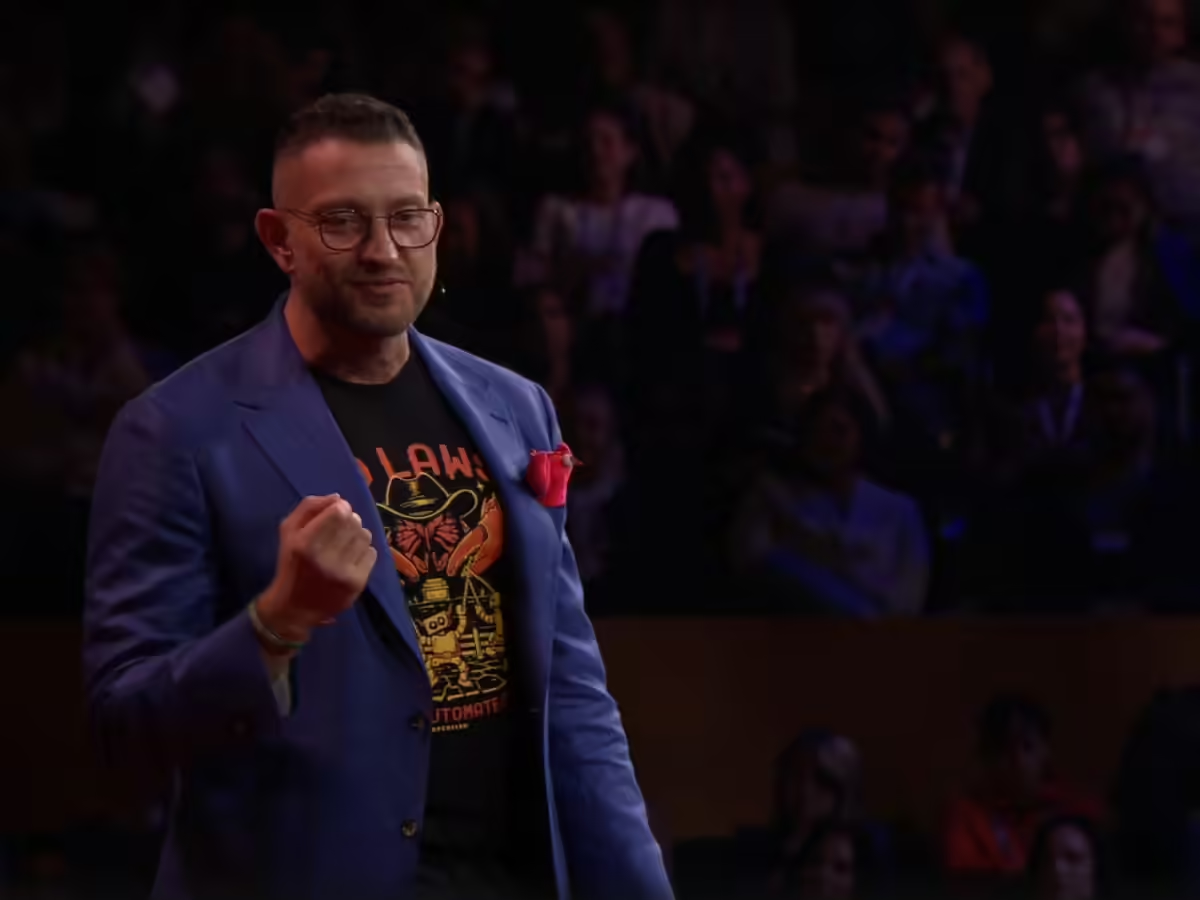
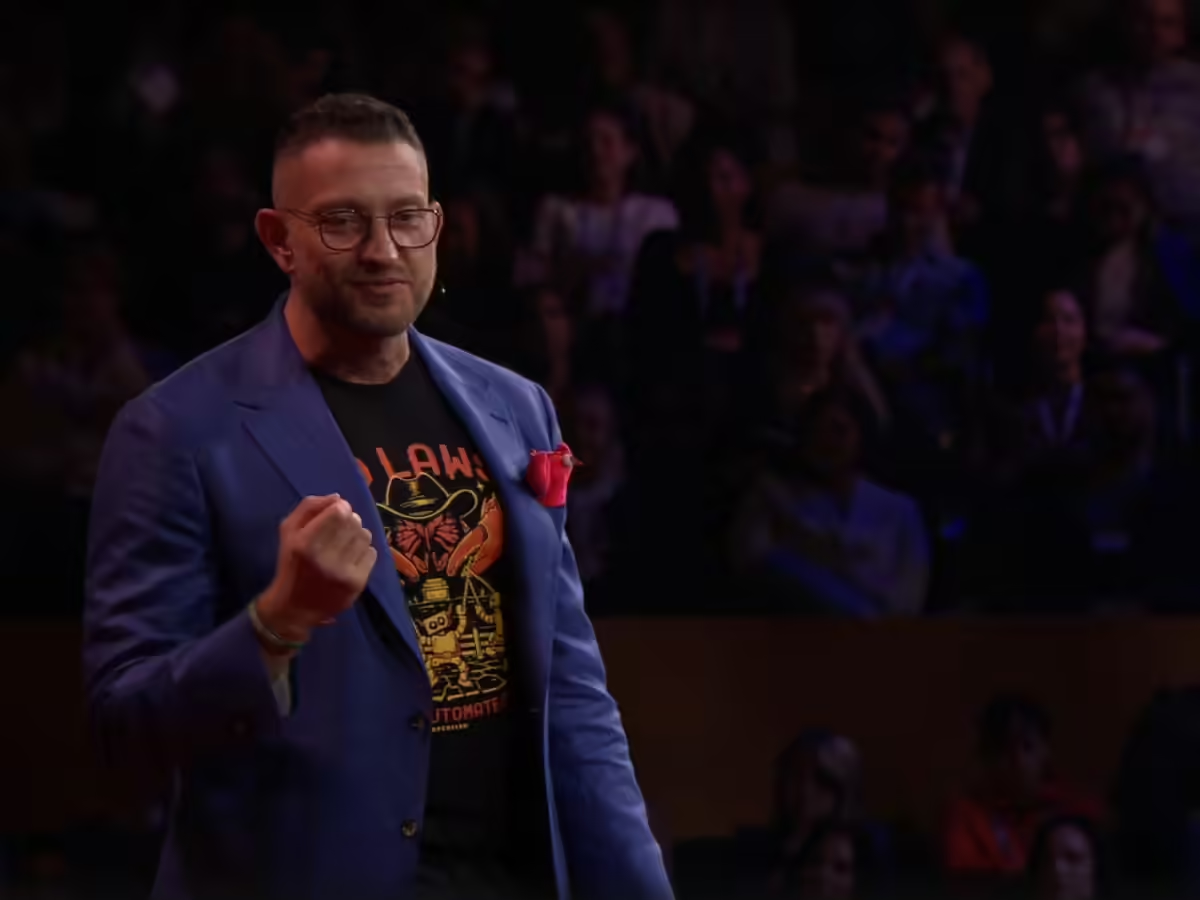
Here's the real disruption: OpenClaw users aren't programmers. They're entrepreneurs, small business owners, and professionals with zero coding background. Steinberger was explicit about this at TED 2026: 'They're not programmers. They're builders. The real transformation is not the technology, it's the access.'
How Did OpenClaw Grow So Fast?
The numbers are staggering. OpenClaw pulled 100,000 stars on GitHub, a metric that typically takes successful open-source projects years to achieve. It drew 2 million visitors in a single week. For context, that's the kind of traffic that venture-backed startups spend millions trying to generate.
The growth wasn't accidental. Steinberger tested the concept with a simple WhatsApp agent released to a public online community. No marketing. No launch strategy. Just an AI system 'intentionally left to operate on its own.' Within hours, it was handling hundreds of interactions. Product-market fit was immediate and obvious.
Jensen Huang's Endorsement: What It Signals
When Nvidia's CEO calls something 'the next ChatGPT,' the enterprise world pays attention. Huang doesn't make casual comparisons. Nvidia powers the infrastructure behind most AI applications, so his endorsement suggests OpenClaw represents a genuine platform shift.
“The next ChatGPT”
— Jensen Huang, CEO of Nvidia, on OpenClaw
ChatGPT changed how people interact with AI. It democratized access to language models. OpenClaw may do the same for AI agents. The difference? ChatGPT answers questions. OpenClaw does work. That's a meaningful distinction for any business leader calculating ROI on AI investments.
Understand the shifting landscape at OpenAI as Steinberger joins the company
OpenClaw for Business: Real-World Use Cases
Steinberger highlighted several adoption patterns during his TED talk. The common thread: incremental automation. Users aren't replacing entire departments. They're assigning daily tasks to AI agents, one at a time, building automated workflows gradually.
- Small business owners automating customer communication and follow-ups
- Entrepreneurs using agents to manage calendars and meeting prep
- Non-technical founders building prototypes without hiring developers
- Professionals offloading repetitive documentation and reporting
The pattern matters more than any single use case. OpenClaw represents a shift from 'hire someone to do this' to 'assign an agent to do this.' For startups and SMBs with limited budgets, that's a fundamental change in how work gets done.
Is OpenClaw Worth the Investment for Your Company?
OpenClaw is now open-source and nonprofit, which changes the cost calculation entirely. You're not paying licensing fees. You're investing in implementation and customization. For companies with any technical capacity, the barrier to entry is remarkably low.
| Factor | OpenClaw | Traditional Automation | Custom AI Development |
|---|---|---|---|
| Upfront Cost | Free (open-source) | $10K-50K/year | $100K-500K+ |
| Technical Skill Required | Minimal | Moderate | High |
| Time to Deploy | Days | Weeks | Months |
| Customization | High | Limited | Unlimited |
| Ongoing Maintenance | Community-supported | Vendor-dependent | In-house team required |
The real investment is organizational. AI agents require clear processes to automate. If your workflows are chaotic, OpenClaw won't magically fix them. But if you have defined, repetitive tasks eating up employee hours, the ROI calculation becomes compelling quickly.
Learn more about automation strategies that complement AI agent deployment
The OpenAI Connection: What Happens Next?
Steinberger joining OpenAI while transitioning OpenClaw to nonprofit status is a strategic move worth watching. It suggests OpenAI sees personal AI agents as a growth area. It also means OpenClaw will likely integrate tightly with OpenAI's models and infrastructure.
For business leaders, this signals stability. Open-source projects live or die based on community support and corporate backing. OpenClaw now has both. The nonprofit structure protects it from acquisition or pivots that could strand enterprise users.
What This Means for Enterprise Adoption
OpenClaw's nonprofit status and OpenAI connection make it a safer bet for enterprise deployment. Unlike VC-backed startups that might pivot or fold, OpenClaw has structural incentives to maintain backward compatibility and community trust. CTOs evaluating the tool should factor this stability into their technology roadmap.
The Bottleneck Shift: From Building to Syncing
Steinberger made a provocative claim at TED 2026: 'The bottleneck is no longer building; it's syncing.' This deserves unpacking. When AI can handle the actual creation work, the constraint moves to coordination. Who decides what gets built? How do multiple agents work together? How do humans stay in the loop?
“All the boring parts of software, AI could do all of it. The bottleneck is no longer building; it's syncing.”
— Peter Steinberger, TED 2026
For business leaders, this reframes the AI conversation. You don't need more developers. You need better orchestration. The competitive advantage shifts from technical execution to strategic coordination. Companies that figure out agent orchestration first will outpace those still hiring for tasks AI can handle.
Risks and Considerations for Business Leaders
✅ Pros
- • Zero licensing cost as open-source, nonprofit project
- • Backed by OpenAI infrastructure and community
- • Enables non-technical employees to deploy automation
- • Incremental adoption reduces implementation risk
- • 100K+ GitHub stars indicate strong community support
❌ Cons
- • Open-source means no vendor support guarantees
- • Security considerations for autonomous agents
- • Organizational change management required
- • Integration complexity with existing enterprise systems
- • Rapidly evolving, may require frequent updates
The security question deserves attention. AI agents acting autonomously on your behalf need guardrails. What can they access? What actions can they take? Who reviews their decisions? These governance questions matter more than technical implementation for most enterprises.
Context on how large enterprises are balancing AI investment with workforce considerations
Frequently Asked Questions About OpenClaw
Frequently Asked Questions
How much does OpenClaw cost for businesses?
OpenClaw is free and open-source as a nonprofit project. Your costs are implementation, customization, and any cloud infrastructure you deploy it on. For most SMBs, expect minimal direct costs with time investment for setup and training.
Do I need developers to implement OpenClaw?
No. Steinberger explicitly noted that OpenClaw users are 'not programmers, they're builders.' The platform is designed for non-technical users to create and manage AI agents. However, having technical support helps for complex enterprise integrations.
How long does it take to deploy OpenClaw?
Basic deployment can happen in days. Steinberger's initial WhatsApp agent was handling hundreds of interactions within hours of release. Enterprise-scale deployment with custom integrations typically takes weeks, not months.
Is OpenClaw secure enough for enterprise use?
As with any AI agent system, security depends on your implementation. OpenClaw's open-source nature allows security auditing, but you need clear policies on what agents can access and what actions they can take autonomously.
What does 'the lobster is loose' mean?
Steinberger's closing metaphor at TED 2026. It means AI agents are now accessible to everyone, not just technologists. Once people experience what personal AI can do, they won't go back to manual processes. The genie, or lobster, is out of the bottle.
Logicity's Take
We've been building AI agent systems for clients using Claude API and n8n workflows for the past year, and OpenClaw's rise validates what we've seen in the field: the demand for autonomous AI isn't coming from engineering teams. It's coming from operations managers, founders, and department heads who are tired of waiting for IT to build their automation. Steinberger's insight about the bottleneck shifting from building to syncing matches our experience exactly. The hard part isn't making the agent work. It's designing the handoffs between AI and humans, setting the right guardrails, and helping teams trust automated decisions. For Indian startups especially, OpenClaw represents an opportunity to compete with better-funded competitors. When a solo founder can deploy AI agents that handle tasks requiring a 5-person team elsewhere, the calculus changes. We're watching the OpenClaw ecosystem closely and expect to see it integrated into our stack within the next quarter.
The Bottom Line for Business Leaders
OpenClaw matters because it shifts who can deploy AI. When non-programmers can create agents that handle real business work, you're not waiting for engineering bandwidth anymore. Every employee becomes a potential automation builder.
Jensen Huang's comparison to ChatGPT isn't hype. ChatGPT democratized AI interaction. OpenClaw democratizes AI action. For business leaders planning 2026 budgets and technology roadmaps, this is the trend to watch. The lobster is indeed loose.
Need Help Implementing This?
Logicity helps businesses deploy AI agent systems that actually work. From initial strategy through production deployment, we handle the technical complexity so your team can focus on business outcomes. Whether you're exploring OpenClaw or need custom AI automation, reach out for a free consultation on how AI agents can transform your operations.
Source: Tech-Economic Times / ET
Manaal Khan
Tech & Innovation Writer
Produced with AI assistance and reviewed by the Logicity editorial team. Learn more in our Editorial Policy.