
Key Takeaways

- CISA has added CVE-2024-21182 to its actively exploited vulnerabilities list with a June 4 patch deadline
- Over 1,592 Oracle WebLogic servers remain exposed online and vulnerable despite a two-year-old patch
- The flaw allows unauthenticated attackers to access critical data without any privileges
The U.S. Cybersecurity and Infrastructure Security Agency (CISA) has ordered federal agencies to patch a high-severity Oracle WebLogic Server vulnerability by June 4. The catch? Oracle released the fix two years ago.
CISA added CVE-2024-21182 to its Known Exploited Vulnerabilities (KEV) catalog on Thursday after confirming attackers are actively exploiting it in the wild. The agency's Binding Operational Directive 22-01 mandates that federal agencies remediate the flaw within 48 hours.
What Makes This Vulnerability Dangerous
Oracle WebLogic Server is an enterprise-grade Java application server used as middleware for large, multi-tier distributed applications. Many Fortune 500 companies and government agencies rely on it to run critical business systems.
CVE-2024-21182 carries a CVSS score of 7.5 (High). The flaw affects Oracle WebLogic Server versions 12.2.1.4.0 and 14.1.1.0.0. What makes it particularly concerning is the low barrier to exploitation.
“Easily exploitable vulnerability allows unauthenticated attacker with network access via T3, IIOP to compromise Oracle WebLogic Server. Successful attacks of this vulnerability can result in unauthorized access to critical data or complete access to all Oracle WebLogic Server accessible data.”
— Oracle, July 2024 security advisory
In plain terms: an attacker needs no credentials and no special privileges. They just need network access to a vulnerable server. The attack complexity is low, and the payoff is access to everything stored on that server.
The Patch Gap Problem
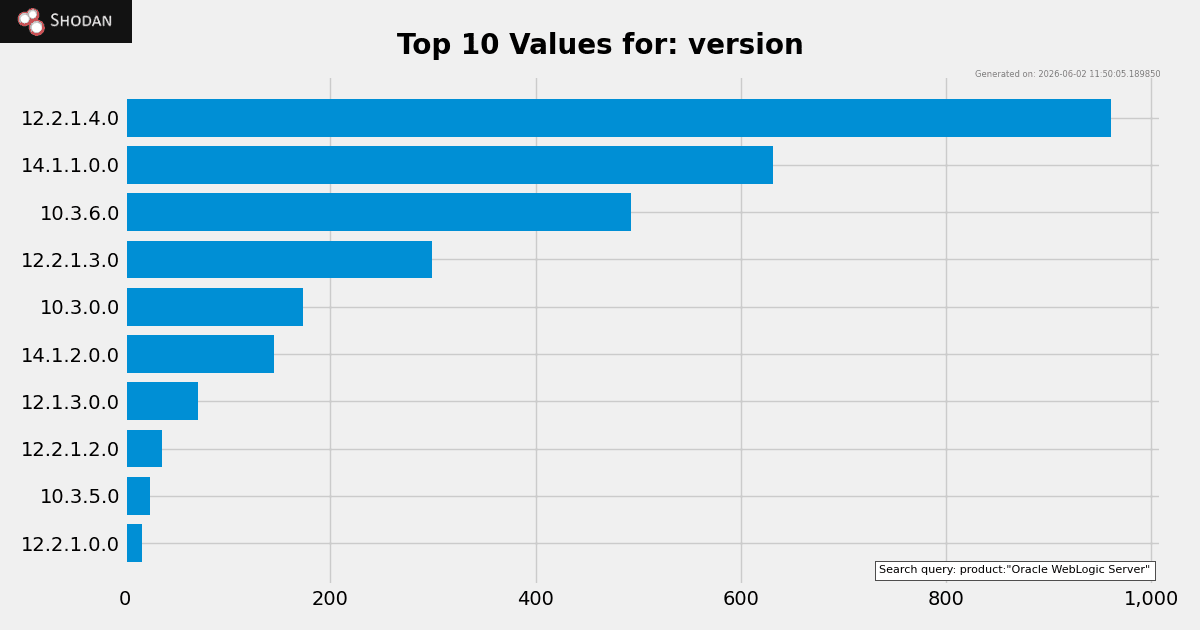
Oracle released patches for this vulnerability in July 2024. Yet internet intelligence platform Shodan currently tracks 1,592 WebLogic servers still exposed online and vulnerable. Of these, 961 run version 12.2.1.4.0 and 631 run version 14.1.1.0.0.

This two-year gap between patch release and active exploitation highlights a recurring problem in enterprise security. Large organizations often struggle to update critical middleware due to complex dependencies, testing requirements, and legacy application compatibility concerns.
Security professionals on Hacker News have pointed to poor asset management and complicated upgrade paths as key factors. When organizations don't know exactly what software they're running, or when upgrading middleware could break dozens of dependent applications, patches sit unapplied for months or years.
CISA's Warning Extends Beyond Federal Agencies
While Binding Operational Directive 22-01 technically applies only to federal civilian executive branch agencies, CISA urged all organizations to act.
"This type of vulnerability is a frequent attack vector for malicious cyber actors and poses significant risks to the federal enterprise," CISA warned. The agency recommended that organizations either apply vendor patches, follow BOD 22-01 guidance for cloud services, or discontinue using the product if patches aren't available.
Oracle's Growing Security Debt
This isn't Oracle's only recent security headache. In October, CISA flagged an unauthenticated server-side request forgery (SSRF) vulnerability (CVE-2025-61884) in Oracle E-Business Suite as actively exploited.
In March, Oracle released an out-of-band security update for a critical unauthenticated remote code execution vulnerability (CVE-2026-21992) in Identity Manager and Web Services Manager. Oracle declined to comment when asked about its exploitation status.
Over the past several years, CISA has flagged 43 vulnerabilities across various Oracle products as exploited in the wild. Of those, 12 have been abused in ransomware attacks.
Another recent example of vendors racing to patch actively exploited vulnerabilities
What You Should Do Now
If your organization runs Oracle WebLogic Server, here's the immediate action list:
- Identify all WebLogic Server instances in your environment, especially versions 12.2.1.4.0 and 14.1.1.0.0
- Check if these servers are internet-accessible. If they don't need to be, restrict access immediately
- Apply Oracle's July 2024 patch if you haven't already
- Monitor for unusual T3 or IIOP protocol traffic to WebLogic servers
- Review Oracle's security advisory for additional hardening recommendations
Organizations that can't patch immediately should consider network segmentation to limit exposure. Blocking T3 and IIOP protocols at the firewall can reduce attack surface, though this may affect application functionality.
Asset sprawl makes vulnerabilities like this harder to track and patch
Logicity's Take
Frequently Asked Questions
What is CVE-2024-21182?
CVE-2024-21182 is a high-severity vulnerability in Oracle WebLogic Server that allows unauthenticated attackers to access critical data remotely. It affects versions 12.2.1.4.0 and 14.1.1.0.0 and carries a CVSS score of 7.5.
When is the CISA patch deadline?
CISA has set a deadline of June 4, 2026 for federal agencies to patch the vulnerability. Private sector organizations are strongly urged to patch immediately as well.
How do attackers exploit this WebLogic vulnerability?
Attackers can exploit the flaw remotely via T3 or IIOP protocols without any authentication. The attack requires no special privileges and is considered low complexity.
Was a patch available before CISA's warning?
Yes. Oracle released security patches for CVE-2024-21182 in July 2024, approximately two years before CISA added it to the Known Exploited Vulnerabilities catalog.
Does this vulnerability only affect government systems?
No. While CISA's mandate applies to federal agencies, Oracle WebLogic Server is widely used across private enterprises. CISA has urged all organizations to patch regardless of sector.
Need Help Implementing This?
Source: BleepingComputer
Manaal Khan
Tech & Innovation Writer
Produced with AI assistance and reviewed by the Logicity editorial team. Learn more in our Editorial Policy.