
Key Takeaways

- Large enterprises average 900+ cloud apps, with 33% of software spend wasted on unused licenses
- Successful rationalization programs typically cut total applications by 30%
- The biggest barrier isn't identifying redundant tools—it's navigating internal politics and team ownership
Every company has that one person who installed a new project management tool because the old one didn't have a dark mode. Multiply that impulse across every department, every team lead, every well-meaning manager who saw a promising demo, and you get what the industry politely calls SaaS sprawl.
The numbers are striking. Large enterprises now run an average of 900+ cloud applications. A third of software spending goes to licenses that sit unused or underutilized. And 59% of IT teams admit they lack clear visibility into their own technology landscape.
Application rationalization is the antidote. It's the process of auditing your software portfolio to decide what stays, what goes, and what gets consolidated. Think of it as a performance review for your tech stack.
What application rationalization actually means
The concept sounds simple: look at all your software and cut what you don't need. In practice, it's more nuanced. Application rationalization examines every tool against defined criteria. Does it serve a unique purpose? Does it integrate with your other systems? Is anyone actually using it?
You'll hear several related terms thrown around, and they're worth distinguishing:
- Application portfolio optimization focuses on getting more value per dollar from existing tools
- IT asset optimization squeezes more out of hardware and software you've already licensed
- Technology standardization picks fewer, company-wide tools so teams aren't doing the same job differently
- Systems consolidation merges overlapping platforms into a single, more capable one
These approaches overlap, but rationalization sits at the center. It's the audit that tells you which apps remain, which die, and which get replaced.
The real cost of doing nothing
Tool proliferation creates problems that compound quietly. Three apps doing the same job means data lives in three places. Customer information ends up fragmented. One team's source of truth contradicts another's. Security gaps open up because shadow IT bypasses your approved software list.
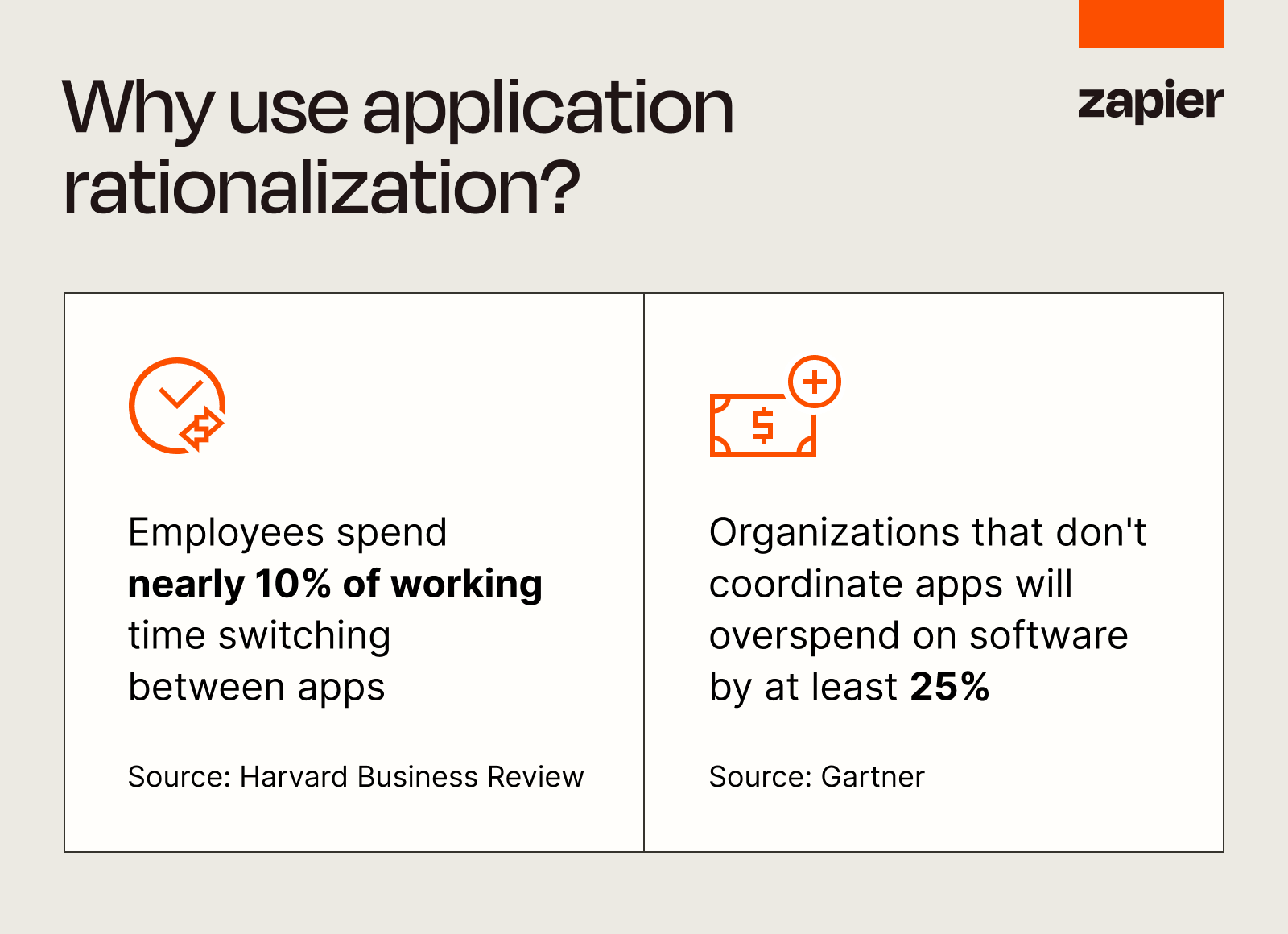
Budget leaks are the most visible symptom, but they're not the worst one. The real damage is cognitive. Employees waste time switching between apps, searching for where they saved something, or manually copying data from one system to another. Productivity paradox research suggests that adding more tools past a certain point actually makes people slower.
Successful rationalization programs typically achieve a 30% reduction in total applications. That's not just cost savings. It's fewer passwords to manage, fewer integration points to maintain, and fewer training sessions to run.
The TIME framework for evaluation
One-time cleanouts don't stick. You need a repeatable method for evaluating tools. Gartner's TIME framework offers a practical approach. The acronym stands for Tolerate, Invest, Migrate, and Eliminate.
Tolerate means the app works well enough and changing it would cost more than keeping it. These tools stay, but don't get additional resources. Invest covers apps that deliver clear value and deserve continued development or expansion. Migrate applies to tools that should be replaced with something better, but require a transition period. Eliminate is for software that can be shut down immediately.
Every application in your portfolio should fit one of these four buckets. If you can't decide which bucket an app belongs in, that's usually a sign you need better usage data.
Six steps to a leaner tech stack
Rationalization isn't a weekend project. It requires cross-functional buy-in and sustained effort. Here's a practical sequence:
- Build a complete inventory. You can't cut what you don't know exists. Shadow IT makes this harder than it sounds.
- Gather usage data. License counts don't tell you if people actually use the software. Look at login frequency, feature adoption, and integration activity.
- Map dependencies. Some apps feed data to others. Cutting one might break a workflow you didn't know existed.
- Categorize using TIME or a similar framework. Be honest about which tools are sacred cows versus genuine necessities.
- Get stakeholder alignment. The person who championed an app will defend it. Involve them early rather than blindsiding them.
- Execute in phases. Don't rip out 50 tools at once. Migrate users gradually and have rollback plans.
The inventory step alone can take weeks in larger organizations. Many IT leaders are surprised by what they find. Departments often purchase tools independently, especially if approval processes are slow or cumbersome.
The political challenge underneath the technical one
Here's what the frameworks don't tell you: rationalization is as much a political problem as a technical one.
“Technical workarounds are a poor solution to social problems.”
— Hacker News contributor
Many tools exist because someone didn't trust the official solution, couldn't get IT to move fast enough, or had a budget to spend before quarter-end. Cutting those tools means revisiting the dysfunction that created them. That requires tact.
Discussions in developer communities frequently note that adding new software is often a band-aid for poor internal communication. The marketing team bought their own analytics tool because the data team's turnaround was too slow. The sales team has a separate CRM because the official one doesn't fit their workflow. These aren't technology problems. They're process problems wearing technology masks.
“Optimize for change, not application performance.”
— Hacker News contributor
This advice suggests building modular, replaceable stacks rather than optimizing individual apps. The goal isn't to find the perfect tool for each job. It's to make swapping tools painless when requirements change.
What keeps rationalization from sticking
Even successful cleanouts can regress. The same pressures that created sprawl in the first place will create it again unless you change the underlying incentives.
Common failure modes include:
- No ongoing governance. Without a review process, new tools accumulate again.
- Approval processes that are too slow. People will bypass IT if getting approval takes months.
- No clear ownership. If no one is accountable for the portfolio, no one will maintain it.
- Shiny feature obsession. Communities joke about this cycle, where companies prioritize acquiring new tech over mastering what they have.
The fix isn't bureaucracy. It's making good choices easier than bad ones. Fast approval for tools that meet standards. Self-service procurement within guardrails. Regular reviews that catch redundancy before it compounds.
Logicity's Take
Frequently asked questions
Frequently Asked Questions
How long does application rationalization typically take?
For large enterprises, a full rationalization cycle takes 6 to 12 months. The inventory and usage analysis phases are the most time-consuming. Smaller organizations can complete the process in 2 to 3 months.
What's the difference between rationalization and consolidation?
Rationalization is the evaluation process that decides which apps to keep, cut, or replace. Consolidation is one possible outcome, where overlapping tools get merged into a single platform.
How do you handle resistance from teams who don't want to give up their tools?
Involve stakeholders early in the evaluation. Show usage data to demonstrate whether tools are actually being used. Offer migration support rather than abrupt cutoffs. Address the underlying need the tool was filling.
What percentage of cost savings should companies expect?
Typical programs achieve 20 to 30% reduction in software spend, though results vary based on starting conditions. The non-financial benefits, like reduced complexity and better security posture, are often more valuable.
Should small startups worry about application rationalization?
Startups under 50 people rarely need formal rationalization. But building good habits early, like documenting tool decisions and reviewing subscriptions quarterly, prevents sprawl from becoming a problem later.
Infrastructure inefficiencies compound just like software sprawl
Need Help Implementing This?
Source: The Zapier Blog
Manaal Khan
Tech & Innovation Writer
Produced with AI assistance and reviewed by the Logicity editorial team. Learn more in our Editorial Policy.