Key Takeaways
- Valar Atomics is raising $1B at a $6B valuation, with Sequoia expected to lead the round
- The company recently demonstrated its reactor powering an Nvidia AI chip and announced a partnership with the chipmaker
- Data center power demand is driving renewed investor interest in small modular nuclear reactors
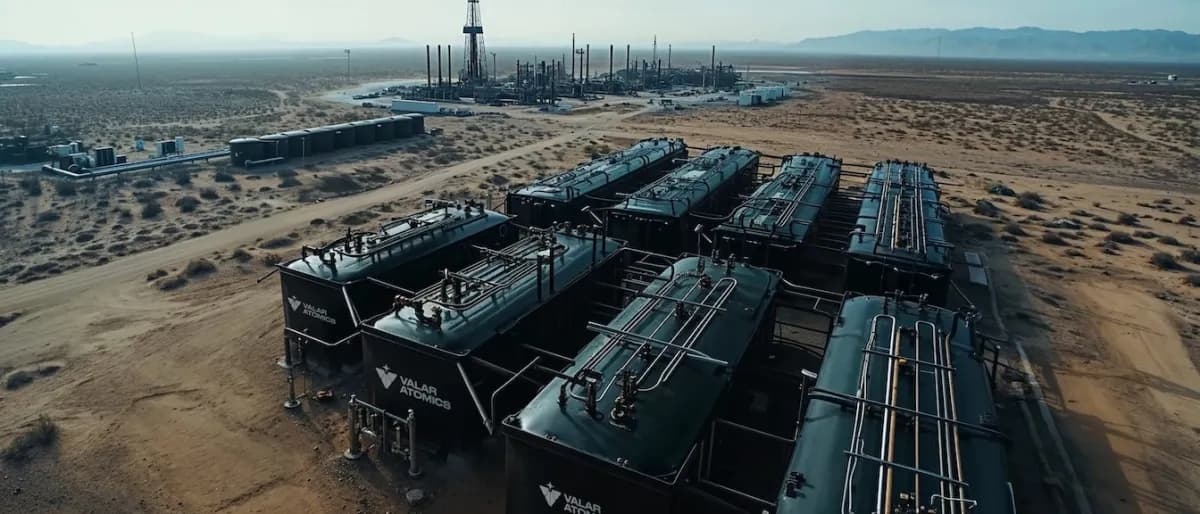
Valar Atomics, a three-year-old startup building small modular nuclear reactors, is in talks to raise $1 billion at a $6 billion valuation, according to TechCrunch. Sequoia is expected to lead the round. The El Segundo, California company wants to build hundreds of miniaturized reactors to power AI data centers, a pitch that has attracted backing from Palmer Luckey (Anduril founder) and Shyam Sankar (Palantir CTO).
The valuation marks a steep jump. Valar had previously raised $450 million at a $2 billion valuation as recently as March, Bloomberg reported. That included $340 million in equity and $110 million in debt. If the new round closes at $6 billion, it represents a 3x markup in four months.
Why the valuation jump now?
Earlier this month, Valar demonstrated its reactor delivering power to an Nvidia AI chip. The proof-of-concept came alongside a partnership announcement with Nvidia to explore nuclear energy for future data centers. That's the kind of validation that moves numbers.
Data centers are hungry and getting hungrier. Electricity demand from AI infrastructure is projected to surge over the next several years, and utilities in many regions cannot add capacity fast enough. That gap has turned nuclear power into a closely watched bet within the AI infrastructure boom.
The structured round question
Here's a detail worth noting: part of the $1 billion round has already been raised at a lower valuation. This structure is increasingly common. Companies raise in tranches, sometimes at different prices, then announce the total as a single round. The result: investors in the same "round" may hold shares at different price points.
For founders watching these numbers, this matters. Headline valuations can obscure what early versus late investors actually paid. It also makes comparing private company valuations trickier than the press releases suggest.
Who else is building SMRs?
Valar isn't alone. NuScale Power is the only SMR developer with U.S. regulatory design approval and won clearance for an upgraded, higher-output reactor last year. Kairos Power and TerraPower (backed by Bill Gates) are building next-generation reactors targeting tech and industrial customers.
What sets Valar apart, at least on paper, is its helium-cooled, high-temperature gas reactor design. The company says this approach makes its reactors suitable for factory production. Whether that translates to cheaper, faster deployment at scale remains unproven.
The regulatory fight
Valar has taken an aggressive legal stance toward the Nuclear Regulatory Commission. Last year, it joined several states and rival startups in suing the NRC, arguing the agency wrongly applies the same lengthy licensing process to small test reactors that it uses for full-size commercial plants.
The case remains unresolved. Both sides have repeatedly paused litigation, which suggests some kind of settlement is in the works. For founders in regulated industries, this is a familiar playbook: sometimes you have to fight the regulator to change the rules.
The founder's profile
Isaiah Taylor, Valar's founder, dropped out of high school at 16. He's now 27 and says he launched two startups before Valar. He's also noted that his great-grandfather worked as a nuclear physicist on the Manhattan Project. The lineage makes for good storytelling. Whether it translates to operational advantage in nuclear engineering is another question.
Logicity's Take
Valar's bet is that data center operators will pay a premium for dedicated, carbon-free power that doesn't depend on grid availability. The Nvidia partnership is smart optics, but the real test is regulatory approval and construction timelines. SMRs are theoretically cheaper than traditional reactors, but no company has yet deployed them at industrial scale. Founders in hardware-intensive, regulated sectors should watch how Valar navigates the NRC lawsuit. If they win concessions on licensing timelines, it could set precedent for other deep-tech startups battling legacy regulatory frameworks.
What's still unclear
The company hasn't disclosed when it expects to deploy its first commercial reactor. SMR technology is nascent, and the path from demonstration to industrial scale is long and uncertain. Cost overruns have plagued nuclear projects for decades. Valar's factory-built approach is designed to avoid that history, but it's a claim, not a proven capability.
Sequoia and Valar Atomics declined to comment on the funding discussions.
Frequently Asked Questions
What is Valar Atomics building?
Small modular nuclear reactors (SMRs) designed to be factory-built and deployed faster and cheaper than traditional nuclear plants, primarily to power AI data centers.
How much has Valar Atomics raised?
Previously $450 million at a $2 billion valuation. The company is now seeking $1 billion at a $6 billion valuation.
Who are Valar Atomics' competitors?
NuScale Power (the only SMR with U.S. regulatory approval), Kairos Power, and TerraPower (backed by Bill Gates).
Why is nuclear power attractive for data centers?
Data center electricity demand is growing faster than utilities can add capacity. Nuclear provides reliable, carbon-free baseload power independent of grid constraints.
Another major funding round in deep-tech infrastructure
Need Help Implementing This?
Building in a regulated industry? Logicity covers funding strategy, regulatory navigation, and deep-tech go-to-market. Subscribe for weekly analysis delivered to your inbox.
Source: Venture Capital News | TechCrunch / Marina Temkin
Manaal Khan
Tech & Innovation Writer
Produced with AI assistance and reviewed by the Logicity editorial team. Learn more in our Editorial Policy.