Key Takeaways

- Traditional RAG retrieves information once; agentic RAG iterates until it has enough context
- Agentic RAG follows a think-act-observe loop that lets models self-correct
- The approach works best when context is scattered across multiple sources or needs verification
The Problem with Standard RAG
Most automation starts with a simple promise: get the repetitive, rules-based stuff out of your way. That works until a policy changes or a data source updates. Then requests come in half-informed, or your AI confidently does the wrong thing.
Until recently, AI systems could retrieve information but couldn't tell when they didn't have enough of it. They could generate answers but couldn't pause to reassess without careful prompting from a human.
That's the core limitation of standard retrieval-augmented generation (RAG). It pulls relevant documents from external sources like knowledge bases, internal docs, or support tickets. It passes that information to a language model. The model generates an answer. Done.
Standard RAG is mostly read-only. It gathers data once and asks the model to reason over whatever came back. It doesn't stop to think: "This doesn't look right. Let me check somewhere else."
For straightforward questions, that's fine. For anything where context is scattered or assumptions need verification, it falls apart.
What Agentic RAG Actually Does
Agentic RAG adds reasoning to retrieval. Instead of looking stuff up when you ask and stopping there, it decides how and when to retrieve information. It can query multiple sources, evaluate what it finds, and go back for more if the first pass wasn't enough.
The core pattern is simple: think, act, observe.
First, the model thinks about the task. What's the real goal here? Is this a simple lookup, or does it need to dig across multiple sources? Are there assumptions to validate before moving forward?
Then it acts. It might query a knowledge base, pull data from a system of record, or call another tool entirely based on what it believes will reduce uncertainty.
Finally, it observes the results. Did it actually answer the question? Is the data complete and current? If something's off, the model gathers more context and adjusts its strategy.
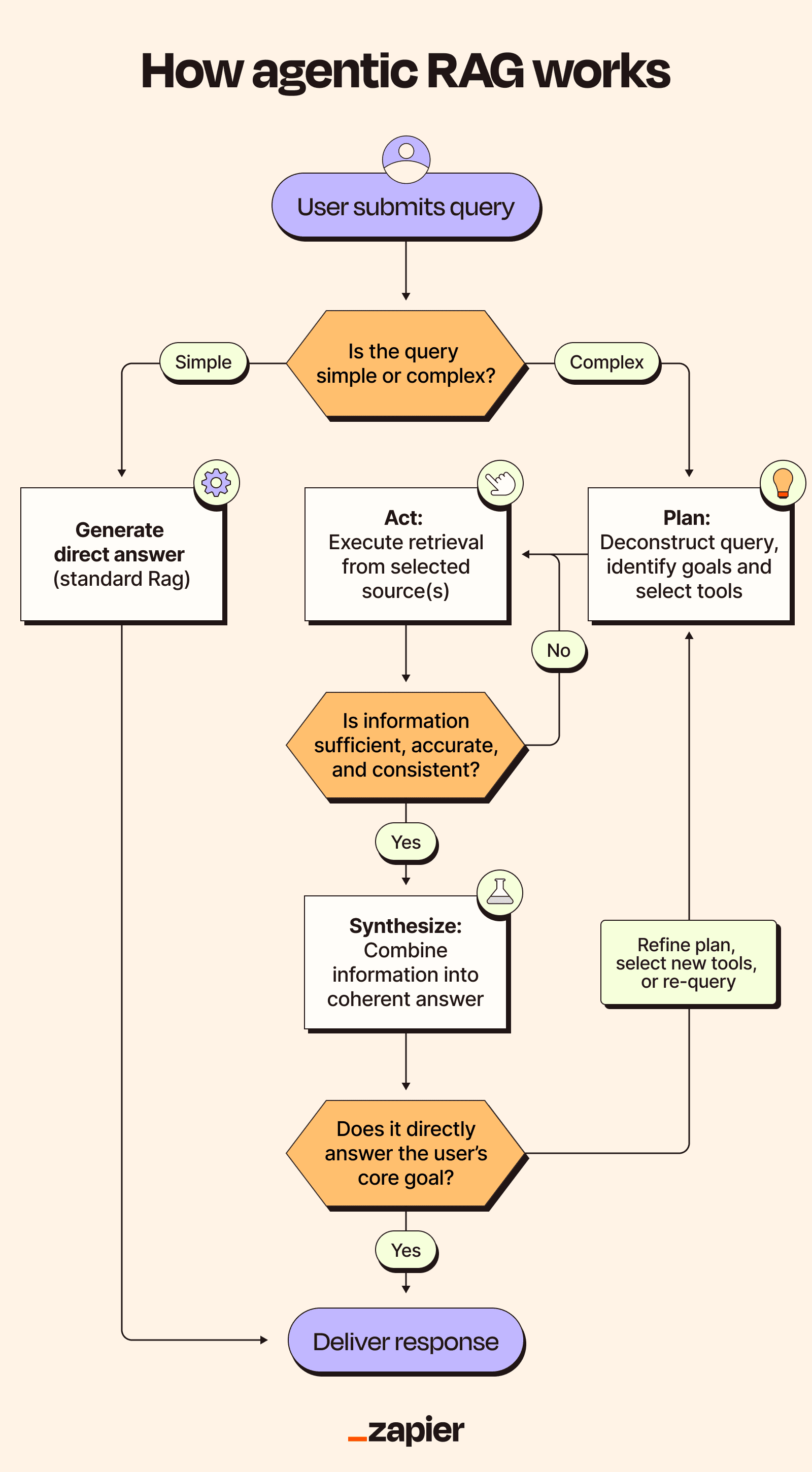
In other words, it fetches with intent and keeps iterating until the job's done.
Traditional RAG vs Agentic RAG
| Capability | Traditional RAG | Agentic RAG |
|---|---|---|
| Retrieval pattern | Single query, single response | Iterative queries based on results |
| Self-assessment | None; uses whatever it retrieves | Evaluates if retrieved info is sufficient |
| Multi-source handling | Manual orchestration required | Decides which sources to query dynamically |
| Error handling | Generates answer regardless of data quality | Recognizes gaps and fetches more context |
| Complexity | Lower; simpler to implement | Higher; requires agent framework |
The distinction matters most when your data isn't tidy. If answers live in one well-structured knowledge base, traditional RAG works fine. If your AI needs to cross-reference a CRM, a policy document, and recent support tickets to give a useful answer, traditional RAG will miss pieces.
When Agentic RAG Makes Sense
Not every retrieval task needs an agent. Adding reasoning loops increases latency and cost. For simple lookups, standard RAG is faster and cheaper.
Agentic RAG earns its overhead in specific scenarios:
- Context is scattered across multiple systems or document types
- Answers require verifying assumptions against current data
- The question itself is ambiguous and needs clarification
- Accuracy matters more than speed, like compliance or customer escalations
- Source data changes frequently and cached retrievals go stale
A customer support bot answering "What's your return policy?" doesn't need agentic RAG. A bot handling "I want to return this item I bought with my rewards points during your holiday promotion" probably does.
Agentic systems introduce new security considerations as they access multiple data sources
The Challenges You'll Hit
Agentic RAG isn't a drop-in upgrade. Several things get harder:
Latency increases. Each think-act-observe loop adds time. If your model decides it needs three retrieval passes, response time triples. For real-time applications, you'll need to cap iterations or accept occasional incomplete answers.
Costs scale with reasoning. More API calls mean higher bills. Language model inference isn't free, and agentic systems use more tokens per response than traditional RAG.
Debugging gets messy. When something goes wrong, you're no longer tracing a single retrieval. You're reconstructing a multi-step reasoning chain. Good logging and observability tooling become essential.
Scope creep is real. An agent that can decide what to retrieve can also decide to retrieve too much. Without guardrails, you'll see retrieval loops that burn through rate limits or pull irrelevant context that confuses the final answer.
Practical Use Cases
Agentic RAG fits workflows where a human would naturally say "let me check on that" multiple times before answering.
- Customer support escalations: Pull account history, recent tickets, and policy exceptions before suggesting a resolution
- Sales research: Cross-reference CRM data, recent news, and competitive intelligence before a call
- Compliance review: Verify a request against multiple policy documents and flag inconsistencies
- Technical troubleshooting: Check logs, documentation, and known issues iteratively until the root cause surfaces
In each case, the value comes from the system recognizing when its first answer isn't good enough and doing something about it.
Logicity's Take
Getting Started
If you're already running RAG workflows, the path to agentic RAG usually involves three additions:
- An agent framework that manages the think-act-observe loop
- Retrieval tools the agent can call dynamically, not just at the start of a query
- Evaluation logic that helps the model decide when to iterate versus when to respond
Platforms like Zapier are building agentic RAG capabilities into their automation tools, letting you connect multiple data sources and add reasoning without building the orchestration layer yourself.
The underlying shift is worth watching even if you're not ready to implement. AI systems that can reason about their own limitations and act on that reasoning are fundamentally more reliable than systems that just generate answers and hope for the best.
Frequently Asked Questions
What is the difference between RAG and agentic RAG?
Traditional RAG retrieves information once and generates an answer from whatever it finds. Agentic RAG adds reasoning, letting the AI model evaluate its results, decide if it needs more context, and retrieve additional information iteratively until it has a complete answer.
When should I use agentic RAG instead of traditional RAG?
Use agentic RAG when context is scattered across multiple sources, when answers require verifying assumptions, or when accuracy matters more than speed. For simple lookups from a single knowledge base, traditional RAG is faster and cheaper.
Does agentic RAG cost more than traditional RAG?
Yes. Each reasoning loop uses additional API calls and token processing. The tradeoff is higher accuracy for complex queries, but you'll pay more per response. Set iteration limits to control costs.
What are the main challenges with implementing agentic RAG?
Higher latency from multiple retrieval passes, increased costs from additional API calls, more complex debugging due to multi-step reasoning chains, and potential scope creep if agents retrieve too much irrelevant context.
Can I add agentic RAG to my existing automation setup?
Yes, if you're already using RAG. You'll need an agent framework to manage reasoning loops, retrieval tools the agent can call dynamically, and evaluation logic to decide when to iterate. Some automation platforms are adding these capabilities as built-in features.
Need Help Implementing This?
Source: The Zapier Blog
Manaal Khan
Tech & Innovation Writer
Produced with AI assistance and reviewed by the Logicity editorial team. Learn more in our Editorial Policy.