
Key Takeaways

- AI governance provides the rulebook teams need to move from pilots to production without legal or security crises
- Without shared governance standards, individual teams use AI in isolation and experiments never scale
- Effective AI transformation requires upfront decisions about approved vendors, data handling, and documentation
Hand someone a blank check and a mission to 'fix work with AI,' and they'll spiral into debates about org charts, agent architectures, and whether they need a compliance certification before touching a single workflow. But give them constraints, a specific process, a clear outcome, and guardrails for what AI can and cannot touch, and they can actually move.
That's the argument Zapier makes for prioritizing AI governance alongside AI transformation. Rules feel like a killjoy. But they're what keep go-live from turning into go-explain-this-to-Legal.
Three Terms That Get Confused
Before getting into why governance matters, it helps to separate three terms that often blur together in strategy conversations.
AI adoption is how teams integrate AI tools into daily workflows. This includes choosing tools, actually using them, and orchestrating how they work together. It's the tactical layer.
AI transformation goes further. It's an organizational shift in how work gets done. Unlike adoption, which often stops at efficiency gains, transformation fundamentally reimagines how teams operate. The outcomes are different too: faster innovation, new business models, not just time saved on existing tasks.
AI governance is the rulebook for doing both without chaos. It covers which vendors and tools are approved, responsible AI use policies, regulations and privacy laws, documentation requirements for AI decisions, and anything else that keeps AI use in check.
Logicity's Take
What Breaks Without Governance
Without clear guidelines about AI usage, you risk security and reliability issues. That's the obvious concern. But there's a subtler problem: individual teams use AI in isolation, with no shared way to scale those experiments into connected workflows.
Zapier has watched this pattern play out enough times to spot where things tend to break down.
AI Pilot Purgatory
AI pilots are often designed as standalone wins. They prove that a system can work. But they don't prove it can survive inside a web of existing tools, data sources, approvals, and workflows.
When those connections aren't defined upfront, pilots stay pilots. They demonstrate potential but never ship. Teams celebrate the demo, then watch it gather dust because nobody clarified how the system should handle edge cases, who approves its outputs, or what data it's allowed to access in production.
Security Theater vs. Actual Security
Without governance, security decisions get improvised under deadline pressure. Someone needs to ship by Friday, so they make a judgment call about what data the AI can see. Maybe that call is fine. Maybe it creates a compliance problem that surfaces six months later during an audit.
Governance handles these decisions upfront. It's not about adding bureaucracy. It's about not having to reinvent the wheel every time someone wants to connect an AI tool to a data source.
Siloed Experiments That Never Connect
Marketing builds an AI workflow for content. Sales builds one for lead scoring. Customer success builds one for ticket routing. Each team picks their own tools, defines their own rules, and solves their own narrow problem.
Six months later, someone asks: can we connect these? The answer is usually no, not without rebuilding. There's no shared standard for how AI decisions get documented, how data flows between systems, or which vendors are approved company-wide.
What Governance Actually Covers
AI governance isn't one document. It's a set of policies and practices that answer recurring questions before they become blockers.
- Approved vendors and tools: Which AI platforms are sanctioned for use? Which are explicitly banned?
- Data access rules: What data can AI systems see? What requires additional approval?
- Responsible use policies: What decisions can AI make autonomously? What requires human review?
- Regulatory compliance: How do you handle GDPR, CCPA, or industry-specific rules for AI-processed data?
- Documentation requirements: How are AI decisions logged for audit trails?
None of these questions are exotic. Every organization using AI will face them. The difference between transformation and stalled pilots is whether you answer them proactively or reactively.
How to Start Building a Governance Framework
You don't need a 50-page policy document to start. You need answers to the questions that will otherwise block your next AI project.
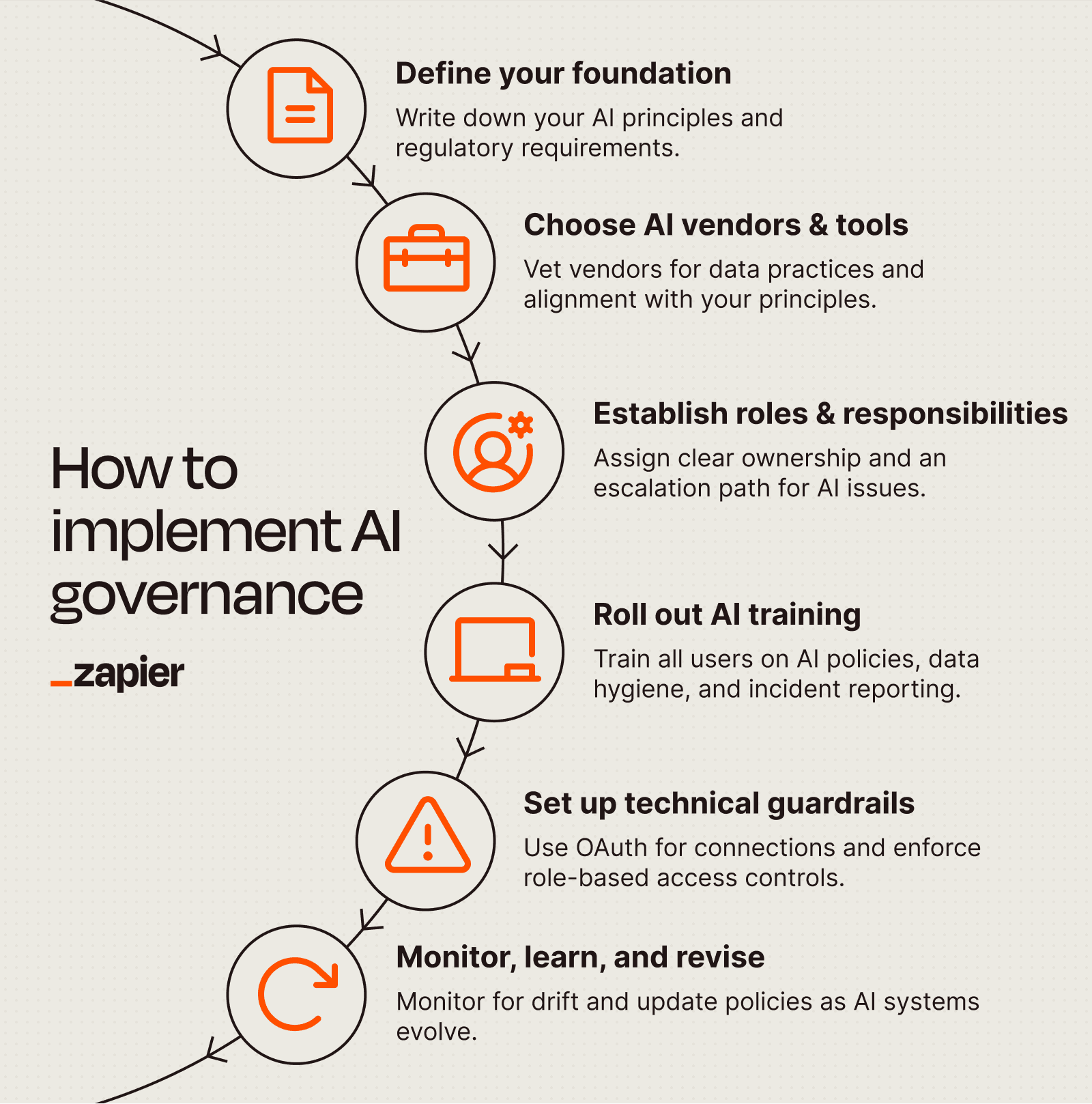
- Inventory current AI use. Find out what tools teams are already using, officially or unofficially. Shadow AI is real.
- Define approved vendors. Pick a shortlist of platforms that meet your security and compliance requirements. Make it easy to use them, hard to use alternatives.
- Set data boundaries. Clarify which data sources AI can access by default and which require explicit approval.
- Establish documentation standards. Decide how AI workflows get logged. Future you will need to audit this.
- Create an escalation path. When someone hits an edge case the policy doesn't cover, who decides?
This isn't comprehensive governance. It's minimum viable governance: enough structure to move without enough bureaucracy to freeze.
The Constraint Paradox
Here's the counterintuitive part: constraints accelerate progress. They don't slow it down.
With a blank canvas, you debate every possibility. With clear boundaries, you focus on what's actually achievable. Teams can move faster when they know what's in bounds without asking permission for every step.
The goal isn't to restrict AI use. It's to make AI use frictionless within defined limits. That's what separates organizations stuck in pilot purgatory from those shipping real transformation.
Governance requires knowing what tools and systems you're actually running
Frequently Asked Questions
What is AI governance in simple terms?
AI governance is the set of rules and practices that define how an organization can use AI tools. It covers approved vendors, data access permissions, documentation requirements, and compliance with regulations.
Why do AI pilots fail to scale?
Most AI pilots prove a concept works in isolation but don't address how it connects to existing tools, data sources, and approval workflows. Without governance defining these connections upfront, pilots stay stuck as demos.
How do you start building AI governance?
Start with inventory (what AI tools are teams using now?), then define approved vendors, set data access rules, establish documentation standards, and create an escalation path for edge cases.
Does AI governance slow down innovation?
Done right, governance accelerates innovation. Clear boundaries let teams move without asking permission for every step. The alternative is improvised decisions that create compliance problems later.
Need Help Implementing This?
Source: The Zapier Blog
Manaal Khan
Tech & Innovation Writer
Produced with AI assistance and reviewed by the Logicity editorial team. Learn more in our Editorial Policy.