Key Takeaways
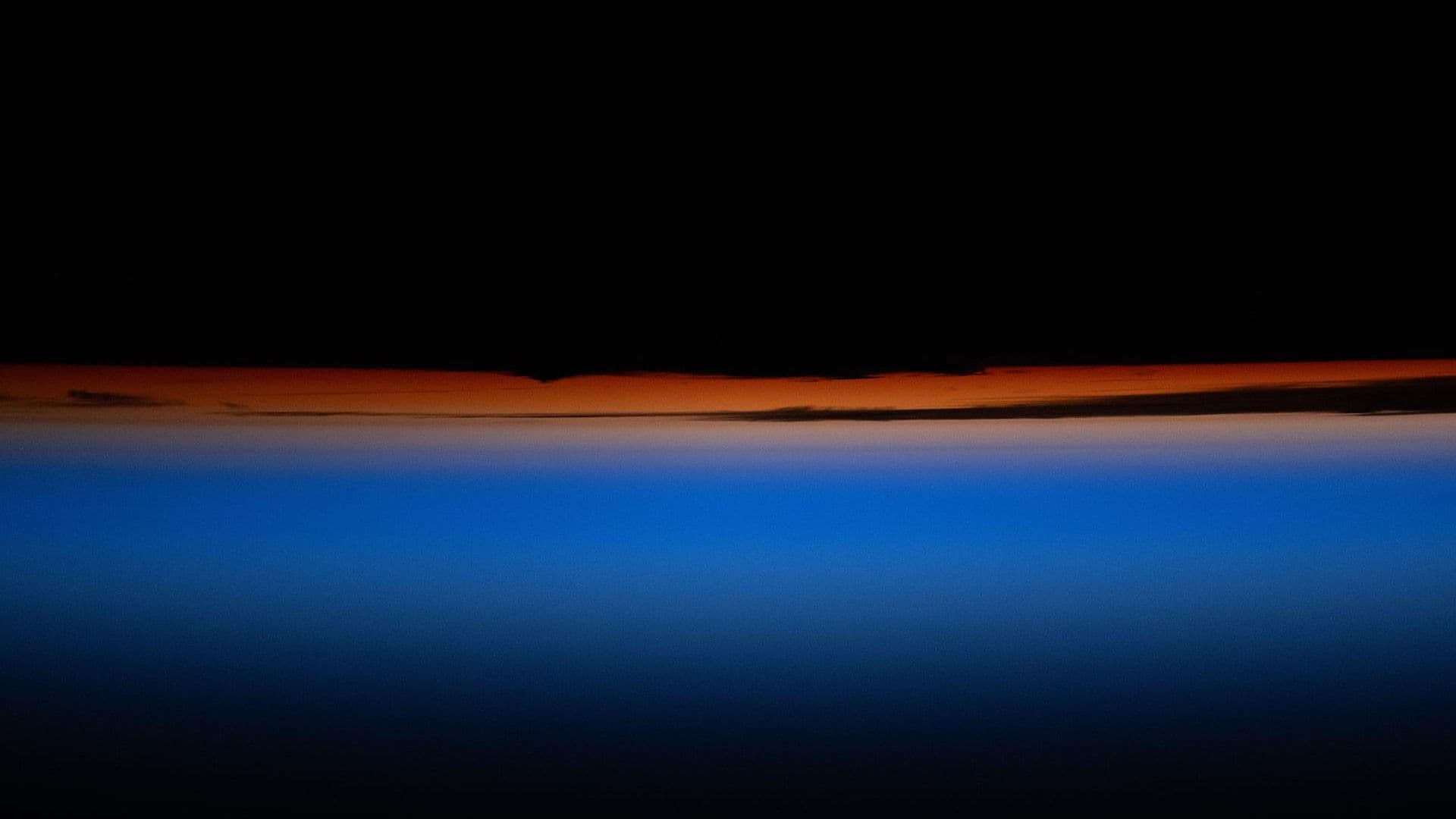
- Chris Williams captured the sunset image from 266 miles above Earth's surface on May 4, 2026
- ISS astronauts experience 16 sunrises and sunsets every 24 hours due to the station's 17,500 mph orbital speed
- The photograph shows Earth's thin atmospheric layers against the black backdrop of space
NASA astronaut Chris Williams shared a photograph of Earth's atmosphere at dusk that stops you mid-scroll. He captured the image on May 4, 2026, from the International Space Station as it passed 266 miles (428 kilometers) above the Patagonia region of South America.
The photograph shows a bright red and orange band streaking across the frame, with a deep blue layer sitting below. Above it all: the pure black of space. No gradual fade to darkness like we see from the ground. Just a hard edge where atmosphere ends and vacuum begins.
16 Sunsets Every Day
The ISS orbits Earth at roughly 17,500 mph. At that speed, the station completes one full orbit every 90 minutes. That means astronauts aboard witness 16 sunrises and 16 sunsets every 24 hours.
Each transition happens fast. The crew moves from full daylight to complete darkness in a matter of minutes. Williams' photograph freezes one of those brief moments when the sun's angle paints the atmosphere in colors you can't see from the surface.
“The thin blue line of our atmosphere is hauntingly beautiful, but from up here, you realize just how fragile and singular our home really is.”
— Chris Williams, NASA Astronaut (Expedition 74)
Why Orbital Sunsets Look Different
From the ground, sunsets spread across the entire sky. Clouds scatter light in every direction. The horizon blocks your view of the atmosphere's actual edge.
From orbit, you're looking at the atmosphere from the side. You see its layers stacked like colored glass. The red and orange bands in Williams' image are sunlight passing through denser atmospheric regions near Earth's surface. The blue below comes from higher-altitude scattering.
And that black backdrop? It's not the night sky. It's space itself, unfiltered by any atmosphere. The contrast makes the thin shell of air around our planet look almost impossibly delicate.
The Overview Effect in Action
Astronauts often describe a cognitive shift when they first see Earth from space. Researchers call it the "Overview Effect." The borders on maps disappear. The atmosphere looks thin enough to puncture. The planet becomes a single, interconnected system rather than a collection of countries and continents.
The first color photograph of Earth from space, captured during Apollo 8 in 1968, triggered a similar response on a global scale. That image showed our planet rising above the lunar horizon. It's credited with helping spark the modern environmental movement.
Williams' sunset photograph operates on the same principle. It shows what you already know but rarely feel: that thin band of color is everything. All the air we breathe, all the weather we experience, all the protection from radiation that lets life exist. It's right there, a narrow stripe between ground and void.
The ISS as Humanity's Observation Deck
The first module of the International Space Station launched in 1998. Humans have lived aboard continuously for over 25 years. That's 25 years of someone always looking down at Earth, camera in hand.
The station functions primarily as a research laboratory. Astronauts run experiments in microgravity, test materials, study human physiology. But it also serves as a permanent observation platform. Every crew member who passes through the cupola, the station's seven-windowed observation dome, brings back images that remind Earth-bound viewers what we're floating in.
Technical Challenges of Orbital Photography
Capturing clean images from the ISS isn't simple. The station moves at over 17,000 mph relative to Earth's surface. The windows in the cupola can introduce glare and reflections. Light conditions change constantly.
Photographers in the space enthusiast community have analyzed Williams' image and similar shots to understand the techniques involved. Discussions on Hacker News have focused on exposure settings and how to manage solar glare during these transitional lighting moments. On Reddit's r/space community, users have worked to identify geographical features visible through the cloud bands.
Logicity's Take
Frequently Asked Questions
How many sunsets do astronauts see on the ISS each day?
ISS astronauts witness 16 sunsets every 24 hours. The station completes one full orbit around Earth every 90 minutes, creating rapid transitions between day and night.
What altitude was the ISS at when this sunset was photographed?
Chris Williams captured the image from 266 miles (428 kilometers) above Earth's surface, while the station passed over the Patagonia region of South America.
Why do sunsets look different from space?
From orbit, you view Earth's atmosphere from the side rather than through it. This reveals distinct color bands where sunlight passes through different atmospheric layers, set against the pure black of space.
What is the Overview Effect?
The Overview Effect is a cognitive shift astronauts often experience when viewing Earth from space. Seeing the planet as a single system with a thin, fragile atmosphere changes how they perceive borders, environments, and humanity's place in the universe.
Need Help Implementing This?
Source: Latest from Space.com
Huma Shazia
Senior AI & Tech Writer
Produced with AI assistance and reviewed by the Logicity editorial team. Learn more in our Editorial Policy.