Key Takeaways
- Copy Fail (CVE-2026-31431) affects virtually every Linux distro released since 2017
- A 732-byte Python script can exploit the flaw to gain root access
- Only Arch Linux and Fedora have patches available; other distros must wait or apply mitigations
What Is Copy Fail?
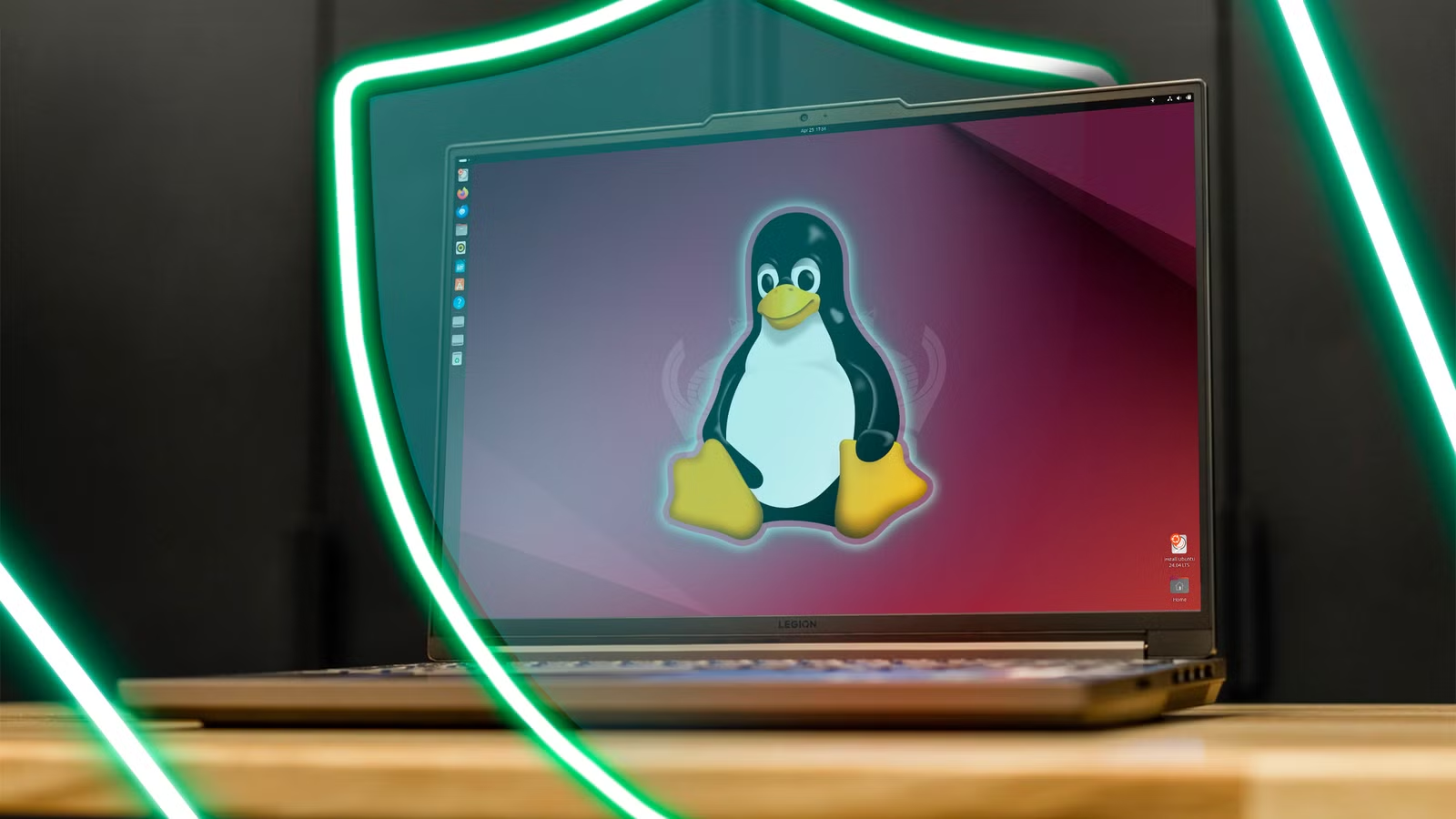
The Linux community is facing its most serious security threat since 2022's Dirty Pipe vulnerability. Security researchers at Theori have published details of Copy Fail, tracked as CVE-2026-31431, a flaw that grants attackers root access to nearly every Linux distribution with minimal effort.
The vulnerability exploits a logic bug in Linux's AEAD template process, which handles extended sequence numbers for IP security. The bug was discovered using AI-assisted analysis. Instead of keeping data within a buffer, four bytes escape outside it. Attackers can write four bytes of their own into the page cache of any readable file to gain root-level access.
Theori demonstrated the exploit's severity with a proof of concept. A 732-byte Python script reportedly gains root on virtually every Linux distro released since 2017. That includes Ubuntu, Red Hat Enterprise Linux, Amazon Linux, and Debian.
Real-World Attack Scenarios
Theori outlined a scenario where an attacker exploits a WordPress plugin flaw to get initial access, then runs the Copy Fail script to gain root on a web host. With root access, they could compromise every tenant on that host. The initial entry point could be any vulnerability. Copy Fail turns that foothold into full system control.
The researchers also warned about container escapes. Attackers could break out of Kubernetes containers or inject malicious code into CI/CD workflows through rogue pull requests. For organizations running containerized workloads, this expands the attack surface well beyond a single compromised system.
Logicity's Take
Patch Status: What's Available Now
Theori disclosed Copy Fail to Linux kernel security developers in late March 2026. The kernel team committed a patch to mainline at the start of April. Fixes exist for recent kernels from version 5.10.2.54 through 7.0.
Here's the problem. Most distributions don't use the latest kernel. They maintain older kernels and backport security fixes themselves. That process takes time. As of publication, only two distributions have patches available.
- Arch Linux: Patch available now
- Red Hat Fedora: Patch available now
- Ubuntu: No patch yet
- Debian: No patch yet
- Red Hat Enterprise Linux: No patch yet
- Amazon Linux: No patch yet
Critics have noted that Theori may not have given distribution maintainers enough lead time before public disclosure. The result resembles a zero-day scenario where users and IT teams must find temporary safeguards while waiting for fixes.
How to Protect Your Systems
If you run Arch Linux or Fedora, update immediately. The fix is available in standard repositories. Run your package manager and reboot.
For other distributions, your options are limited until official patches arrive. Consider these interim measures.
- Limit local shell access. Copy Fail requires the ability to run code on the system. Restrict who can log in.
- Audit running services. Any exploitable service could provide the initial access needed to run the Copy Fail script.
- Monitor for unusual activity. Watch for unexpected root-level processes or modified system files.
- Consider kernel updates from mainline. If you can test and deploy mainline kernels, patches are already available for versions 5.10.2.54 through 7.0.
For production environments, patching carries its own risks. Test any kernel updates in staging before rolling them to production servers.
Related reading on avoiding security bottlenecks in automated systems
Why This Matters for Enterprise Linux Users
Enterprise distributions like Red Hat Enterprise Linux and Amazon Linux prioritize stability over rapid updates. That approach works well for most security patches, which arrive after coordinated disclosure periods. Copy Fail's timing has disrupted that model.
Organizations running containerized workloads face particular exposure. Kubernetes environments often assume container isolation will limit the blast radius of a compromised workload. Copy Fail can break that assumption by enabling container escapes.
If you manage CI/CD pipelines, audit your pull request workflows. The ability to inject malicious code through rogue PRs is a direct threat to software supply chain integrity.
Timeline of the Copy Fail Disclosure
Frequently Asked Questions
What Linux distributions are affected by Copy Fail?
Virtually every distribution released since 2017 is affected, including Ubuntu, Debian, Red Hat Enterprise Linux, Amazon Linux, and Fedora. The vulnerability exists in the Linux kernel itself, not in distribution-specific code.
How can attackers exploit Copy Fail?
Attackers need the ability to run code on the system. They execute a 732-byte Python script that writes four bytes into the page cache of any readable file, granting root access. The initial access could come from any other vulnerability.
Is there a patch for Copy Fail?
Yes, for mainline Linux kernels 5.10.2.54 through 7.0. Arch Linux and Fedora have distribution patches available. Other major distributions are still working on backporting the fix.
Can Copy Fail be exploited remotely?
Not directly. An attacker needs local code execution first, which could come from a separate remote vulnerability like a WordPress plugin flaw. Copy Fail then escalates that access to root.
How serious is Copy Fail compared to Dirty Pipe?
Security researchers describe Copy Fail as Linux's gravest threat since Dirty Pipe in 2022. Both vulnerabilities enable privilege escalation, but Copy Fail affects systems going back eight years and has a trivially small exploit script.
Need Help Implementing This?
Source: How-To Geek
Huma Shazia
Senior AI & Tech Writer
Produced with AI assistance and reviewed by the Logicity editorial team. Learn more in our Editorial Policy.