Key Takeaways
- Google switched Gemini from daily prompt limits to compute-based quotas that refresh every five hours
- Users report 3.5 Flash feels less reliable than 3.1 Pro, which is now restricted to higher tiers
- AI Ultra dropped from $250 to $200 per month, with a new $100 tier for lower-limit advanced access
Google announced sweeping changes to Gemini AI's usage limits and subscription tiers following Google I/O this week. The response was immediate and negative. Users across Reddit and social media report restrictive throttling and a noticeable drop in output quality with the new 3.5 Flash model.
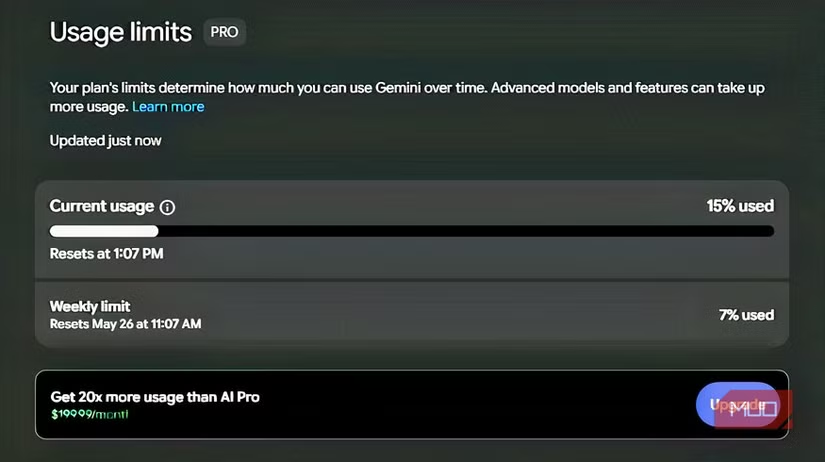
The core change: Google shifted from a daily prompt allowance to measuring total compute used. Quotas now refresh every five hours, with an overarching weekly limit. The system dynamically grades the complexity of each request. Heavier tasks burn through allowances faster.
New Pricing Tiers: Winners and Losers
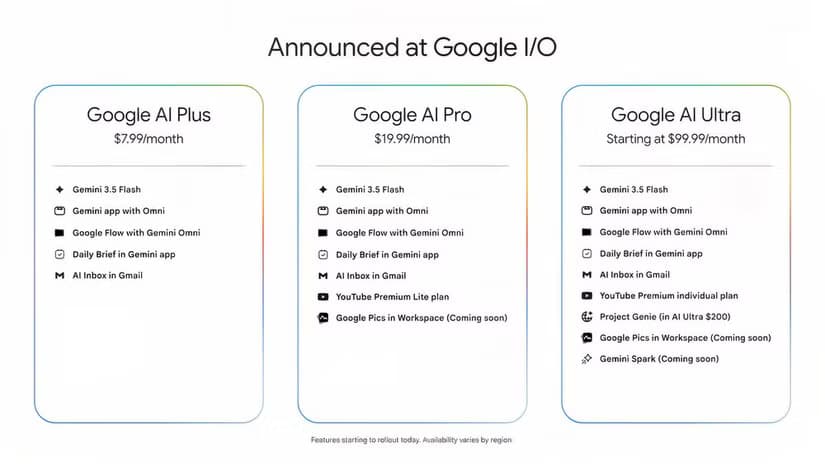
Google restructured its Gemini subscription hierarchy. All plans now include Gemini 3.5 Flash, Omni, Flow, Daily Brief, and Gmail AI features. But access to the older 3.1 Pro model, which many users consider more reliable, is now restricted.
Here's how the new tiers break down:
- AI Plus: $7.99 per month. Does not include Pro 3.1.
- AI Pro: $19.99 per month. Now bundles YouTube Premium Lite, Google Pics image creation, and voice capabilities in Gmail, Docs, and Keep coming this summer.
- AI Ultra ($100/month): Advanced access with lower limits. Includes full YouTube Premium.
- AI Ultra ($200/month): Full limits, full YouTube Premium, plus exclusive access to Gemini Spark and Project Genie for creating interactive 3D worlds.
The top-tier price dropped from $250 to $200 per month. That sounds like a win until you notice the new $100 tier that offers "advanced access with lower limits." Users on promotional plans, like the $100-per-year 5TB Pro deal from Black Friday, anticipate those offers won't return.
The 3.5 Flash Problem
The model swap is where frustration concentrates. Google positions 3.5 Flash as the default experience across all tiers. Early testers say it doesn't live up to the claims. Widespread reports describe outputs that feel less coherent and less reliable than 3.1 Pro.
The catch: 3.1 Pro, the model users preferred, is now locked behind compute quotas that make heavy use impractical for anyone below the Pro tier. Power users report burning through allowances quickly.
Compute Quotas vs. Daily Limits
The old system was simple. You got a set number of prompts per day. Use them or lose them. The new system is more opaque. A lightweight question might cost almost nothing. A complex coding task or long document analysis could eat a significant chunk of your five-hour quota.
Google hasn't published a clear pricing table showing what different tasks cost. Users are left guessing why they hit limits faster than expected.
Google's own AI leadership has emphasized trust as critical to adoption
The Anthropic Comparison
The source article's headline draws a direct line to Claude's token limits. Both Google and Anthropic have moved toward usage-based restrictions that throttle heavy users. The difference: Anthropic's limits have been visible longer, giving users time to adjust workflows. Google's change landed without much warning.
For teams that built processes around Gemini's previous unlimited-feeling daily prompts, the shift requires immediate recalculation. Some workflows that fit comfortably before now exceed quotas.
Logicity's Take
What Happens to Black Friday Deals
Users who locked in promotional pricing last year are watching closely. The $100-per-year 5TB Pro plan offered during Black Friday represented significant value. Google hasn't confirmed whether those plans will be honored, converted, or eliminated at renewal.
If you're on a legacy promotional tier, document your current terms now. When renewal comes, you'll want proof of what you signed up for.
Automation can help manage usage across multiple AI tools
Frequently Asked Questions
How do Gemini's new compute limits work?
Quotas refresh every five hours with an overarching weekly limit. The system grades task complexity dynamically, so heavier requests consume more allowance.
Is Gemini 3.1 Pro still available?
Yes, but access is now restricted by compute quotas. Heavy use of 3.1 Pro burns through allowances quickly, especially on lower-tier plans.
What's included in the $19.99 AI Pro tier?
AI Pro includes YouTube Premium Lite, Google Pics image creation, and upcoming voice features in Gmail, Docs, and Google Keep.
Will Black Friday promotional plans be honored?
Google hasn't confirmed. Users on deals like the $100-per-year 5TB Pro plan should document their terms before renewal.
How does this compare to Claude's limits?
Both Anthropic and Google now use compute-based restrictions that throttle heavy users. Claude's limits have been visible longer, giving users more time to adapt.
Need Help Implementing This?
Source: MakeUseOf
Gemini Spark and Android XR Hardware Unveiled at I/O 2026
The article introduces several major 2026 developments, including Gemini Spark, an autonomous digital assistant, and a partnership for Android XR smart glasses with Gentle Monster and Warby Parker. It also details the new 'Antigravity' coding tool and a global rollout of AI-powered search boxes that accept video and image inputs.
Google Home Spring 2026 Gemini 3.1 Integration
The new article introduces the Spring 2026 Smart Home Upgrade, which replaces Google Home's legacy voice engine with a local, Gemini 3.1-powered system. This update enables natural language understanding for smart home devices, moving away from rigid keyword-based commands.
Manaal Khan
Tech & Innovation Writer
Produced with AI assistance and reviewed by the Logicity editorial team. Learn more in our Editorial Policy.