Key Takeaways
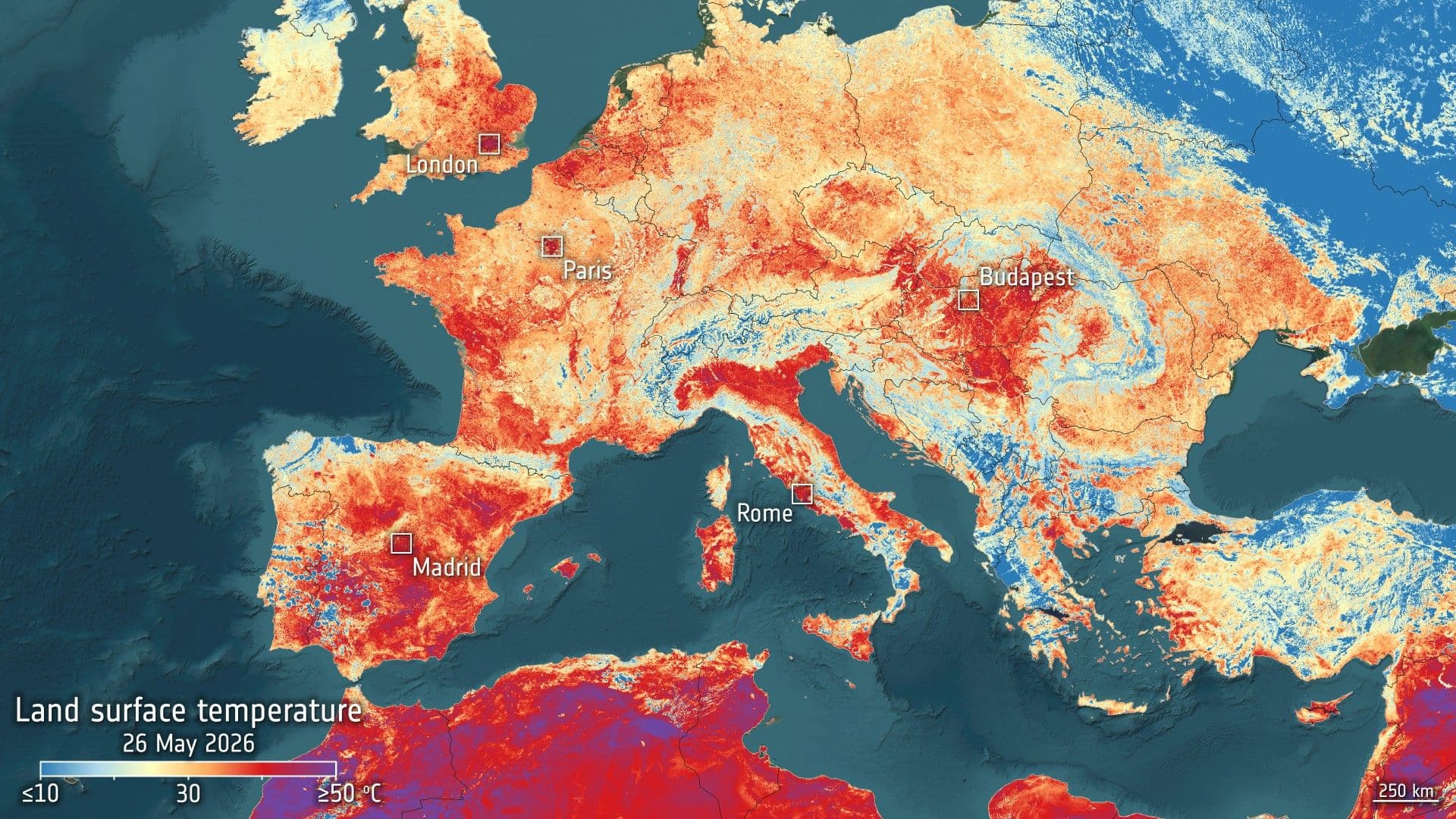
- Sentinel-3 satellite data shows land surface temperatures exceeding 40°C across Southern Europe in late May
- London recorded 34.8°C on May 25, shattering its previous May temperature record
- A heat dome high-pressure system trapped hot air from North Africa over Western Europe
Europe is baking under an extreme heat wave, and you can see it from orbit. New data from the European Space Agency's Sentinel-3 satellite shows land surface temperatures exceeding 40°C across Southern Europe. The vivid thermal maps reveal just how far the scorching conditions have spread, from Spain and Italy through Germany and into the UK.
What makes this heat wave remarkable isn't just the temperatures. It's the timing. Summer hasn't officially started in the Northern Hemisphere, yet conditions across Western Europe look more like mid-August than late May.
Records Falling Across the Continent
The numbers tell the story. London recorded 34.8°C on May 25, 2026, setting a new national temperature record for the month of May. For context, typical May temperatures in London average between 10°C and 19°C, often accompanied by rain. The current reading is nearly double the upper end of that range.
France saw even more extreme conditions. The Landes region in southwestern France peaked at 37.1°C during the heat wave. Across the continent, severe weather alerts are in effect for Hungary, Spain, Italy, Germany, and Switzerland.
What's Causing This Heat Dome?
The culprit is a massive high-pressure system known as a heat dome. This atmospheric pattern acts like a lid, trapping hot air originating from North Africa over Western Europe. The system prevents cooler air from moving in and blocks cloud formation, creating sustained extreme heat.
“The intensity and early timing of this heat wave is a stark reminder that the seasonal boundaries we once relied upon are becoming increasingly blurred in our warming climate.”
— Dr. Elena Rossi, Senior Climatologist at the European Centre for Medium-Range Weather Forecasts
Climate scientists say extreme heat events like this are now 10 times more likely in Europe compared to pre-industrial times. The increase is directly linked to climate change.
How Sentinel-3 Captures Heat from Space
The Sentinel-3 satellite launched in 2018 as part of the Copernicus Earth-observation program, a joint project between the European Commission and the European Space Agency. It's one of several satellites in the program designed to monitor changes across Earth's seas and land.
The satellite measures land surface temperature, which differs from the air temperature reported by weather stations. Land surfaces absorb solar radiation and can get significantly hotter than the surrounding air, especially in urban areas and bare soil. The thermal maps from Sentinel-3 show these surface temperatures in vivid color gradients, with deep reds indicating the hottest areas.
Climate Scientists Sound the Alarm
Peter Thorne, director of the ICARUS Climate Research Centre at Maynooth University in Ireland, described the situation bluntly to CNN.
“We know beyond a shadow of a doubt that heat wave events such as this have been made more likely and more severe due to climate change. But nevertheless many of the records being set, particularly in the U.K. and France, are mind-bogglingly crazy.”
— Peter Thorne, director of the ICARUS Climate Research Centre at Maynooth University
The early timing makes this event particularly concerning. May heat waves don't typically match the intensity of summer events, but this one is breaking records that usually stand until July or August.
Why Space-Based Monitoring Matters
When people hear "space mission," they often think of astronauts on the Moon or telescopes peering at distant galaxies. But Earth-observation satellites like Sentinel-3 serve a different purpose: looking back at our own planet to track how it's changing.
Space provides a unique vantage point for monitoring large-scale weather patterns. A ground-based weather station can measure temperature at a single point. A satellite can map temperatures across an entire continent in a single pass, revealing patterns that would be invisible from the surface.
Discussion on Reddit's r/science and r/space communities has focused on the Sentinel-3 imagery, with users expressing alarm at the color-coded maps. Many are debating the need for improved early-warning satellite infrastructure, including the upcoming Meteosat Third Generation series.



Logicity's Take
Frequently Asked Questions
What is causing the May 2026 heat wave in Europe?
A powerful heat dome, a high-pressure system, has trapped hot air from North Africa over Western Europe. This prevents cooler air from moving in and blocks cloud formation, creating sustained extreme temperatures.
What temperature records were broken during this heat wave?
London recorded 34.8°C on May 25, 2026, setting a new national May temperature record. France's Landes region peaked at 37.1°C. Typical May temperatures in London average 10-19°C.
What is Sentinel-3 and how does it measure heat waves?
Sentinel-3 is a European satellite launched in 2018 as part of the Copernicus Earth-observation program. It measures land surface temperatures from orbit, creating thermal maps that show temperature patterns across entire continents.
How has climate change affected heat waves in Europe?
Extreme heat events in Europe are now 10 times more likely compared to pre-industrial times due to climate change. Scientists say climate change has made events like this both more likely and more severe.
What countries are affected by the May 2026 heat wave?
Severe weather alerts are in effect across Western Europe, including the UK, France, Spain, Italy, Germany, Switzerland, and Hungary. Southern Europe has seen temperatures reach 40°C.
Need Help Implementing This?
Source: Latest from Space.com
Manaal Khan
Tech & Innovation Writer
Produced with AI assistance and reviewed by the Logicity editorial team. Learn more in our Editorial Policy.