Key Takeaways
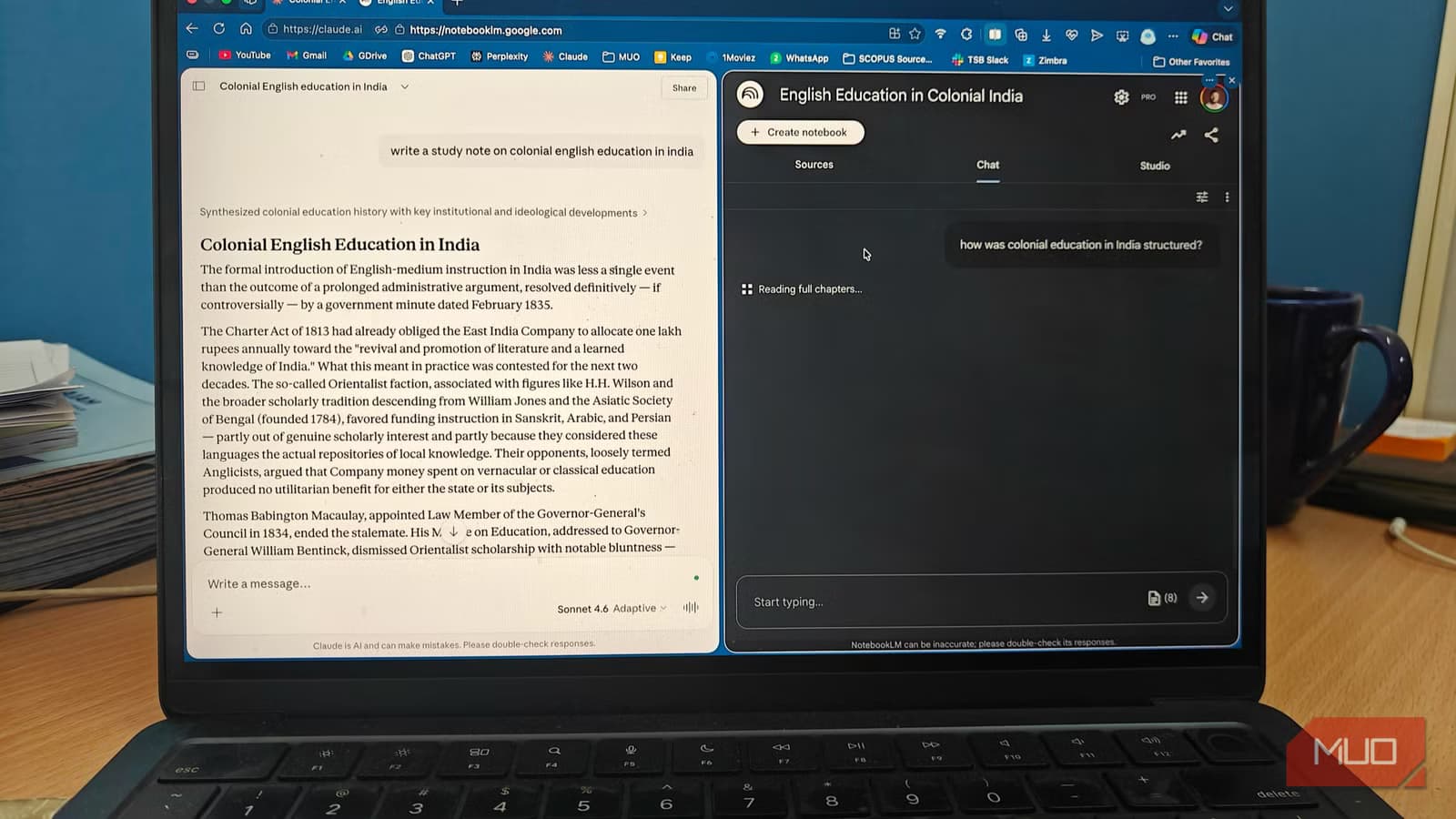
- Claude excels at reasoning, writing, and synthesis across broad knowledge
- NotebookLM stays strictly faithful to uploaded source documents
- The optimal research workflow uses both tools for different stages
The problem with expecting one AI to do everything
Abhijith N Arjunan, a researcher and Assistant Professor of English, thought he'd found the perfect AI research partner in Claude. After switching from ChatGPT, he was impressed by Claude's writing quality and reasoning skills. It became his go-to tool for literature reviews, course preparation, lecture development, and article outlining.
The workflow seemed smooth. Claude handled documents well. It followed lengthy conversation threads. It explained its thinking clearly. Arjunan considered it a genuine thinking partner.
Then he noticed a problem.
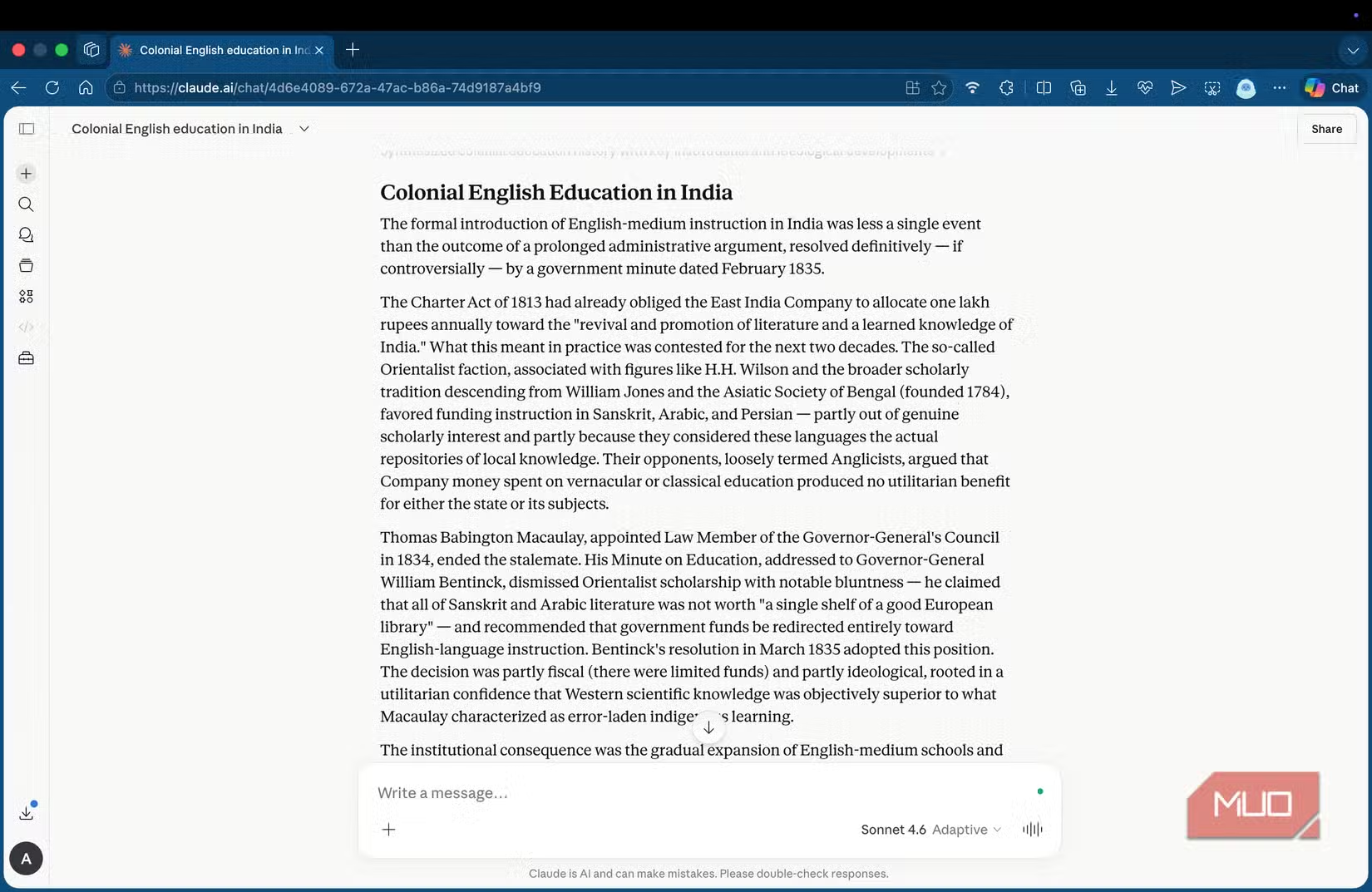
When he asked Claude questions about general knowledge, the responses were solid. But when he uploaded specific sources and asked Claude to base responses only on those materials, something else happened. Claude mixed in information from outside the provided documents. For general writing, that's fine. For academic research requiring strict source fidelity, it's a problem.
Where Claude shines and where it doesn't
Claude's strength is synthesis. It draws connections between concepts, structures arguments, and produces polished prose. When you want a thinking partner who can help you develop ideas, Claude delivers.
The trade-off is that Claude treats your uploaded documents as one input among many. Its training data, reasoning patterns, and broader knowledge all influence the output. You can instruct it to stick to your sources, but the boundary isn't absolute.
For academic work, mixing general knowledge with source-specific claims creates citation headaches. If Claude adds a claim that sounds right but isn't in your sources, you have to catch it before it ends up in your paper.
NotebookLM takes a different approach
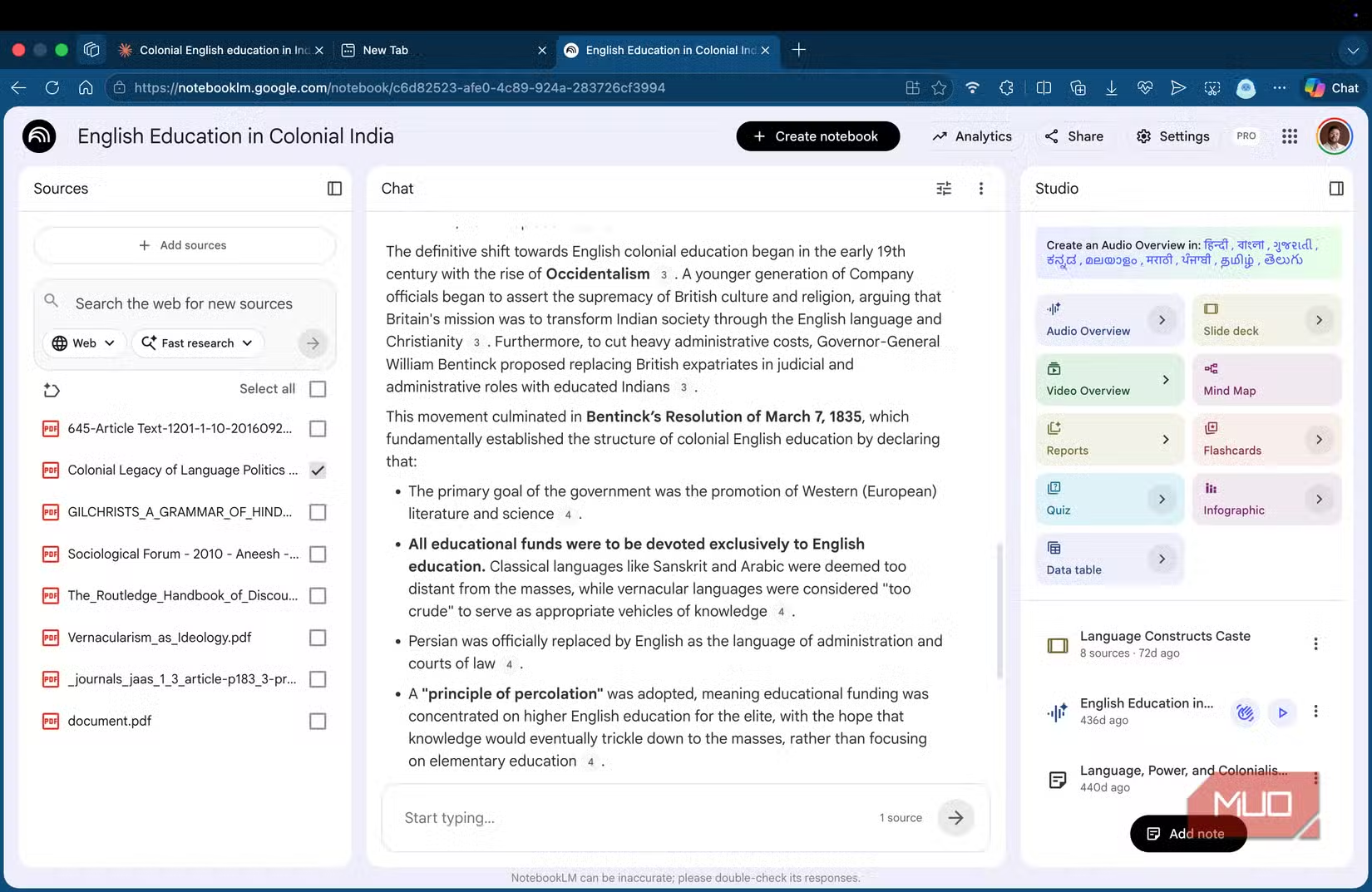
Google's NotebookLM is built around a simple idea: the AI should only know what you upload. You add PDFs, documents, or notes to a notebook. The AI answers questions based solely on that material.
This design trades breadth for precision. NotebookLM won't synthesize your sources with outside knowledge. It won't suggest connections to papers you haven't uploaded. It stays in its lane.

For researchers who need to extract insights from a specific corpus, this constraint is a feature. Every claim NotebookLM makes can be traced back to something you provided. No surprise citations. No hallucinated details dressed up as facts from your sources.
The two-tool workflow
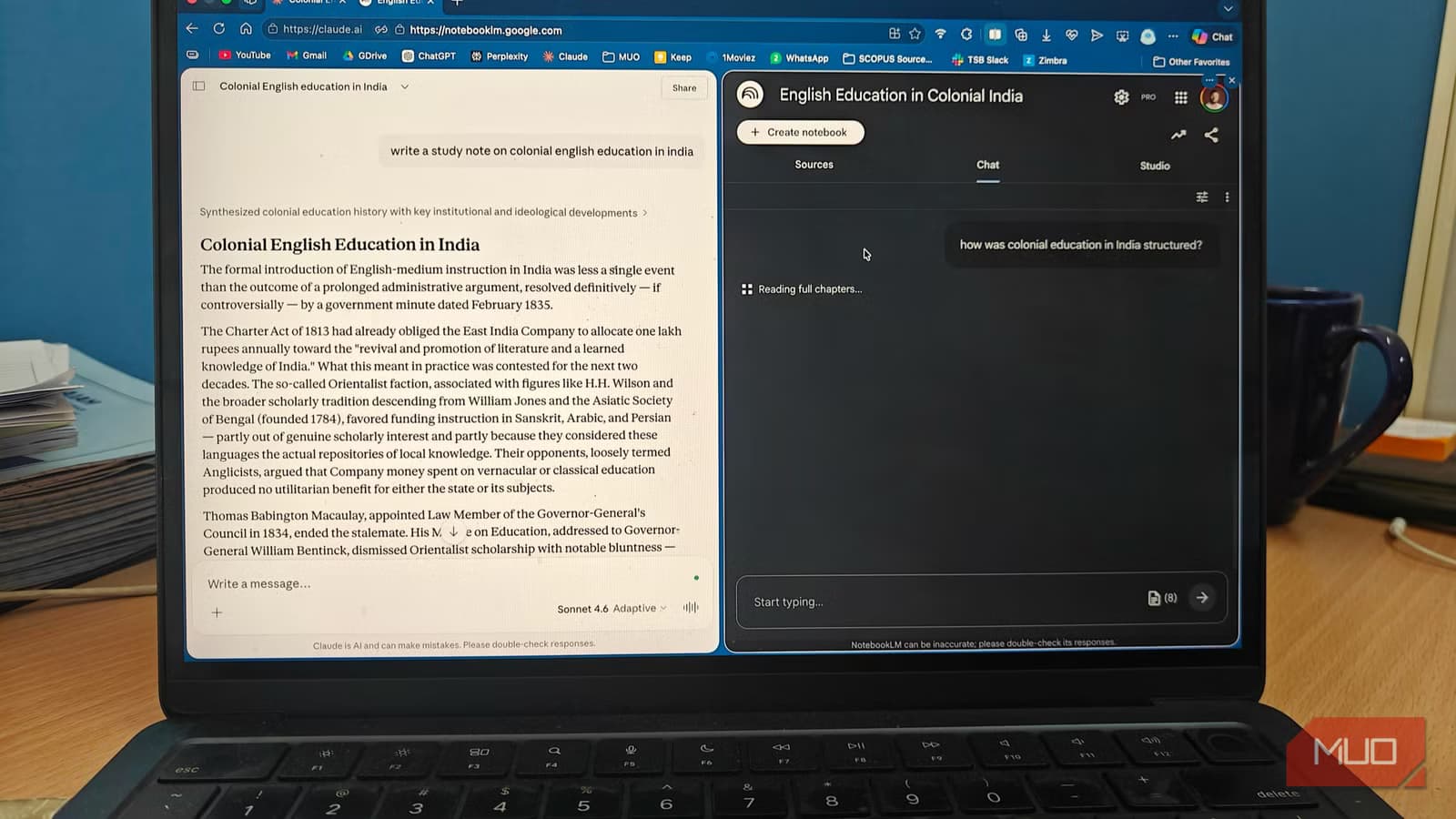
Arjunan's solution was to stop expecting one tool to handle everything. Instead, he uses both tools for what they do best.
NotebookLM handles source-specific work. Upload your research materials. Ask questions. Get answers grounded in exactly what you provided. Use it when source fidelity matters more than creative synthesis.
Claude handles the thinking-out-loud phase. Use it to structure arguments, explore angles, draft prose, and refine ideas. Let it draw on its broader knowledge when that helps rather than hurts.
The combination addresses a gap neither tool fills alone. NotebookLM keeps you honest about what your sources actually say. Claude helps you figure out what to do with that information.
Another perspective on switching productivity tools when needs evolve
When source fidelity matters
The distinction matters most in contexts where mixing sources creates real problems. Academic papers need precise attribution. Legal research requires knowing exactly which documents support a claim. Compliance work demands audit trails.
In these cases, NotebookLM's constraint isn't a limitation. It's the point. The tool does less so you can trust what it does.
For brainstorming, drafting, and general knowledge work, Claude's broader approach wins. You want the AI to bring its own knowledge to the table. That's the value proposition.
| Feature | Claude | NotebookLM |
|---|---|---|
| Knowledge base | Training data + uploads | Only your uploads |
| Best for | Synthesis, writing, reasoning | Source-grounded Q&A |
| Citation reliability | May include outside knowledge | Strictly from provided docs |
| Creative synthesis | Strong | Limited by design |
| Conversation depth | Long threads, context retention | Notebook-scoped |
More on choosing the right AI tool for specific workflow needs
The lesson for AI tool selection
The broader point extends beyond these two tools. AI products make trade-offs. A tool optimized for one task usually compromises on others. Understanding those trade-offs beats searching for a single tool that does everything.
Claude and NotebookLM aren't competitors. They're complements. One helps you think. The other keeps you grounded. Using both beats using either alone.
Logicity's Take
Frequently Asked Questions
Can Claude be instructed to only use uploaded sources?
You can ask Claude to base responses on provided documents, but it may still incorporate knowledge from its training data. The boundary isn't absolute.
Is NotebookLM free to use?
Google offers NotebookLM with a free tier. Check Google's current pricing for usage limits and premium features.
Which tool is better for academic writing?
NotebookLM is better for source-grounded research where citation accuracy matters. Claude is better for drafting, structuring arguments, and synthesizing ideas.
Can I use both tools together in one workflow?
Yes. Use NotebookLM to extract insights from your source corpus, then use Claude to develop those insights into polished arguments and prose.
Does NotebookLM work with all document types?
NotebookLM supports PDFs, Google Docs, and text files. Check Google's documentation for the current list of supported formats.
Need Help Implementing This?
Source: MakeUseOf
Uber's Engineering Team Exhausts 2026 AI Budget on Claude Code
The new article provides specific data on Uber's engineering team burning through their 2026 AI budget in four months due to massive Claude Code adoption. It includes details on individual API costs ($500-$2,000), usage statistics (95% of engineers), and the corporate impact of these tools at scale.
Manaal Khan
Tech & Innovation Writer
Produced with AI assistance and reviewed by the Logicity editorial team. Learn more in our Editorial Policy.