AI-Powered Solar Cell Factory Hits 27.22% Efficiency: How Machines Are Now Inventing Better Materials
Key Takeaways
- AI system achieved 27.22% power conversion efficiency in perovskite solar cells
- Automated platform is nearly 5 times more reproducible than manual fabrication
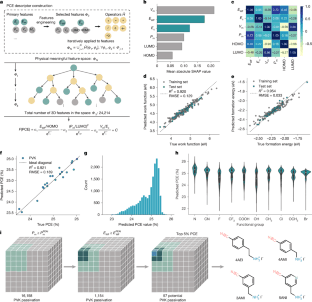
- Discovered novel passivation molecule 5ANI through machine learning and quantum modeling
- Solar cells retained 98.7% efficiency after 1,200 hours of continuous operation
- Mini-modules scaled up to 21.4 cm² while maintaining 23.49% efficiency
Read in Short
Scientists built an AI system that both discovers new materials AND manufactures solar cells automatically. It found a molecule called 5ANI that pushed efficiency to 27.22%, and the whole process is nearly 5 times more consistent than when humans do it manually. This is a big deal for scaling up next-gen solar technology.
Here's the thing about solar cell research: it's painfully slow. Scientists spend years mixing chemicals, tweaking temperatures, and running thousands of experiments hoping something works better than what came before. It's basically educated guessing with a lot of expensive lab equipment. But what if you could take the humans out of the loop entirely?
That's exactly what a team publishing in Nature just demonstrated. They've created what they call an "autonomous closed-loop framework" for perovskite solar cells. And before your eyes glaze over at the jargon, let me translate: they built a robot scientist that invents new materials, manufactures solar cells, tests them, learns from the results, and then tries again. All without a coffee break.
Why Perovskite Solar Cells Matter (And Why They're Hard to Make)
Perovskite solar cells are the scrappy underdog of the renewable energy world. Traditional silicon panels took decades to reach commercial viability. Perovskites? They've gone from lab curiosity to challenging silicon's dominance in about 15 years. They're cheaper to produce, can be made flexible, and theoretically could be painted onto surfaces.
The catch is that making them consistently is a nightmare. The materials are sensitive to moisture, temperature, and basically everything else in the environment. Two cells made the same way often perform completely differently. This is the commercialization bottleneck everyone talks about but nobody had really solved. Until now, apparently.
What's a Passivation Molecule?
Passivation molecules are additives that coat defects in solar cell materials, preventing energy loss. Think of them as tiny bandages that patch up imperfections in the crystal structure. The right passivation molecule can dramatically boost efficiency and stability.
The AI Brain Behind the Operation
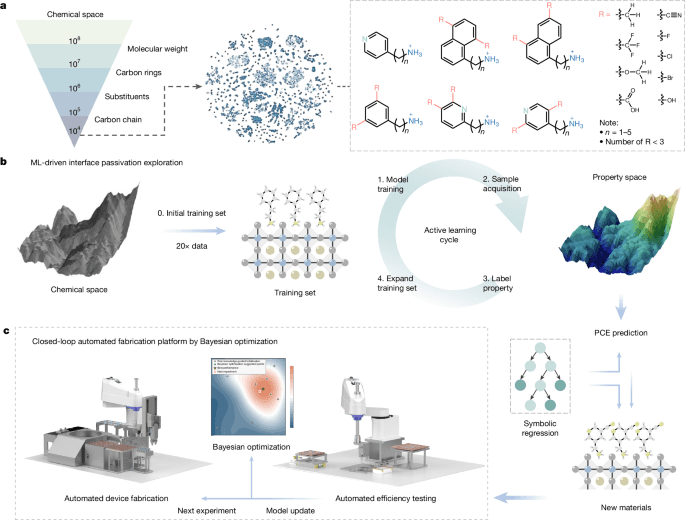
The system combines two separate but connected pieces. First, there's a machine learning engine that uses active learning and quantum modeling to hunt for promising new molecules. It doesn't just randomly test things. It builds a model of what makes a good passivation molecule, predicts candidates, and gets smarter with every experiment.
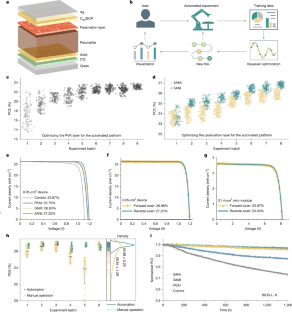
The second piece is the manufacturing platform. This uses Bayesian optimization and something called symbolic regression to continuously refine how the cells are actually made. Every solar cell produced feeds data back into the system. The temperature was 2 degrees higher? The spin coating lasted half a second longer? The AI notices, learns, and adjusts.
What makes this special is that both pieces talk to each other. The discovery AI finds a promising molecule, the manufacturing AI figures out the best way to make cells with it, and the results inform both systems simultaneously. It's genuinely autonomous in a way most "AI research" announcements aren't.
The Numbers That Actually Impress
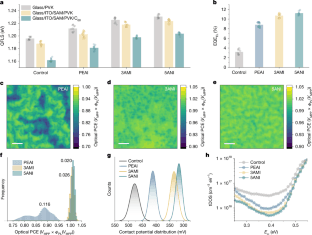
So what did this robot scientist actually achieve? It discovered a molecule with the memorable name 5-(aminomethyl)nicotinonitrile hydroiodide. Thankfully, they call it 5ANI. This molecule, when used in the solar cell manufacturing process, produced cells with 27.22% power conversion efficiency. That's certified at 27.18% under maximum power point tracking, which is the standard measurement everyone trusts.
But here's where it gets really interesting. The efficiency number is great, but it's not the whole story. The automated platform achieved reproducibility nearly 5 times better than human researchers. Think about what that means for manufacturing. You're not just making better solar cells. You're making them consistently, batch after batch.
- Small cells (0.05 cm²): 27.22% efficiency
- Mini-modules (21.4 cm²): 23.49% efficiency
- Stability test: 98.7% efficiency retained after 1,200 hours
- Reproducibility: ~5x better than manual fabrication
The stability result is huge too. These cells kept 98.7% of their initial efficiency after 1,200 hours of continuous operation under standardized testing protocols. Perovskites have historically degraded quickly, which has been one of the main knocks against them. Over a thousand hours of solid performance suggests this problem might be solvable.
The quantum modeling techniques mentioned in this research connect to broader quantum computing applications in materials science
What This Means for Solar Energy's Future
Let's be real about what's happening here. This isn't just a new solar cell record. Records get broken all the time. This is a demonstration that the entire R&D process for materials science can be automated. The same approach could theoretically work for batteries, catalysts, semiconductors, or any material where trial-and-error has been the norm.
The 5x reproducibility improvement is what industry people will pay attention to. Manufacturing consistency has killed more promising technologies than technical limitations ever have. If you can't make something reliably at scale, it doesn't matter how good your lab results are.
“This work establishes an automated closed-loop system that synergizes ML-powered discovery with the high-fidelity data from automated manufacturing, setting a benchmark for autonomous discovery and manufacturing in photovoltaics and materials.”
— Nature research publication
The Skeptic's Corner
Now, I'm not going to pretend this is all sunshine and solved problems. There are legitimate questions. How much did the initial system setup cost? How long did it take to train the AI models before they started finding useful molecules? Can this scale beyond mini-modules to the full-sized panels you'd actually put on a roof?
The paper mentions 21.4 cm² mini-modules at 23.49% efficiency. That's a significant drop from the small cell results, which is normal but still represents a scaling challenge. And 1,200 hours of stability testing is good, but commercial panels need to last 25+ years. We're talking about 200,000 hours, not 1,200.
Still, those are engineering problems. The fundamental breakthrough here is proving that autonomous systems can handle both discovery and manufacturing in a feedback loop. That's a methodology that can be improved, scaled, and applied elsewhere.
The Bigger Picture: Machines That Invent
We've been hearing about AI revolutionizing drug discovery for years. AlphaFold cracked protein folding. But materials science has been a tougher nut because you can't just simulate your way to a manufacturing process. The physical reality of making things is messy and unpredictable.
This research suggests we might be entering an era where AI systems don't just predict which materials might work. They actually make them, test them, and iterate. The loop is closed. The human researcher becomes more of a strategic director than a hands-on experimenter.
Is that good? Probably, for getting better solar panels faster. The climate crisis isn't waiting around for us to run more manual experiments. If robots can speed up clean energy development, that seems like a win.
Understanding how manufacturing automation is reshaping semiconductor and materials production globally
What Happens Next
The research team has essentially published a blueprint. Other labs will try to replicate and improve upon this autonomous framework. Expect to see similar closed-loop systems popping up for battery research, LED development, and other areas where materials discovery meets manufacturing challenges.
For perovskite solar cells specifically, the path to commercialization just got clearer. If you can manufacture consistently and discover better materials faster, the economics start to work. We might actually see these cells on rooftops within the next decade, not as a research curiosity but as a real alternative to silicon.
And honestly? Having machines that can invent and manufacture better clean energy technology feels like exactly the kind of AI application we should be excited about. Not chatbots writing mediocre blog posts, but actual scientific discovery accelerated by automation. That's the future I can get behind.
Frequently Asked Questions
What is 5ANI and why does it matter?
5ANI (5-(aminomethyl)nicotinonitrile hydroiodide) is a passivation molecule discovered by the AI system. It coats defects in perovskite solar cells to prevent energy loss, enabling the record 27.22% efficiency.
How does the autonomous system work?
It combines machine learning for discovering new molecules with an automated manufacturing platform. Both systems share data in a feedback loop, continuously improving both material selection and fabrication processes.
Can this technology scale to commercial solar panels?
The research demonstrated mini-modules at 23.49% efficiency, showing early scaling promise. Manufacturing consistency improved 5x over manual methods, which is crucial for commercialization.
How long do these solar cells last?
Testing showed 98.7% efficiency retention after 1,200 hours of continuous operation. Longer-term durability for commercial use (25+ years) still needs to be demonstrated.
Source: Nature
Manaal Khan
Tech & Innovation Writer
Produced with AI assistance and reviewed by the Logicity editorial team. Learn more in our Editorial Policy.