
Key Takeaways

- Prescriptive analytics is the fourth stage of analytics maturity, answering 'What should we do?' rather than just 'What happened?' or 'What might happen?'
- The global prescriptive analytics market is projected to grow at 26.42% CAGR between 2025 and 2030, reaching $15.59 billion by 2025
- The biggest barrier isn't the math. It's clearly defining business objectives and constraints before the optimization can begin
Your dashboards show what happened last quarter. Your machine learning models forecast what might happen next month. But when it's time to decide what to actually do about any of it, most teams revert to spreadsheets, gut instinct, and meetings that go nowhere.
This is the gap prescriptive analytics was designed to close. It's the stage where insight finally turns into action.
The Four Stages of Analytics Maturity
Prescriptive analytics sits at the top of a four-stage maturity model. Understanding where it fits helps explain why so many organizations never reach it.
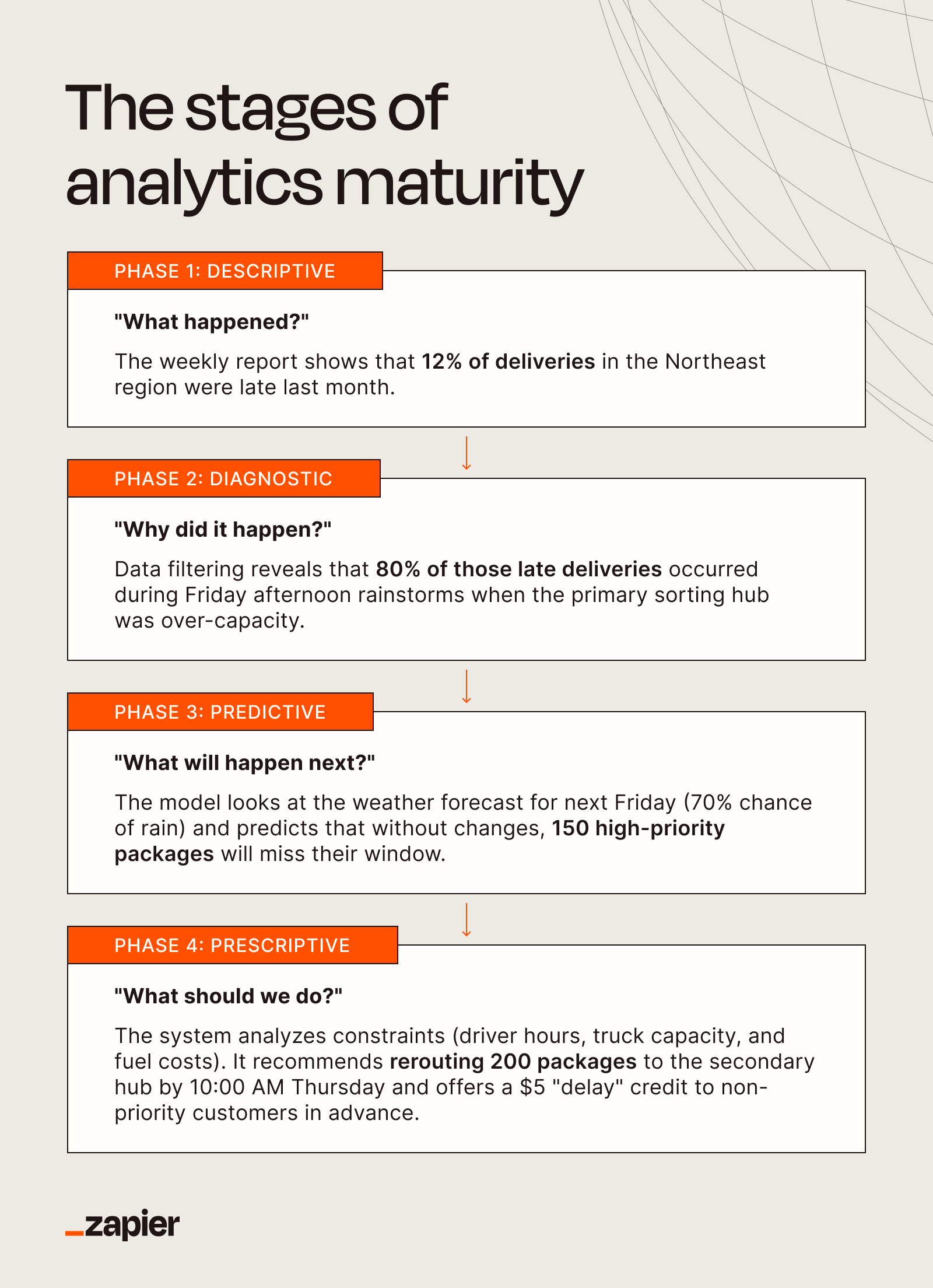
Descriptive analytics answers 'What happened?' It's your rearview mirror: monthly revenue, churn rates, average order value. Useful, but entirely backward-looking.
Diagnostic analytics answers 'Why did it happen?' It hunts for root causes. Did sales dip in Q3? Diagnostic analytics tells you whether to blame a competitor's promotion, a product issue, or a supply chain delay.
Predictive analytics answers 'What might happen?' It looks ahead using historical patterns to forecast which customers are likely to churn, what next-month inventory demand will be, and which leads are most likely to convert.
Prescriptive analytics answers 'What should we do about it?' It analyzes trade-offs and recommends exact steps. Shift this marketing budget. Adjust that inventory level. All optimized toward a specific goal, whether that's maximizing revenue, cutting costs, or keeping customers happy.
| Stage | Question | Time Orientation | Output | Typical Users |
|---|---|---|---|---|
| Descriptive | What happened? | Past | Reports, dashboards | Analytics, executives |
| Diagnostic | Why did it happen? | Past | Root cause analysis | Data analysts |
| Predictive | What might happen? | Future | Forecasts, scores | Data scientists |
| Prescriptive | What should we do? | Future | Recommendations, decisions | Ops leaders, decision-makers |
Why Teams Stall at Prediction
Most teams stall at the predictive stage because having a forecast feels like enough. You know which customers might churn. You know which deals might close. The model worked. Job done.
Except it isn't. Teams running excellent predictive models still make slow, inconsistent decisions. The models aren't the problem. The missing piece is a system that can turn a recommendation into coordinated action.
Consider a retailer that predicts demand for next month's inventory. The prediction is solid. But what happens next? Someone has to decide which suppliers to contact, how much to order, when to adjust pricing, and whether to shift warehouse capacity. Those decisions involve trade-offs, constraints, and competing objectives. Without a prescriptive layer, each decision gets made in isolation, often by different people with different priorities.
How Prescriptive Analytics Works
Prescriptive analytics combines mathematical optimization, simulation algorithms, and business logic. It takes the output of predictive models, adds constraints (budget limits, capacity, regulatory requirements), defines an objective (maximize revenue, minimize cost, reduce wait times), and computes the best course of action.
There are two main approaches. Rules-based systems apply 'if-then' logic: if inventory drops below X, reorder Y units. These are simple to implement but brittle when conditions change.
Optimization-based systems use algorithms to find the best solution across many variables simultaneously. Linear programming, constraint satisfaction, and reinforcement learning fall into this category. These handle complexity better but require clearer definitions of objectives and constraints.
The Market Is Growing Fast
The global prescriptive analytics market is projected to hit $15.59 billion by 2025, driven by AI adoption and demand for real-time decision-making. North America holds roughly 36% of the global market, making it the largest regional adopter.
This growth reflects a broader shift. Organizations are moving away from manual dashboard analysis toward automated decision-making. The question isn't whether to adopt prescriptive analytics. It's how quickly competitors will get there first.
Common Use Cases
Prescriptive analytics shows up wherever decisions involve trade-offs across multiple variables.
- Supply chain optimization: Which suppliers, what quantities, when to ship, how to route
- Dynamic pricing: Real-time price adjustments based on demand, inventory, and competitor behavior
- Workforce scheduling: Shift assignments that balance employee preferences, labor costs, and coverage requirements
- Marketing spend allocation: Budget distribution across channels optimized for conversion or lifetime value
- Healthcare resource allocation: Bed assignments, staff scheduling, equipment utilization
The common thread: these decisions happen repeatedly, involve constraints, and benefit from optimization rather than intuition.
The Real Barrier Isn't the Math
Community discussions on Hacker News and Reddit frequently point out that prescriptive analytics is largely the modern evolution of traditional operations research. Linear programming, constraint optimization, and simulation have existed for decades. The math isn't new.
The real barrier is organizational. Prescriptive analytics requires clearly defined business objectives and constraints. What exactly are you optimizing for? What trade-offs are acceptable? Which constraints are hard limits versus soft preferences?
Many organizations can't answer these questions precisely. They have competing priorities, unstated assumptions, and goals that shift quarterly. The prescriptive system can only be as clear as the objectives fed into it.
Logicity's Take
Getting Started
If you're considering prescriptive analytics, start with a decision that's made repeatedly, has clear constraints, and currently relies on manual judgment or simple rules.
- Identify a high-frequency decision with measurable outcomes
- Document the objective function: what exactly are you trying to maximize or minimize?
- List all constraints: budget, capacity, regulations, policies
- Audit your data: do you have the inputs the optimization will need?
- Start with a rules-based approach, then graduate to optimization as complexity warrants
The biggest mistake is jumping to sophisticated optimization before the fundamentals are solid. If you can't articulate your objective in a single sentence, no algorithm will save you.
Understanding AI pricing tiers helps when evaluating analytics tools
The Bottom Line
Prescriptive analytics is the final stage of analytics maturity. It takes predictions and turns them into coordinated action. The technology exists. The math is well-understood. The barrier is clarity: knowing what you want to optimize and what constraints you'll accept.
If your organization has solid predictive capabilities but still makes slow, inconsistent decisions, the problem isn't your models. It's the gap between knowing what might happen and deciding what to do about it.
Frequently Asked Questions
What is the difference between predictive and prescriptive analytics?
Predictive analytics forecasts what might happen using historical data. Prescriptive analytics takes those forecasts and recommends specific actions, optimized for a defined objective like maximizing revenue or minimizing cost.
What are examples of prescriptive analytics in business?
Common examples include supply chain optimization, dynamic pricing, workforce scheduling, marketing budget allocation, and healthcare resource management. Any repeated decision involving trade-offs and constraints is a candidate.
Is prescriptive analytics the same as AI?
Not exactly. Prescriptive analytics can use AI techniques like reinforcement learning, but it also relies heavily on traditional optimization methods like linear programming. Many effective prescriptive systems use no AI at all.
Why don't more companies use prescriptive analytics?
The main barrier is organizational, not technical. Prescriptive analytics requires clearly defined objectives and constraints. Many organizations struggle to articulate exactly what they're optimizing for.
How do I get started with prescriptive analytics?
Start with a high-frequency decision that has measurable outcomes. Document your objective, list all constraints, audit your data, and begin with simple rules-based approaches before moving to full optimization.
Need Help Implementing This?
Source: The Zapier Blog
Manaal Khan
Tech & Innovation Writer
Produced with AI assistance and reviewed by the Logicity editorial team. Learn more in our Editorial Policy.