Key Takeaways
- The Trionda Final embeds sensors that detect touch events with millisecond precision, feeding VAR and offside decisions
- Edge inference on a moving object under physical stress is a harder ML deployment than most cloud workloads
- Sports officiating is becoming an automation proving ground with lessons for any real-time AI system
The World Cup 2026 Trionda Final match ball is not just leather stitched tighter. It contains sensors that register every touch, transmitting data to officiating systems in real time. FIFA has already used it in the semifinals, and it will appear in the third-place match and the final. For AI builders, the ball is less a sports story than a case study in deploying inference at the edge under physical stress.
What the Trionda Final actually does
Adidas has supplied FIFA with connected ball technology since 2022, when the Al Rihla debuted at the Qatar World Cup. The Trionda Final extends that system. An embedded sensor unit detects acceleration, spin, and the exact moment the ball contacts a player. That data feeds into FIFA's Video Assistant Referee infrastructure, particularly for offside calls where knowing the precise frame of the pass matters.
The sensor must survive 90 minutes of kicks, headers, and goalkeeper punches without drifting out of calibration. It transmits wirelessly to stadium receivers while moving at speeds exceeding 100 km/h. The latency budget is tight. If the data arrives a few hundred milliseconds late, the VAR feed is already past the relevant frame.
Why edge ML under physical stress is harder than it looks
Most production ML systems run in data centers with stable power, cooling, and network. The Trionda Final runs inference on a battery-powered chip inside a pressurized sphere that gets kicked. Vibration, temperature swings, and centrifugal force all affect sensor accuracy. The engineering challenge is not the model. It is keeping the model reliable when the hardware is being abused.
This problem generalizes. Any team deploying ML on drones, robots, wearables, or vehicles faces similar constraints. The World Cup is simply a high-visibility test environment where failure is broadcast to 500 million viewers.
Sports officiating as an automation proving ground
FIFA's investment in connected ball technology reflects a broader trend: sports leagues are among the first to automate high-stakes, real-time decisions. The margin for error is public and immediate. A bad offside call trends on social media within seconds. That pressure drives faster iteration than most enterprise AI deployments see.
Tennis uses Hawk-Eye. Cricket uses Snickometer and ball-tracking. Formula 1 streams telemetry from 20 cars simultaneously. Each sport has become a sandbox for sensor fusion, low-latency inference, and human-AI collaboration. The referee still makes the call, but the system provides evidence at a speed no human could match.
A century of iteration, not revolution
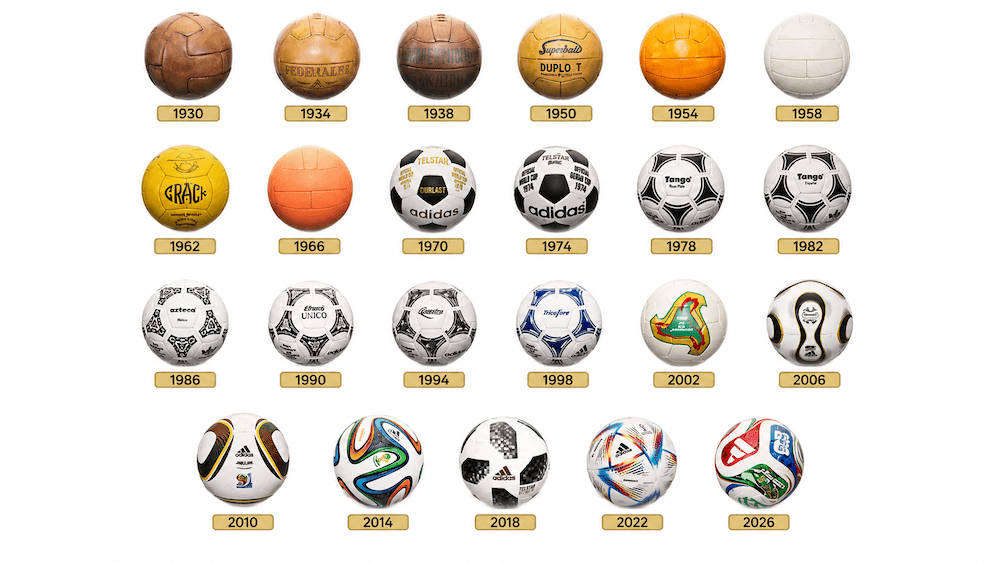
The Forbes source frames the Trionda Final as the end of a century of innovation, from handcrafted leather to smart sensors. That framing is accurate but undersells the gradualism. The 1970 Telstar introduced the black-and-white panel pattern for TV visibility. Synthetic materials replaced leather in the 1980s. Thermal bonding eliminated stitched seams in the 2000s. The Al Rihla dropped to 14 panels for better aerodynamics. Each change was incremental. The smart sensor is the latest step, not a leap.
For product teams, this is the lesson. Large-scale deployments do not happen in one release. They accumulate over decades of small improvements, each solving one constraint. The World Cup ball in 2030 will probably have better battery life, tighter calibration, and more sensor modalities. It will not be a fundamentally different object.
Logicity's Take
The Trionda Final matters less for sports and more for what it proves about edge ML readiness. If you can run reliable inference inside a ball being kicked at 120 km/h, you can run it on most industrial hardware. Teams building wearables, drones, or IoT devices should study FIFA's engineering choices. The constraints are similar: low power, high vibration, tight latency. The difference is that FIFA's bugs get replayed in slow motion for a global audience.
What this means for AI product teams
If you are building real-time systems, the World Cup offers a benchmark. Can your hardware survive physical abuse? Can your latency stay under the decision threshold? Can your system degrade gracefully when one sensor fails? These are the questions FIFA's suppliers have been answering since 2022.
The ball also shows how automation enters regulated domains. FIFA did not hand decisions to the system. It gave the system a role in evidence collection while keeping human referees in the loop. That hybrid model is what most enterprises will deploy for the next decade. Full autonomy is rarely the first step.
Frequently Asked Questions
What sensors are inside the World Cup 2026 ball?
The Trionda Final contains an inertial measurement unit that tracks acceleration, rotation, and contact events. It transmits data wirelessly to stadium receivers for use in VAR decisions.
How does the connected ball help with offside calls?
The sensor detects the exact moment the ball leaves a player's foot. Combined with player-tracking cameras, this allows semi-automated offside detection by pinpointing the frame of the pass.
Is the ball fully automated for officiating?
No. The system provides evidence to human referees, who make the final call. FIFA uses a human-in-the-loop model, not full automation.
How does the sensor survive being kicked?
The sensor unit is ruggedized for shock, vibration, and temperature variation. Adidas has iterated on durability since the Al Rihla in 2022.
Another look at how AI inference is moving to edge devices and what product teams should prioritize.
Need Help Implementing This?
If you're building edge ML systems and want to stress-test your hardware assumptions, reach out to Logicity's consulting partners. We connect AI teams with engineers who have deployed in high-vibration, low-latency environments.
Source: Forbes Middle East / Forbes Middle East
Huma Shazia
Senior AI & Tech Writer
Produced with AI assistance and reviewed by the Logicity editorial team. Learn more in our Editorial Policy.