Key Takeaways
- AI has become infrastructure for work, education, science, and government. Dependency on closed APIs creates existential risk.
- The Human Rights Foundation granted $100,000 to support open source AI development as a hedge against corporate power concentration.
- Open source AI allows local deployment without exposure to shifting terms, opaque moderation, or sudden model unavailability.
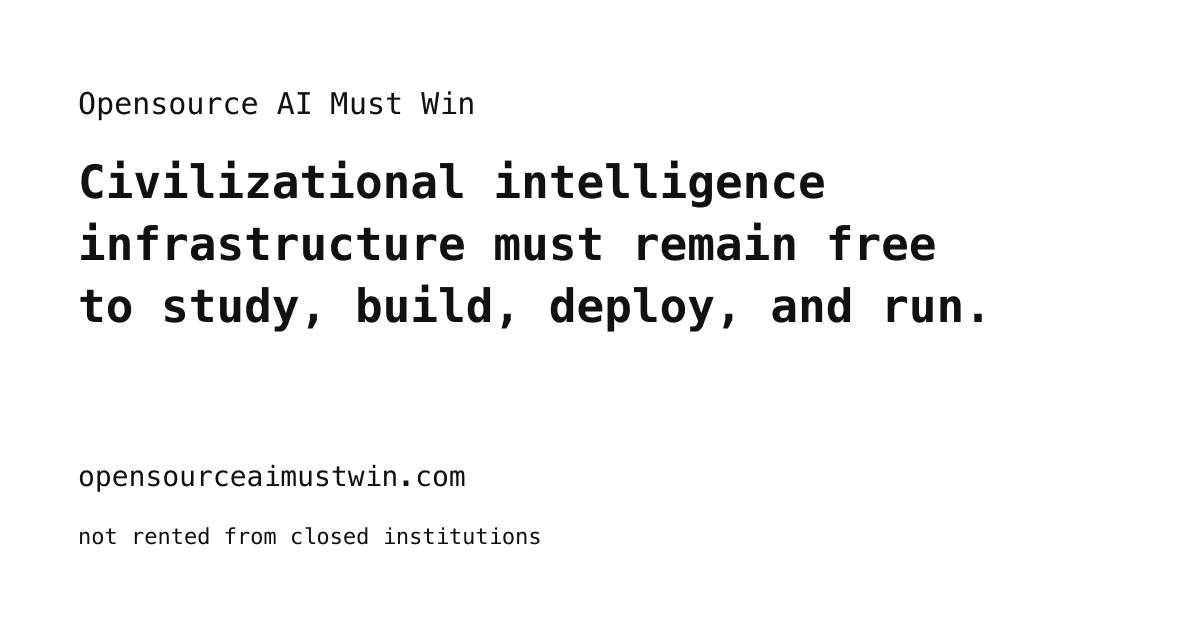
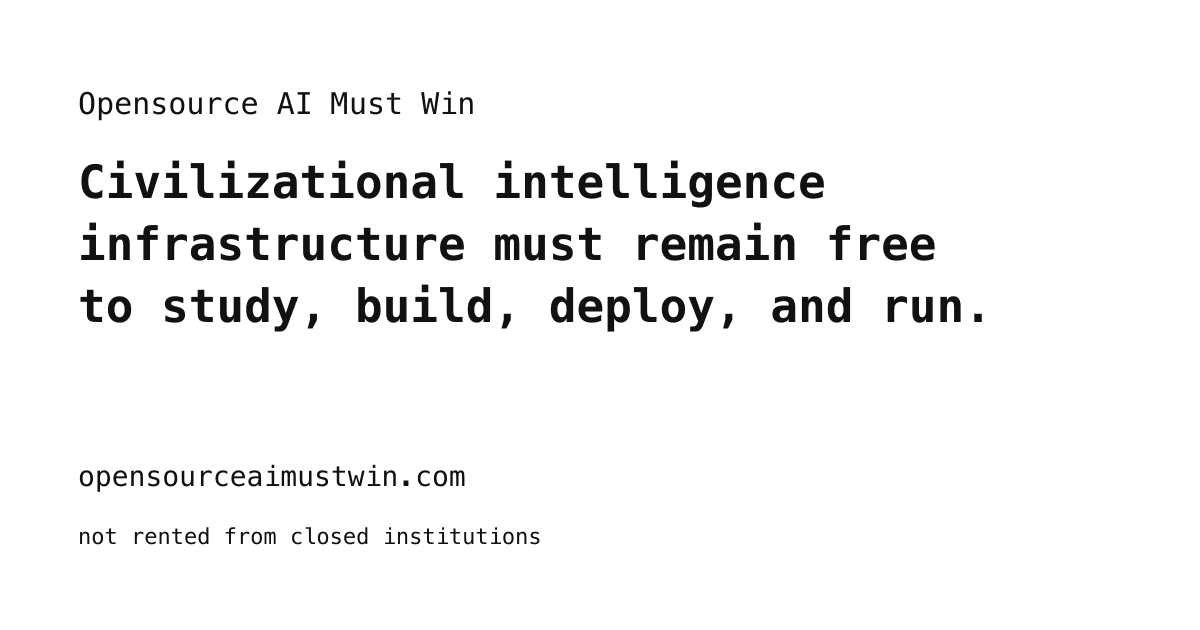
A manifesto titled 'Open Source AI Must Win' is circulating through tech communities this week. It makes a simple argument: artificial intelligence has become too important to rent from corporations.
The document, written by Ahmad Osman, frames AI as 'civilizational infrastructure' on par with electricity or the internet. Work, education, science, creativity, public services, and national capacity now depend on it. The question is who controls that infrastructure.
“If intelligence becomes something people can only rent from a few closed institutions, the public does not just lose software freedom. It loses operational freedom.”
— Open Source AI Must Win Manifesto
The Subscription Economy for Cognition
The manifesto's core concern is dependency. When a handful of frontier labs and cloud platforms control the models, users lose the ability to study, build, repair, deploy, audit, adapt, teach, preserve, and run intelligence systems without asking permission.
This creates what the document calls a 'subscription economy for cognition.' Your ability to use AI depends on API availability, pricing decisions made in boardrooms, shifting terms of service, and moderation policies you cannot see or challenge.
The timing matters. Hacker News discussions around the manifesto reflect anxiety about recent government-mandated suspensions of popular frontier models. Users are asking: what happens when the API you built your business on disappears?
What Open Source AI Means Here
The manifesto sets a specific standard for what counts as genuinely open source AI. Models must be:
- Usable without permission from any company
- Understandable, with published architectures and training details
- Reproducible by independent researchers
- Locally deployable on your own hardware
- Economically viable to run
- Community-governed rather than corporate-controlled
This is a higher bar than 'open weights,' where a company releases model parameters but not training data, code, or the ability to modify and redistribute. The manifesto explicitly calls out that open-weight model providers could also 'change direction or disappear.'
The National Security Frame
The document takes a deliberately American framing: 'America should not fall behind on the freedom to run, inspect, modify, benchmark, teach, and preserve intelligence infrastructure.'
This positions open source AI as a matter of national capacity, not just developer freedom. The practical posture, it argues, is 'American capacity with global open standards.' The U.S. should maintain the ability to run its own AI infrastructure while contributing to international open frameworks.
The Human Rights Foundation has put money behind similar reasoning. The organization granted $100,000 to support open source AI development specifically to prevent closed-lab power concentration.
The Practical Case for Local AI
Beyond philosophy, there are operational reasons to care about local AI deployment. Closed APIs introduce several failure modes:
- Service outages can halt your operations
- Pricing changes can destroy your unit economics overnight
- Terms of service can prohibit use cases you depend on
- Model updates can break workflows without warning
- Data sent to APIs leaves your control
- Regulatory changes in one jurisdiction can affect global availability
Local, open source models eliminate these dependencies. You control the hardware, the model, and the data. No API call required, no terms to accept, no vendor to trust.
The tradeoff is capability. Frontier closed models still outperform open alternatives on many benchmarks. But the gap is narrowing, and for many production use cases, an 80% capable model you control beats a 100% capable model that might disappear.
What Happens If Closed Labs Win
The manifesto's worst-case scenario: AI becomes like mobile telecom in the early 2000s. A few gatekeepers control access. Innovation happens only where they permit. Pricing reflects monopoly power. Users have no recourse.
Applied to cognition, this means the ability to build software, analyze data, generate content, automate work, and access knowledge would all flow through corporate chokepoints. Education systems would depend on API access. Government services would require vendor relationships.
“The ability to study, build, repair, deploy, audit, adapt, teach, preserve, and run intelligence systems without asking permission is of existential importance.”
— Open Source AI Must Win Manifesto
Logicity's Take
Where This Goes Next
The manifesto is a call to action, not a detailed policy proposal. It invites supporters to reach out directly. But the underlying movement is already building.
Projects like Llama, Mistral, and dozens of smaller efforts are producing increasingly capable open models. Hardware costs for local inference continue to drop. Tooling for deployment is maturing. The technical foundation exists.
The question is whether open source AI can maintain relevance as frontier capabilities advance. If the next generation of models requires hundreds of billions in compute to train, only a few organizations will be able to produce them. Open source would depend on those organizations choosing to release their work.
That's the bet the manifesto is making: that the value of open AI is high enough that the community, foundations, and governments will fund its development. The Human Rights Foundation grant suggests some are already convinced.
India's government-backed open AI initiative shows how nations are pursuing AI sovereignty.
Open source alternatives succeeding against closed defaults, in a different domain.
Frequently Asked Questions
What is the 'Open Source AI Must Win' manifesto?
A document by Ahmad Osman arguing that AI has become civilizational infrastructure too important to depend on closed corporate APIs. It calls for AI that is locally deployable, community-governed, and free from vendor lock-in.
Why does the manifesto frame open source AI as a national security issue?
Because AI now underpins work, education, science, and government services. If a few foreign or domestic companies control access, they control critical infrastructure. The manifesto argues America should maintain independent AI capability.
What's the difference between open source AI and open weights?
Open weights means a company releases model parameters but may not share training data, code, or modification rights. True open source AI, as defined in the manifesto, must be reproducible, modifiable, and community-governed.
Can open source AI models compete with closed frontier models?
Not on all benchmarks, but the gap is narrowing. For many production use cases, an open model you control outperforms a closed model that could disappear, change pricing, or prohibit your use case.
Who is funding open source AI development?
Various organizations including the Human Rights Foundation, which granted $100,000 specifically to prevent power concentration in closed AI labs. Tech companies like Meta also release open models.
Need Help Implementing This?
Source: Hacker News: Best / Ahmad Osman
Manaal Khan
Tech & Innovation Writer
Produced with AI assistance and reviewed by the Logicity editorial team. Learn more in our Editorial Policy.