Key Takeaways
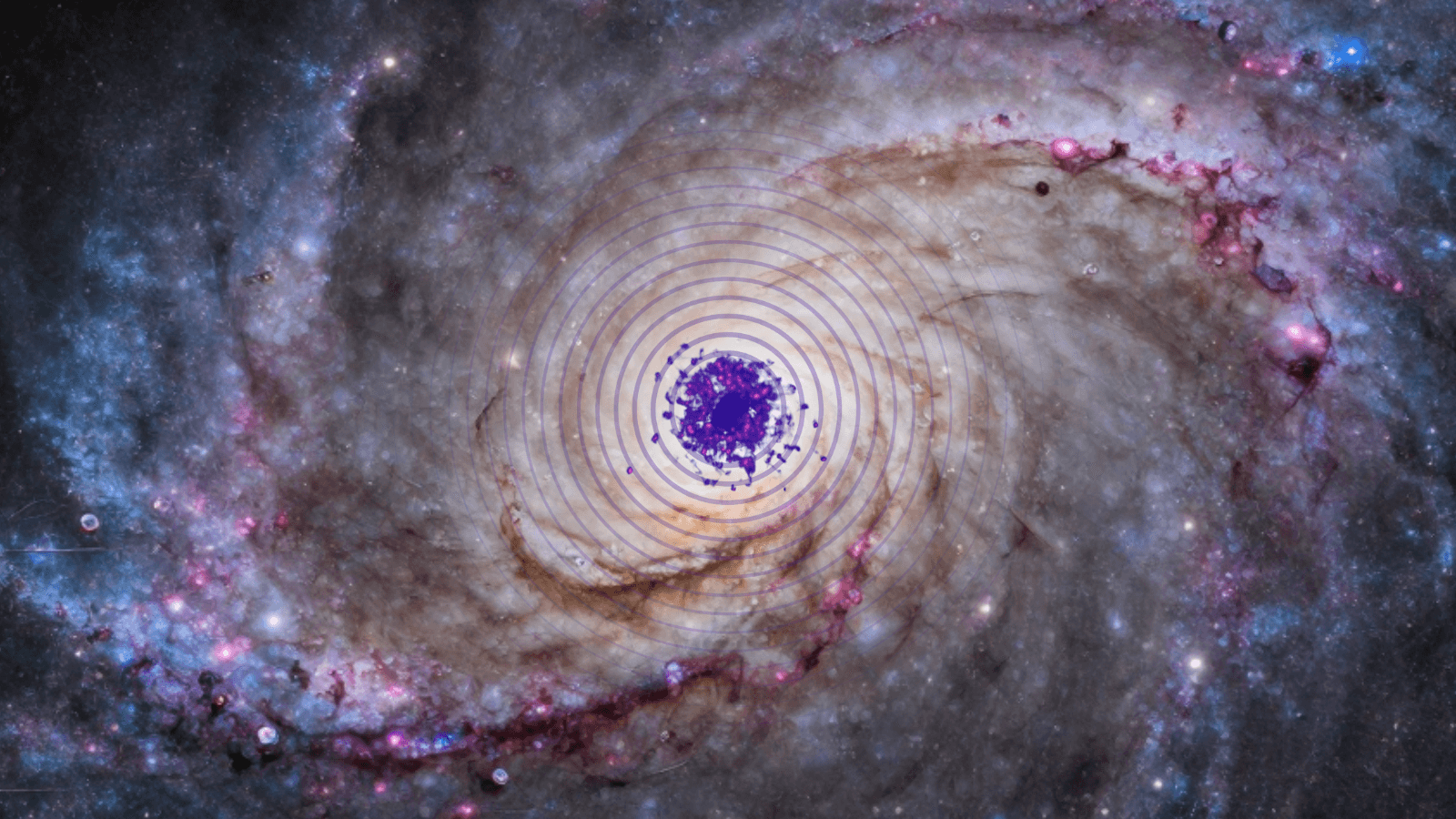
- Standard dark matter theory assumes particles pass through each other without interacting, but this fails to explain several observed phenomena
- Self-interacting dark matter could create dense clumps that explain gravitational lensing anomalies, star stream disruptions, and unusual cluster formation
- The same mechanism works across three completely different cosmic settings, from distant galaxies to our own Milky Way neighborhood
One Theory, Three Mysteries
Dark matter makes up about 85% of all matter in the universe. It outweighs the stuff we can see, touch, and measure by a ratio of roughly five to one. Yet we know almost nothing about what it actually is.
The standard model of cosmology, called lambda cold dark matter (LCDM), treats dark matter as "cold." Its particles move slowly and pass through each other like ghosts. They never collide, never clump together on their own, never interact with anything except through gravity.
That model has worked well for explaining the universe at large scales. But it keeps running into problems when astronomers look at specific cosmic structures. New research from the University of California, Riverside suggests a simple fix: what if dark matter particles do interact with each other?
“What's striking is that the same mechanism works in three completely different settings — across the distant universe, within our galaxy, and in a neighboring satellite galaxy. All show densities that are difficult to reconcile with standard model dark matter but arise naturally in self-interacting dark matter.”
— Hai-Bo Yu, University of California, Riverside
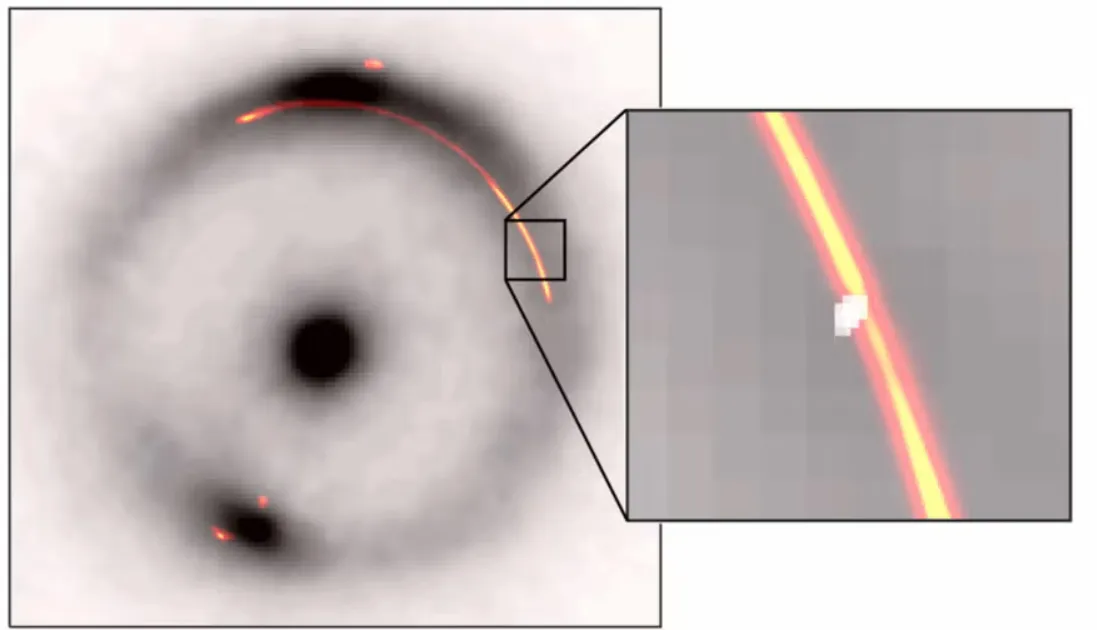
Mystery 1: The Ultradense Clump in JVAS B1938+666
The first puzzle involves a distant system called JVAS B1938+666. When astronomers observe this system, they see gravitational lensing, a phenomenon predicted by Einstein's general relativity where massive objects bend light around them.
The problem? There is an ultradense clump of matter in this system that the standard dark matter model cannot explain. Cold dark matter should spread out more evenly. It should not form such concentrated blobs.
Self-interacting dark matter, however, could create exactly this kind of dense structure. When dark matter particles collide and transfer energy, they can lose velocity and fall toward gravitational centers, piling up into denser regions than the standard model allows.
Mystery 2: The Scar in the GD-1 Star Stream
The second mystery sits much closer to home. GD-1 is a stream of stars within our own Milky Way galaxy. Stars in a stream like this should flow smoothly, pulled along by the galaxy's gravity in a relatively orderly fashion.
But GD-1 has a visible "scar." Something dense and invisible ripped through the star stream, disrupting its flow. The standard dark matter model has trouble explaining what could have caused this. Cold dark matter does not form the kind of compact, massive object needed to create such a wound.
Self-interacting dark matter could. If dark matter particles collide and cluster together, they could form dense subhalos, invisible objects massive enough to punch through a star stream and leave exactly the kind of scar astronomers observe in GD-1.
Mystery 3: The Strange Formation of Fornax 6
The third puzzle involves Fornax 6, an unusual star cluster in the Fornax dwarf galaxy, which orbits our Milky Way. Star clusters normally form when gas clouds collapse and ignite into new stars. Fornax 6 seems to have formed differently.
The evidence suggests a dense patch of dark matter acted as a gravitational trap, capturing passing stars and holding them together as a cluster. This is not something cold dark matter can easily do. Its diffuse, non-interacting nature makes such concentrated gravitational traps unlikely.
But self-interacting dark matter, which can collapse into denser structures through particle collisions, could create exactly the kind of gravitational well needed to form a cluster like Fornax 6.
Why This Matters for Dark Matter Research
The LCDM model remains the dominant framework for understanding cosmic evolution. It explains the large-scale structure of the universe, the cosmic microwave background radiation, and the distribution of galaxies across billions of light-years.
But scientists have known for years that LCDM struggles at smaller scales. Galaxy cores are denser than the model predicts. Satellite galaxies are fewer than expected. And now these three additional anomalies add to the pile of small-scale problems.
Self-interacting dark matter is not a new idea. Physicists have proposed it before. What makes this research notable is that a single version of the theory, with consistent parameters, could explain three unrelated observations across vastly different cosmic environments.
Dark matter that only interacts through gravity is the simplest assumption. But the universe is not obligated to be simple. If dark matter particles have some ability to collide, scatter, and exchange energy with each other, the math changes. Dense structures become possible. The three mysteries start to make sense.
Logicity's Take
What Comes Next
The researchers, including Hai-Bo Yu and collaborators at the Center for Experimental Cosmology and Instrumentation, are calling for more observations of gravitationally lensed systems, star streams, and dwarf galaxy structures. Each new data point either supports or challenges the self-interaction hypothesis.
Future telescopes and surveys will provide exactly this kind of data. The James Webb Space Telescope, the Vera Rubin Observatory, and next-generation gravitational wave detectors will all contribute to our understanding of dark matter's behavior at scales where the LCDM model struggles.
For now, self-interacting dark matter remains one of several competing ideas. But its ability to address three distinct puzzles with a single mechanism makes it a theory worth watching.
Frequently Asked Questions
What is self-interacting dark matter?
Self-interacting dark matter is a theoretical type of dark matter whose particles can collide and exchange energy with each other, unlike the standard model which assumes dark matter particles pass through each other without interacting.
Why does standard dark matter theory have problems?
The standard lambda cold dark matter model works well at large cosmic scales but struggles to explain certain small-scale observations, including unusually dense matter clumps, disrupted star streams, and anomalous cluster formations.
What are the three cosmic mysteries this theory could explain?
The theory could explain an ultradense matter clump in the JVAS B1938+666 system, a visible scar in the GD-1 star stream, and the unusual formation of the Fornax 6 star cluster in a satellite galaxy of the Milky Way.
Has self-interacting dark matter been proven?
No. This research shows that self-interacting dark matter could explain multiple observations, but it has not been directly detected or proven. More observations and experiments are needed to confirm or rule out the hypothesis.
How much of the universe is dark matter?
Dark matter accounts for approximately 85% of all matter in the universe, outweighing ordinary matter like stars, planets, and everything we can see by a ratio of about five to one.
Need Help Implementing This?
Source: Latest from Space.com
Manaal Khan
Tech & Innovation Writer
Produced with AI assistance and reviewed by the Logicity editorial team. Learn more in our Editorial Policy.