Key Takeaways
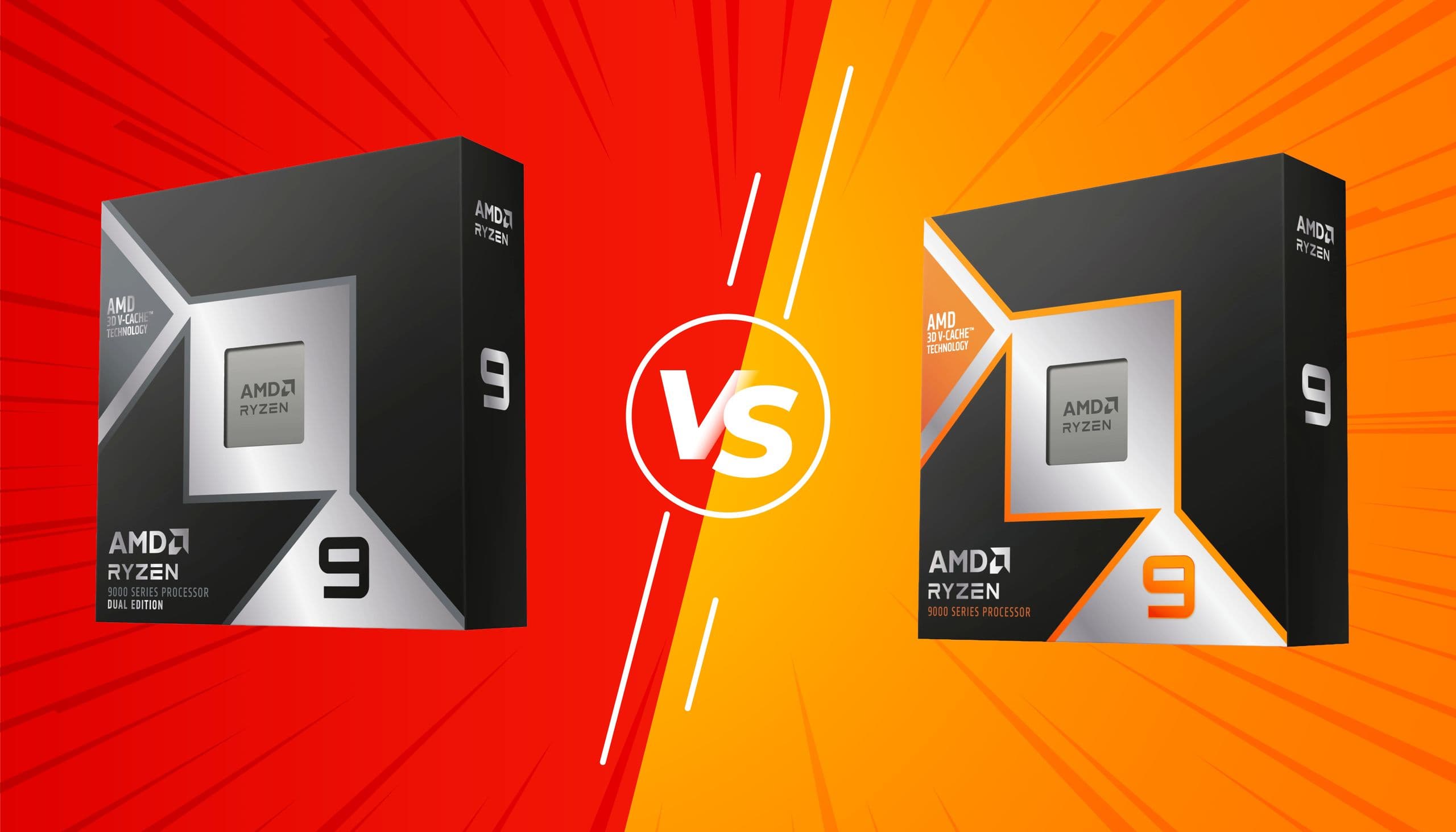
- The 9950X3D2 has 192MB of L3 cache spread across both CCDs, compared to 144MB on the standard 9950X3D
- At $900, the Dual Edition costs $200-300 more than the vanilla 9950X3D and is AMD's most expensive consumer CPU
- Higher TDP (200W vs 170W) and PPT (270W vs 230W) mean increased power and cooling demands
AMD's Ryzen 9 9950X3D2 represents a simple but expensive proposition: what if we put 3D V-Cache on both CCDs instead of just one? The result is a $900 processor with 192MB of total L3 cache. That's AMD's most expensive consumer chip ever, sitting in an awkward gap between mainstream parts and Threadripper workstation CPUs.
The standard Ryzen 9 9950X3D already topped AMD's Zen 5 lineup with its single-CCD cache stacking. Now the Dual Edition arrives with a $200-300 premium and promises to push gaming and creative workloads even further. But does doubling the cache math work out to doubling the value?
Specifications: What You Get for the Extra Money
| Specification | Ryzen 9 9950X3D2 | Ryzen 9 9950X3D |
|---|---|---|
| Price | $900 | $640-700 |
| Architecture | Zen 5 X3D (4nm) | Zen 5 X3D (4nm) |
| Cores / Threads | 16 / 32 | 16 / 32 |
| Base / Boost Clock | 4.3 / 5.6 GHz | 4.3 / 5.7 GHz |
| Total L3 Cache | 192MB (96MB per CCD) | 144MB (128MB + 16MB) |
| TDP / PPT | 200W / 270W | 170W / 230W |
| Memory Support | DDR5-5600 | DDR5-5600 |
Both processors share the same Zen 5 architecture built on TSMC's 4nm process. They have identical core and thread counts. They support the same DDR5-5600 memory speeds and provide 24 PCIe Gen 5 lanes on the AM5 socket. Both include integrated Radeon graphics.
The differences come down to cache layout and power. The 9950X3D2 stacks 3D V-Cache on both CCDs, giving each chiplet 96MB of L3 cache. The standard 9950X3D has the stacked cache on only one CCD, resulting in an asymmetric configuration: 128MB on one side, just 16MB on the other.
The Boost Clock Trade-Off
There's a small penalty for all that extra cache. The 9950X3D2 maxes out at 5.6 GHz, while the vanilla 9950X3D can hit 5.7 GHz. That 100 MHz difference matters in workloads that don't benefit from the extra cache but do scale with frequency.
This is the eternal 3D V-Cache trade-off. Stacking extra silicon on top of the cores adds thermal insulation. Heat escapes more slowly. AMD compensates by slightly reducing maximum clocks to keep temperatures manageable.
Power and Cooling Demands
The Dual Edition draws more power. Its TDP sits at 200W versus 170W for the standard model. Peak package power (PPT) hits 270W compared to 230W. That's a 17% increase in sustained power and 17% higher peak draw.
These numbers have real-world implications for cooling. A 360mm AIO that handles the 9950X3D comfortably might run hotter with the 9950X3D2. Anyone building around this chip needs to budget for premium cooling.
Logicity's Take
Who Is This Actually For?
AMD positions the 9950X3D2 for creative professionals. The company knows that gamers don't need 192MB of L3 cache. Most games run primarily on a single CCD anyway. The extra cache on the second chiplet sits idle during typical gaming sessions.
Productivity workloads tell a different story. Video editing, 3D rendering, and scientific computing can spread work across all 16 cores. These applications benefit from cache on both CCDs because threads on either chiplet can access fast local memory.
The ideal buyer is someone who renders video or 3D models during the day, then games at night. They want top-tier performance in both scenarios and refuse to choose between a creative workstation and a gaming rig. That's a narrow demographic, but it exists.
The Price Problem
At $900, the 9950X3D2 occupies awkward territory. It costs far more than any mainstream Intel or AMD processor. But it's not expensive enough to compete with Threadripper workstation chips that offer more cores and PCIe lanes for professional use.
The standard 9950X3D sells for $640-700 depending on retailer. That's $200-260 less for a chip that matches the Dual Edition in core count, thread count, and general architecture. The only thing you give up is symmetric cache distribution.
✅ Pros
- • 192MB of total L3 cache, highest in any consumer CPU
- • Symmetric cache across both CCDs benefits multi-threaded workloads
- • Top-tier gaming performance matches or beats all alternatives
- • Same AM5 socket as standard Ryzen 9000 chips
❌ Cons
- • $300 premium over already-expensive 9950X3D
- • Higher power draw requires premium cooling
- • 100 MHz lower boost clock than standard model
- • Gaming gains often minimal since most titles use one CCD
Should You Upgrade?
If you already own a 9950X3D, the answer is almost certainly no. The Dual Edition offers incremental gains in specific scenarios. Unless your workflow specifically bottlenecks on second-CCD cache access, you won't notice the difference.
If you're building new and have the budget, the calculus changes slightly. The 9950X3D2 is objectively the fastest consumer CPU AMD makes. It tops benchmark hierarchies for both gaming and productivity. Some buyers will pay for that status.
For most users, the standard 9950X3D offers better value. It delivers nearly identical gaming performance at a $200-300 discount. The saved money could fund a better GPU, more RAM, or faster storage. Those upgrades might deliver more noticeable performance gains than the extra cache.
Frequently Asked Questions
How much cache does the Ryzen 9 9950X3D2 have?
The 9950X3D2 has 192MB of total L3 cache, split evenly between two CCDs at 96MB each. This includes the 3D V-Cache stacked on both chiplets.
Is the Ryzen 9 9950X3D2 good for gaming?
Yes, it's among the fastest gaming CPUs available. However, most games don't benefit from the dual cache configuration since they typically run on a single CCD. The standard 9950X3D offers similar gaming performance for less money.
What cooling does the Ryzen 9 9950X3D2 need?
With a 200W TDP and 270W PPT, the 9950X3D2 requires robust cooling. A high-quality 360mm AIO or premium air cooler is recommended.
What is the price difference between 9950X3D2 and 9950X3D?
The 9950X3D2 costs $900 while the standard 9950X3D sells for $640-700, making the Dual Edition $200-300 more expensive.
Need Help Implementing This?
Source: Latest from Tom's Hardware
Manaal Khan
Tech & Innovation Writer
Produced with AI assistance and reviewed by the Logicity editorial team. Learn more in our Editorial Policy.