Key Takeaways
- Vector quantization in PostgreSQL can speed up similarity searches by 4x
- HNSW indexing enables high-recall vector search without switching databases
- PostgreSQL's multi-modal capabilities let teams combine vectors, JSON, and relational data in one system
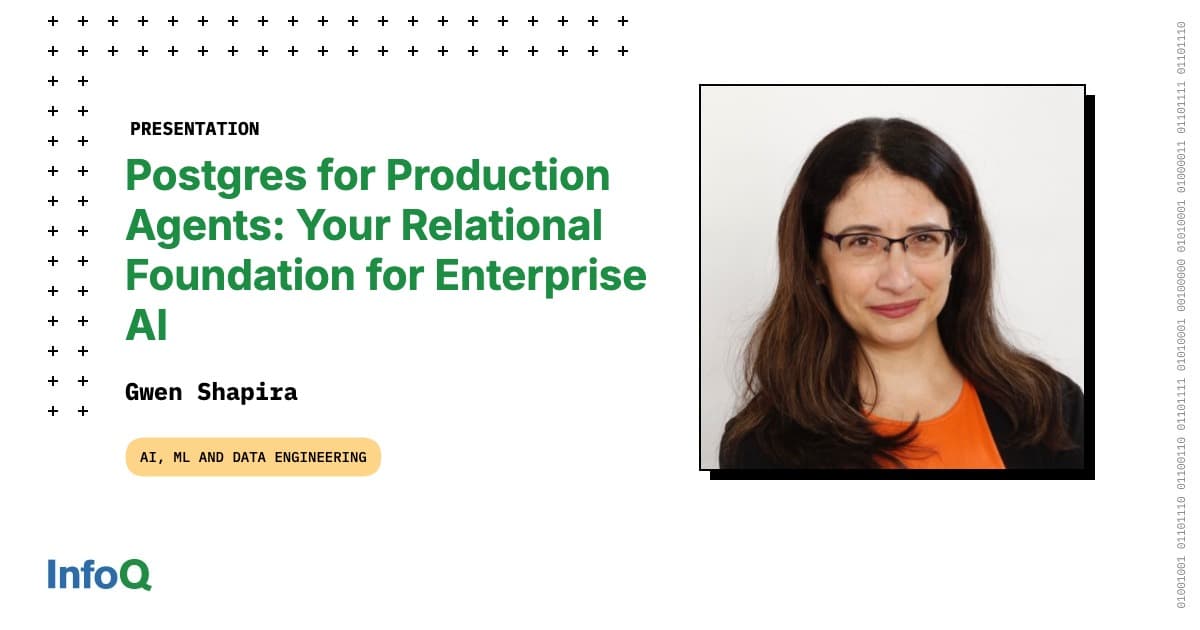
PostgreSQL can run production AI agent workloads without bolting on a separate vector database. That's the core argument Gwen Shapira, co-founder of Nile and Apache Kafka committer, made at QCon AI. Her presentation laid out how teams are using Postgres's native capabilities, including HNSW vector indexing, JSONB parsing, and vector quantization, to deliver both deterministic and semantic context to LLMs at scale.
The talk comes at a moment when enterprise teams face a sprawling tooling problem. AI agents need context. That context lives in vectors, JSON documents, and relational tables. The default approach has been to run three databases. Shapira's point: Postgres already handles all three.
Why agent context is an infrastructure problem
AI agents don't just call an LLM and return a response. They need memory. They retrieve documents. They track conversation state. They enforce business rules. Each of these requirements touches a different data type.
Vector search handles semantic similarity, finding the three documents most relevant to a user's question. JSONB stores unstructured metadata and agent configurations. Relational tables enforce referential integrity for things like user permissions and audit logs. Running separate systems for each creates latency, consistency headaches, and operational overhead.
Shapira frames this as an infrastructure problem, not an AI problem. The LLM is a black box. What you control is what goes into it. Getting context retrieval wrong means the model hallucinates or misses critical information. Getting it right means deterministic, reliable outputs.
HNSW indexing for high-recall vector search
The pgvector extension adds vector similarity search to PostgreSQL. The key feature Shapira highlights is HNSW (Hierarchical Navigable Small World) indexing. HNSW builds a graph structure that enables approximate nearest neighbor search with recall rates typically above 95%.
This matters because exact nearest neighbor search scales poorly. With millions of embeddings, brute-force comparison becomes impractical. HNSW trades a small amount of recall for dramatic speed improvements. You can tune the tradeoff by adjusting the index parameters.
For teams already running Postgres, adding pgvector means no new infrastructure. The vectors live in the same database as the application data. Joins work. Transactions work. Backups work. This is the unsexy but critical advantage of staying inside a single system.
Vector quantization delivers 4x query speedup
Shapira detailed how vector quantization can accelerate similarity queries by 4x. The technique compresses high-dimensional vectors into smaller representations, reducing memory footprint and speeding up distance calculations.
The tradeoff is precision. Quantized vectors introduce approximation errors. But for most retrieval-augmented generation (RAG) use cases, the precision loss is acceptable. You're fetching the top 5 or 10 documents, not computing exact distances. A small recall drop is worth a 4x latency improvement when you're serving thousands of agent requests per minute.
Managing agentic memory at scale
AI agents accumulate state. Conversation history, tool call results, intermediate reasoning steps. This memory must persist across requests and, in many cases, across sessions. Shapira discussed strategies for structuring this memory in Postgres.
The relational model helps here. Memory entries can reference users, sessions, and agent configurations through foreign keys. Queries can filter by recency, relevance, or business rules. You can enforce that an agent only sees data it's authorized to access, a hard requirement in enterprise settings.
JSONB handles the unstructured parts. Tool outputs vary in shape. LLM responses contain nested objects. Storing these as JSONB columns lets you query them with Postgres's JSON operators while avoiding rigid schema migrations every time your agent's behavior changes.
The broader shift toward consolidated data layers
Shapira's argument fits a broader trend. The early AI infrastructure stack was maximally distributed: a vector database here, a document store there, a graph database for knowledge representation. Teams are now consolidating.
The reasons are operational. Distributed systems fail in distributed ways. When your agent returns garbage, you need to debug across three databases. When your backups diverge, you have inconsistent state. When your latency spikes, you're tracing across multiple network hops. Fewer moving parts means fewer failure modes.
Postgres isn't the only path. MongoDB added vector search. DuckDB has extensions for embeddings. But Postgres has the largest ecosystem, the deepest enterprise adoption, and the most mature operational tooling. For teams already running it, the incremental cost of adding AI capabilities is low.
Logicity's Take
This presentation reflects a maturing AI infrastructure market. The 2023 approach, spin up Pinecone for vectors, Redis for caching, Postgres for relational data, is giving way to consolidation. Postgres's extensibility (pgvector, pg_embedding, timescaledb) lets it absorb workloads that previously required specialized systems. For engineering managers evaluating vector databases like Pinecone (starts at $70/month), Weaviate, or Milvus, the question is whether the specialization justifies the operational overhead. For many enterprise workloads, especially those already on Postgres, it doesn't.
Frequently Asked Questions
Can PostgreSQL handle vector search at scale?
Yes. With pgvector and HNSW indexing, PostgreSQL supports approximate nearest neighbor search with high recall rates, suitable for millions of embeddings. Vector quantization further improves performance.
What is HNSW indexing in PostgreSQL?
HNSW (Hierarchical Navigable Small World) is a graph-based index structure that enables fast approximate nearest neighbor search. It trades a small recall loss for significant speed improvements over brute-force comparison.
How does PostgreSQL compare to dedicated vector databases?
Dedicated vector databases like Pinecone offer optimized performance and managed infrastructure. PostgreSQL offers consolidation benefits, keeping vectors, JSON, and relational data in one system with familiar operational tooling.
What is vector quantization in AI workloads?
Vector quantization compresses high-dimensional embeddings into smaller representations, reducing memory usage and speeding up similarity calculations at the cost of some precision.
How do AI agents use relational databases for memory?
Agents store conversation history, tool outputs, and reasoning steps in relational tables. Foreign keys enforce access controls. JSONB columns handle unstructured data without rigid schemas.
Need Help Implementing This?
If you're evaluating PostgreSQL for AI agent workloads or need help architecting your retrieval layer, reach out to our team at Logicity. We help engineering teams design data infrastructure that scales.
Source: InfoQ
Manaal Khan
Tech & Innovation Writer
Produced with AI assistance and reviewed by the Logicity editorial team. Learn more in our Editorial Policy.