Key Takeaways
- Musk commits to open-sourcing X's entire codebase with no exceptions after security review
- Third-party reviewers will verify the published code matches production systems
- The move follows regulatory pressure in Europe and controversies around Grok's algorithms
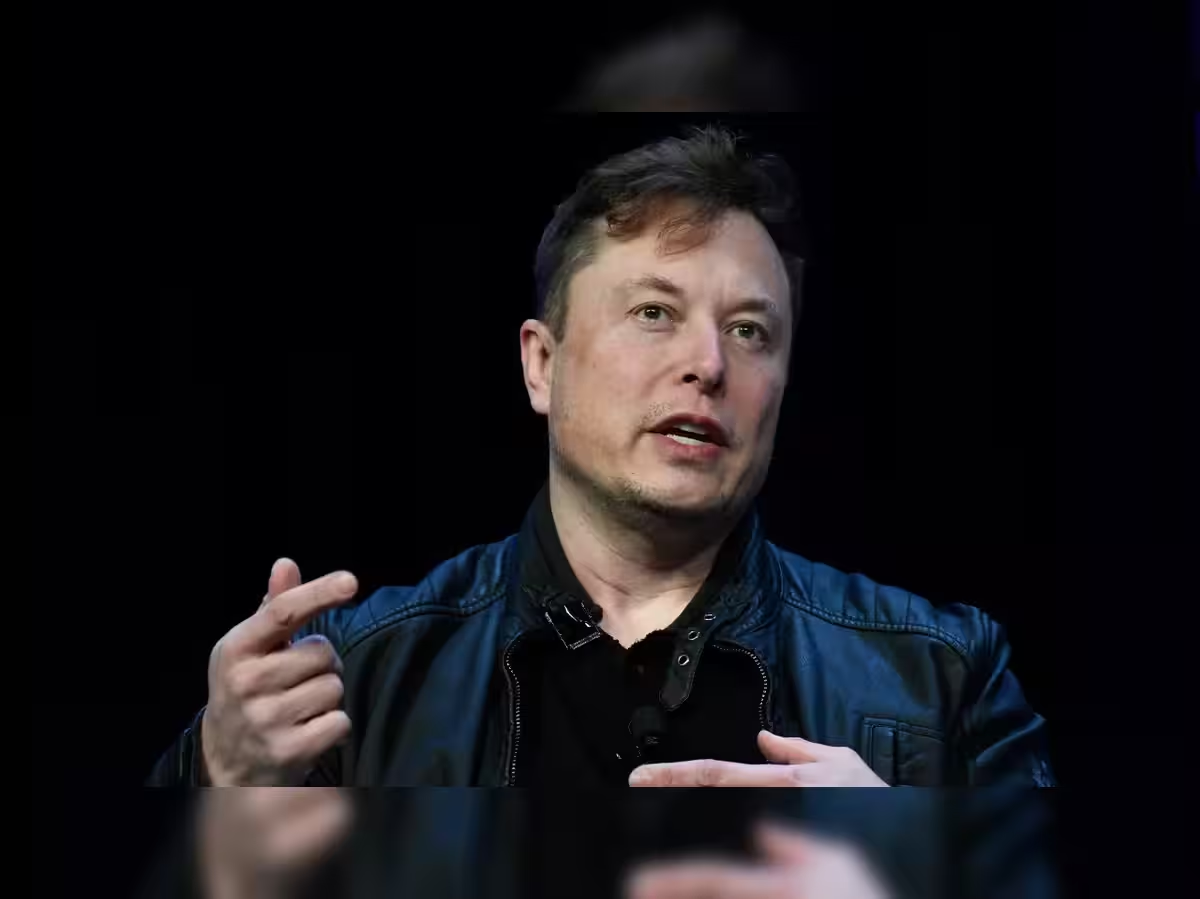
Elon Musk announced Wednesday that X will release its entire codebase as open source once the company finishes a security vulnerability review. The promise includes third-party verification that the published code matches what actually runs in production.
"Once we have completed our review for security vulnerabilities, we will make the entire codebase of X open source, with no exceptions," Musk wrote on X. "Moreover, we will invite third party reviewers to examine the system that is running to confirm that the open source code is what is running."
Musk added that trust through total transparency "is the only thing that should be believed." The statement came the same week xAI, Musk's AI company, open-sourced its Grok Build coding agent following data privacy controversies.
Why open-source a social media platform?
Companies open-source code for several reasons. Transparency tops the list, especially for systems handling sensitive functions like recommendation algorithms, data processing, and content moderation. Publishing the code lets regulators, researchers, and users verify claims about how the platform works.
Open-sourcing also invites outside contributions. External developers can submit bug fixes, performance improvements, or extensions the core team lacks bandwidth to build. Some companies do it to showcase engineering talent and keep internal coding standards sharp.
If X follows through, it becomes the first major social media platform to make its entire codebase publicly available with independent verification. Meta has released specific components, and Bluesky publishes its AT Protocol, but neither offers full transparency into production systems.
Regulatory pressure and the timing question
The announcement arrives at a charged moment. French prosecutors are investigating X's content algorithms for political bias. The EU has raised concerns about content moderation under the Digital Services Act, which requires large platforms to disclose how their systems work.
xAI's Grok chatbot, integrated into X, has faced scrutiny over its algorithms and how it surfaces information. Open-sourcing Grok Build addresses some of those concerns. "Open sourcing Grok Build allows anyone to support making a reliable and robust harness," xAI stated. "Check out our code, including the Git repo for the Grok Build CLI."
Strict regulations give Musk a compliance incentive. Getting ahead of disclosure requirements could reduce friction with European regulators.
What "open source" doesn't guarantee
Publishing code online does not automatically equal transparency. Previous open-source announcements from tech companies have resulted in partial releases, with proprietary components excluded. Machine learning models, training data, and certain infrastructure pieces often stay private.
Musk's "no exceptions" language is unusually strong. But the "after security review" caveat leaves flexibility on timeline and scope. No deadline was given. Security reviews can take months, and the definition of a "vulnerability" can stretch to cover sensitive business logic.
The third-party verification promise is more novel. If independent auditors confirm the published code matches production, that would address a common criticism: that companies publish sanitized versions while running different code in practice.
The scale of X's codebase
Twitter's codebase was previously estimated at around 335 million lines of code. Under Musk, the platform has undergone significant rewrites and staff cuts. The workforce dropped from roughly 7,500 to around 2,000 employees. How much of the original codebase remains intact is unclear.
Musk paid $44 billion for Twitter in October 2022. The platform claims over 500 million monthly active users. Making that infrastructure public would give competitors, security researchers, and regulators unprecedented visibility into how a major social network operates.
Precedent from Twitter's algorithm release
This is not Musk's first transparency move. In March 2023, X released portions of Twitter's recommendation algorithm on GitHub. That release showed how the platform prioritizes content, revealing factors like engagement metrics and network connections.
Researchers found the release useful but incomplete. Certain components were missing, and the code alone did not explain the training data or model weights behind machine learning decisions. The full codebase release would need to go further to satisfy critics.
Logicity's Take
Musk's promise is ambitious, but watch the execution. "No exceptions" and "third-party verification" are meaningful commitments if honored. The real test comes when the code ships. Companies from Meta to Google have selectively open-sourced components while protecting core systems. If X delivers full production code with independent audits, it sets a precedent that regulators may cite when pushing other platforms. If the release stalls or arrives with carve-outs, it becomes another example of announcement theater. For CTOs evaluating transparency claims from any vendor, the lesson applies broadly: verify that published code matches what runs in production, not just what marketing releases.
Frequently Asked Questions
When will X release its open-source codebase?
Musk did not provide a specific date. The release will happen after X completes a security vulnerability review, which has no stated deadline.
Will X's recommendation algorithm be included?
Musk said the release will have "no exceptions," which would include the recommendation algorithm. However, machine learning model weights and training data may be handled differently.
How will third-party verification work?
Independent reviewers will examine X's running systems to confirm the open-source code matches what is deployed in production, preventing sanitized releases.
Is X the first social media platform to go fully open source?
If completed as described, yes. Meta and Bluesky have released specific components, but neither has published full production codebases with independent verification.
Does this affect Grok or xAI?
Separately, xAI open-sourced its Grok Build coding agent. The Grok chatbot integrated into X may be covered under the broader X release, but xAI has not confirmed this.
Another major platform making strategic moves to capture developer and enterprise trust
Need Help Implementing This?
If you're navigating open-source strategy, algorithm transparency, or platform compliance for your organization, Logicity's team covers the tools and tactics that matter. Subscribe to our newsletter for weekly briefings on tech decisions that affect your stack.
Source: Tech-Economic Times / ET
Huma Shazia
Senior AI & Tech Writer
Produced with AI assistance and reviewed by the Logicity editorial team. Learn more in our Editorial Policy.




