Key Takeaways
- RPA excels at high-volume, repetitive tasks in legacy systems with clear rules
- Agentic AI handles complex workflows where conditions change and inputs are unstructured
- The two technologies can complement each other — RPA for stable processes, agentic AI for dynamic decision-making
RPA bots follow scripts. Agentic AI figures out what to do next. That distinction sounds simple, but it determines which automation approach will actually work for your operations team. A new breakdown from Zapier lays out when each makes sense, and why the answer is often both.
Disclosure
Some links in this post are affiliate links — Logicity earns a commission if you sign up, at no extra cost to you. We only link products we have used or actively recommend.
Robotic process automation has been around for years, handling the boring stuff: copying data between systems, filling forms, clicking through interfaces that lack APIs. It works well for tasks that happen the same way every time. But RPA breaks when the rules change mid-process or when data arrives in unexpected formats.
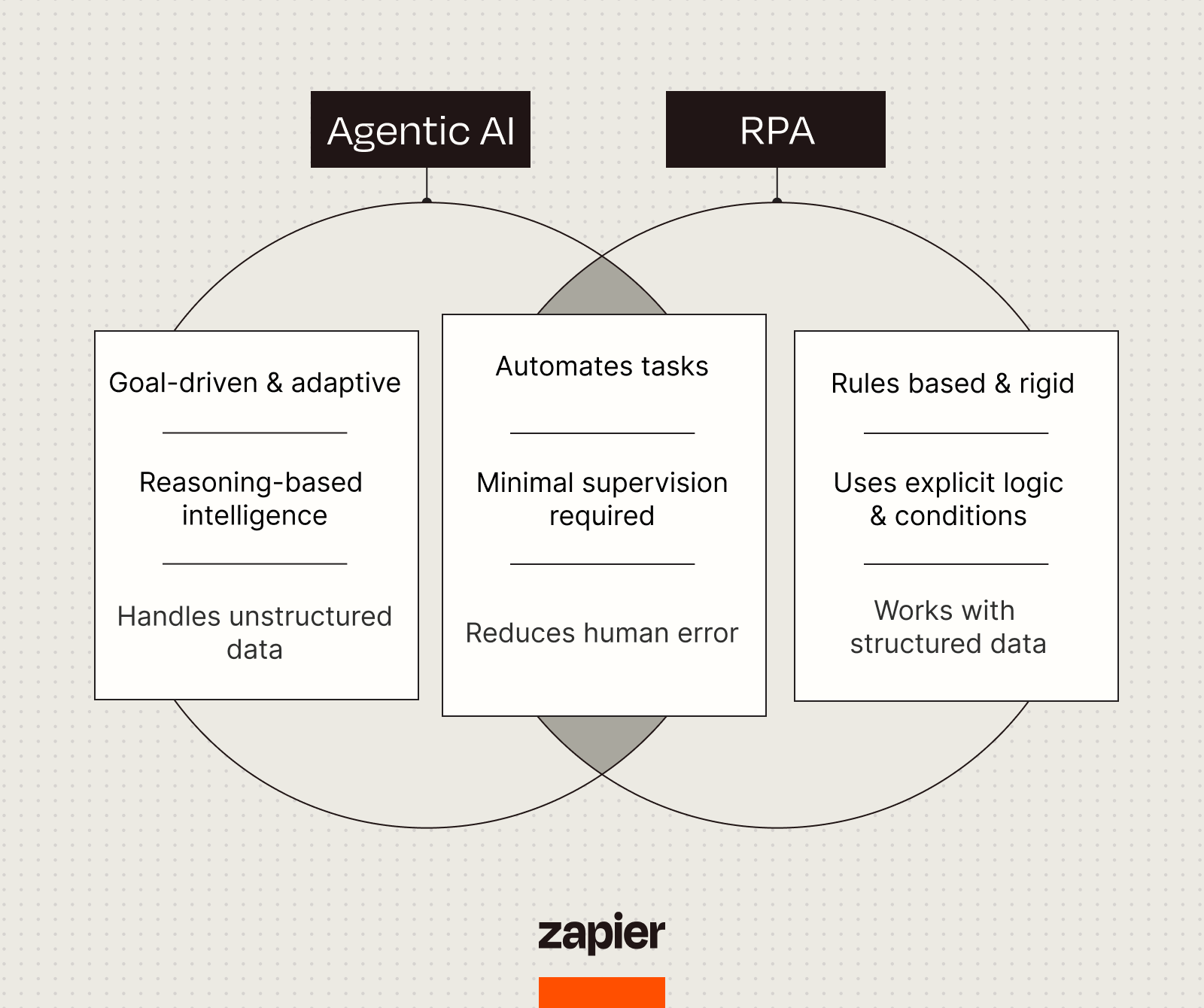
Agentic AI takes a different approach. Instead of executing a fixed script, it reasons toward a goal. It can pull context from multiple sources, decide which tools to use, and adjust when circumstances shift. Think of it as the difference between a macro and a junior analyst.
How RPA actually works
RPA bots mimic human interactions with software. They click buttons, copy text, move files. The logic is entirely predefined: if this field contains X, do Y. This makes RPA fast to deploy for stable, high-volume processes. Payroll entry, invoice processing, data migration from legacy ERP systems.
The tradeoff is rigidity. Change a button's location or update a form field, and the bot fails. RPA also struggles with unstructured data. An email written in natural language, a PDF with inconsistent formatting, a support ticket that requires judgment. RPA was never built for those.
How agentic AI differs
Agentic AI systems operate through a continuous loop: perceive, reason, act, learn. They gather information from APIs and databases, use large language models to plan their approach, execute through tools and agent protocols, then incorporate feedback.
The key distinction: agentic systems decide what actions to take. They're not just faster humans. They're systems that can handle ambiguity.
Zapier describes an AI agent as "the worker" and agentic AI as "the whole operation." One agent might draft a follow-up email. An agentic system coordinates multiple agents to research a prospect, identify next steps, write personalized outreach, and log everything to your CRM. Tools like Salesforce, HubSpot, or Pipedrive become data sources and action endpoints rather than manual interfaces.
Real examples from operations teams
ClickUp faced a concrete problem: 5,000 support tickets monthly, each requiring about 15 minutes of manual research before a rep could respond. They built an agent that pulls full ticket context from Zendesk, cross-references their internal knowledge base and past tickets, then classifies the issue and maps it to relevant documentation. By the time a rep opens the ticket, the research is done.
NisonCo took a similar approach for sales. Their agents analyze call recordings, extract action items, draft personalized follow-ups, and log everything back to their CRM. The system handles the coordination work that used to eat hours of rep time.
These aren't theoretical use cases. They're running today on Zapier's platform.
When to use each approach
The choice depends on what you're automating.
Use RPA when the process is stable, repetitive, and rule-based. Data entry across legacy systems without APIs. Moving files between folders on a schedule. Any task where the steps never change and the inputs are structured.
Use agentic AI when the workflow requires judgment, when inputs are unstructured, or when conditions change mid-process. Support triage, sales research, document analysis, multi-step workflows that span multiple tools.
Many teams will use both. RPA handles the predictable volume work. Agentic AI tackles the complex decision chains.
| Factor | RPA | Agentic AI |
|---|---|---|
| Best for | Stable, repetitive tasks | Complex, dynamic workflows |
| Handles unstructured data | Limited | Yes |
| Adapts to changes | No | Yes |
| Typical interface | GUIs, screen scraping | APIs, agent protocols |
| Setup complexity | Lower for simple tasks | Higher, but more flexible |
| Failure mode | Breaks on UI changes | May reason incorrectly |
The integration layer matters
Neither approach works in isolation. RPA needs stable interfaces to interact with. Agentic AI needs clean data sources and well-defined tool access.
This is where platforms like Zapier, Make, and n8n fit in. They provide the connective tissue: pre-built integrations, API management, orchestration logic. For agentic AI specifically, Zapier's MCP (Model Context Protocol) support lets agents interact with external tools through a standardized interface.
The direction is clear. Agentic AI isn't replacing RPA entirely. It's adding a reasoning layer on top of the automation stack.
Logicity's Take
For RevOps teams, the real question isn't agentic AI or RPA. It's which processes deserve which treatment. Start by auditing your current automation. How much time goes to exception handling when RPA bots fail? Those exception-heavy workflows are prime candidates for agentic approaches. Zapier's agent features start on their Professional plan ($29.99/month). UiPath's RPA platform runs significantly higher for enterprise deployments, often $10K+ annually. The cost math has shifted toward AI-native tools for complex workflows.
Frequently Asked Questions
Can agentic AI and RPA work together?
Yes. Many enterprises use RPA for stable, high-volume tasks while deploying agentic AI for workflows that require reasoning or handle unstructured inputs. The two technologies serve different automation needs.
What happens when an agentic AI system makes a mistake?
Agentic systems can reason incorrectly or choose wrong actions. Most enterprise deployments include human-in-the-loop checkpoints for high-stakes decisions. The systems are designed to ask for confirmation when confidence is low.
Is RPA becoming obsolete?
Not for its core use cases. RPA remains effective for repetitive, rules-based tasks in legacy systems. The limitation is that these stable, structured processes represent a shrinking portion of enterprise work.
What skills do teams need for agentic AI implementation?
Less coding than traditional software, more systems thinking. Teams need to define clear goals, select appropriate tools, and design feedback loops. Prompt engineering and workflow architecture matter more than traditional programming.
For teams evaluating automation platforms, understanding the data integration landscape helps inform which tools will connect to your agentic workflows.
Need Help Implementing This?
Evaluating automation approaches for your ops stack? Reach out to our team for a walkthrough of how agentic AI and RPA fit different workflow patterns. Contact us at hello@logicity.in.
Source: The Zapier Blog
Manaal Khan
Tech & Innovation Writer
Produced with AI assistance and reviewed by the Logicity editorial team. Learn more in our Editorial Policy.