Key Takeaways
- Token prices dropped 97% from GPT-4 to GPT-5.4, but cost per token is the wrong metric for agentic workflows
- GPT-5.6 delivers 54% fewer output tokens and 57% less time per task, shifting ROI calculations toward outcome-based measurement
- Enterprise admins need visibility into who uses AI, which models they choose, and whether usage reflects experimentation or business-critical workflows
OpenAI published a framework for managing AI investments as enterprises shift from chatbots to autonomous agents that run multi-step workflows. The core argument: stop measuring token prices and start measuring useful work per dollar. With GPT-5.6 now consuming 54% fewer output tokens and completing coding tasks 57% faster than predecessors, the company is pushing customers to rethink how they evaluate AI spending.
The guidance arrives at a moment when agentic systems create genuine budgeting headaches. Unlike a simple chat query that returns in seconds, an agent might spawn dozens of sub-tasks, call external tools, and run for hours. A single business process could generate thousands of API calls. Traditional cost controls built around per-user seats or monthly quotas break down.
Why token price is now the wrong metric
OpenAI's pricing has dropped 97% per million tokens from GPT-4 to GPT-5.4. That sounds like a straightforward win for buyers. But the company argues that raw token costs obscure what actually matters: tasks completed, time saved, decisions improved, workflows ready to scale.
A cheaper model might fail, retry, or produce output that needs human correction. A more expensive model might hit an acceptable result on the first attempt with no review required. The total cost of reaching a usable outcome, not the sticker price per token, determines real ROI.
This framing benefits OpenAI, obviously. If customers focus on outcomes rather than unit costs, they're less likely to defect to cheaper competitors. But the underlying logic holds regardless of vendor: agentic workflows make cost accounting messier, and teams need new measurement approaches.
The five-step framework
OpenAI's playbook breaks into five areas. None are groundbreaking individually, but together they form a coherent governance model for AI that operates across enterprise systems.
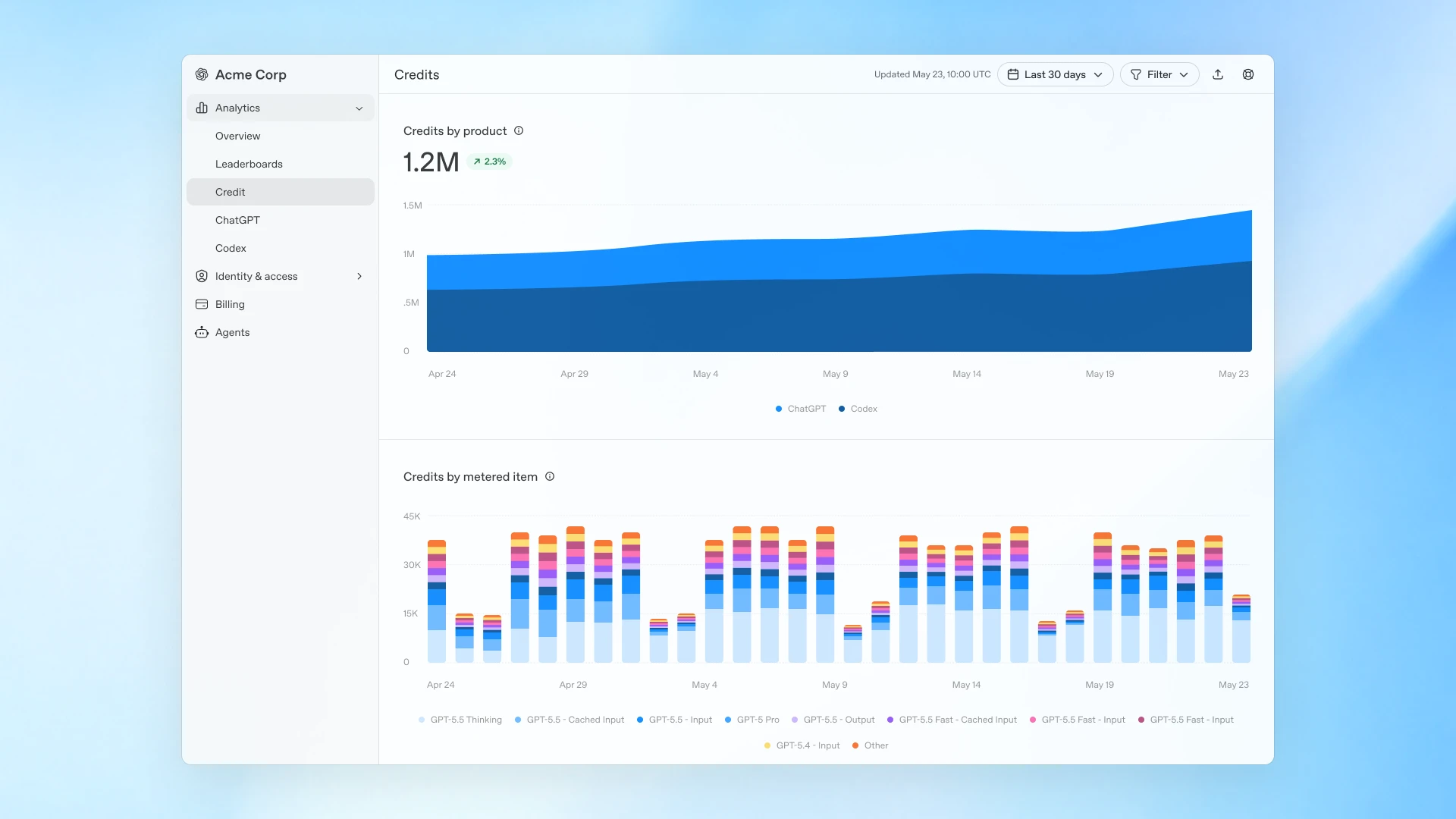
First, sharpen visibility into usage and spend. Admins need to see who uses AI, which models they select, how much capacity they consume, and what kind of work that usage supports. The updated Admin Console tracks adoption, credit usage, and spend by user, product, and model. Without this visibility, a growing bill could mean waste, productive experimentation, or a workflow that's becoming business-critical. You can't tell which without granular data.
Second, evaluate models by outcome ROI. Use evals that reflect real tasks, including edge cases. Define what counts as good enough before testing. Then measure the full cost of reaching that standard: model usage, tool calls, attempts, completion rate, latency, and human review time. For priority workflows, track cost per accepted outcome. In customer support, that's a resolved case. In engineering, it's a tested change that passes review.
Third, govern advanced workflows before they scale. Define what context ChatGPT can access, which tools it can call, what actions it can take, and who approves higher-risk steps. This matters more as teams adopt plugins, connectors, and Computer Use capabilities that operate across enterprise systems. Privacy controls, retention policies, and compliance visibility need to be configured before a workflow goes into production.
Fourth, fund workflows that can compound. The article cuts off here in the source, but the implication is clear: once you identify workflows that deliver consistent ROI, allocate more capacity to them rather than spreading investment thinly across experiments.
Fifth, presumably involves ongoing optimization, though the full text wasn't available. The pattern matches standard enterprise software lifecycle management.
What this means for product teams building on agents
If you're building agentic features into your product, OpenAI's framework suggests several practical changes. Instrument everything. Log not just API calls but the business outcomes those calls produce. A customer support agent that resolves tickets in one turn costs less than one that loops through five clarification steps, even if the per-token rate is identical.
Build model fallback logic. Start with a smaller, faster model for routine tasks. Escalate to frontier models only when the simpler option fails or the task is flagged as high-stakes. This tiered approach matches OpenAI's own recommendation to reserve expensive intelligence for complex, ambiguous, or high-risk work.
Design explicit stopping conditions. Agentic loops can burn through budgets when they get stuck retrying failed approaches. Define maximum attempts, timeout windows, and escalation paths before the agent starts.
The governance gap for multi-agent systems
OpenAI's framework addresses single-agent workflows reasonably well. But enterprises increasingly run multiple agents that hand off tasks to each other. Agent A summarizes documents, Agent B extracts action items, Agent C schedules follow-ups. Each agent might use different models, different tools, different cost profiles.
Attributing costs and outcomes across a multi-agent pipeline is harder than OpenAI's guidance suggests. If the final output fails quality checks, which agent caused the problem? If the workflow succeeds, which agent deserves credit for the efficiency gain? These questions matter for teams trying to optimize spend.
The Admin Console improvements help with visibility at the model and user level. They don't yet solve the orchestration layer problem. Teams building complex agent systems will need their own telemetry and attribution logic on top of whatever the platform provides.
Logicity's Take
OpenAI is teaching its customers how to buy more AI, but the framework is genuinely useful. Measuring cost per accepted outcome instead of cost per token forces teams to connect AI spending to business results. The missing piece: competitive benchmarking. Teams using Claude via Anthropic's API, Gemini through Google Cloud, or open-source models through providers like Fireworks or Together AI need cross-platform cost comparisons. OpenAI's console only shows OpenAI usage. For now, teams building multi-vendor agent stacks will need tools like Helicone or LangSmith for unified cost tracking across providers.
Frequently Asked Questions
How much have OpenAI's token prices dropped?
97% from GPT-4 to GPT-5.4. GPT-5.6 adds further efficiency gains with 54% fewer output tokens and 57% faster task completion.
What is 'useful work per dollar' in AI measurement?
A metric that tracks tasks completed, time saved, decisions improved, and workflows ready to scale, rather than raw token consumption. It connects AI spend to business outcomes.
How should enterprises evaluate AI models for agentic workflows?
Run evals on real tasks including edge cases, define acceptable quality before testing, then measure total cost to reach that standard: model usage, retries, completion rate, latency, and human review time.
What governance controls does OpenAI recommend for AI agents?
Define what context agents can access, which tools they can call, what actions they can take, who approves high-risk steps, and how additional capacity gets granted for valuable workflows.
Does Zero Data Retention work for all enterprise use cases?
OpenAI offers ZDR options for high-trust environments, but teams need to configure retention policies, access controls, and compliance visibility before scaling sensitive workflows.
Covers enterprise AI deployment architecture from Anthropic's perspective, relevant context for multi-vendor agent strategies
Need Help Implementing This?
Logicity helps AI product teams design cost attribution systems and governance frameworks for agentic workflows. Contact us to discuss your agent architecture.
Source: OpenAI News
Manaal Khan
Tech & Innovation Writer
Produced with AI assistance and reviewed by the Logicity editorial team. Learn more in our Editorial Policy.