Key Takeaways
How to run Claude Code from Google Cloud ?
- Claude on Google Cloud runs as a Model-as-a-Service with three endpoint types: global, regional, and multi-region
- Global endpoints auto-failover across regions; regional endpoints keep data in-geography for compliance
- Authentication uses Application Default Credentials, inheriting existing IAM and VPC configurations
Google Cloud now serves Anthropic's Claude models through three distinct endpoint architectures, each solving a different production problem. The setup treats Claude invocations identically to any other Google Cloud service: same IAM, same VPC controls, same logging. For engineering teams already deep in GCP, this eliminates a category of infrastructure work.
Three endpoint types, three deployment patterns
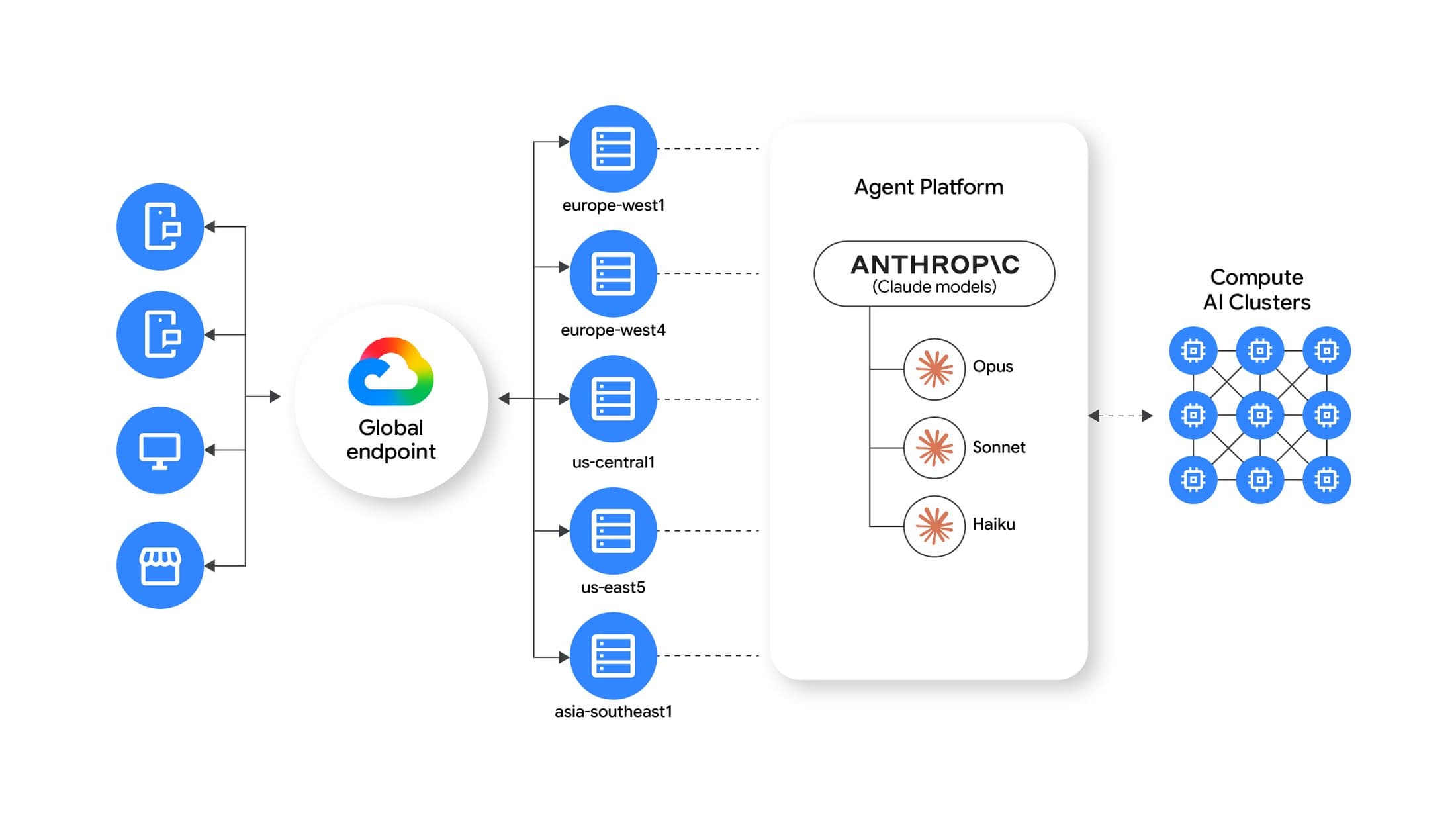
The endpoint choice determines where your prompts route and how resilient your inference calls become. Global endpoints balance load across regions automatically. If us-central1 hits capacity limits, traffic shifts to europe-west1 without any application-side logic. This is the lowest-cost option and maximizes availability, but data crosses regional boundaries.
Regional endpoints lock prompts, completions, and intermediate state to a specific geography. Pick us-east5 or europe-west1, and nothing leaves that boundary. Latency drops because requests don't traverse continents. Compliance teams approve because regulated data stays in-region.
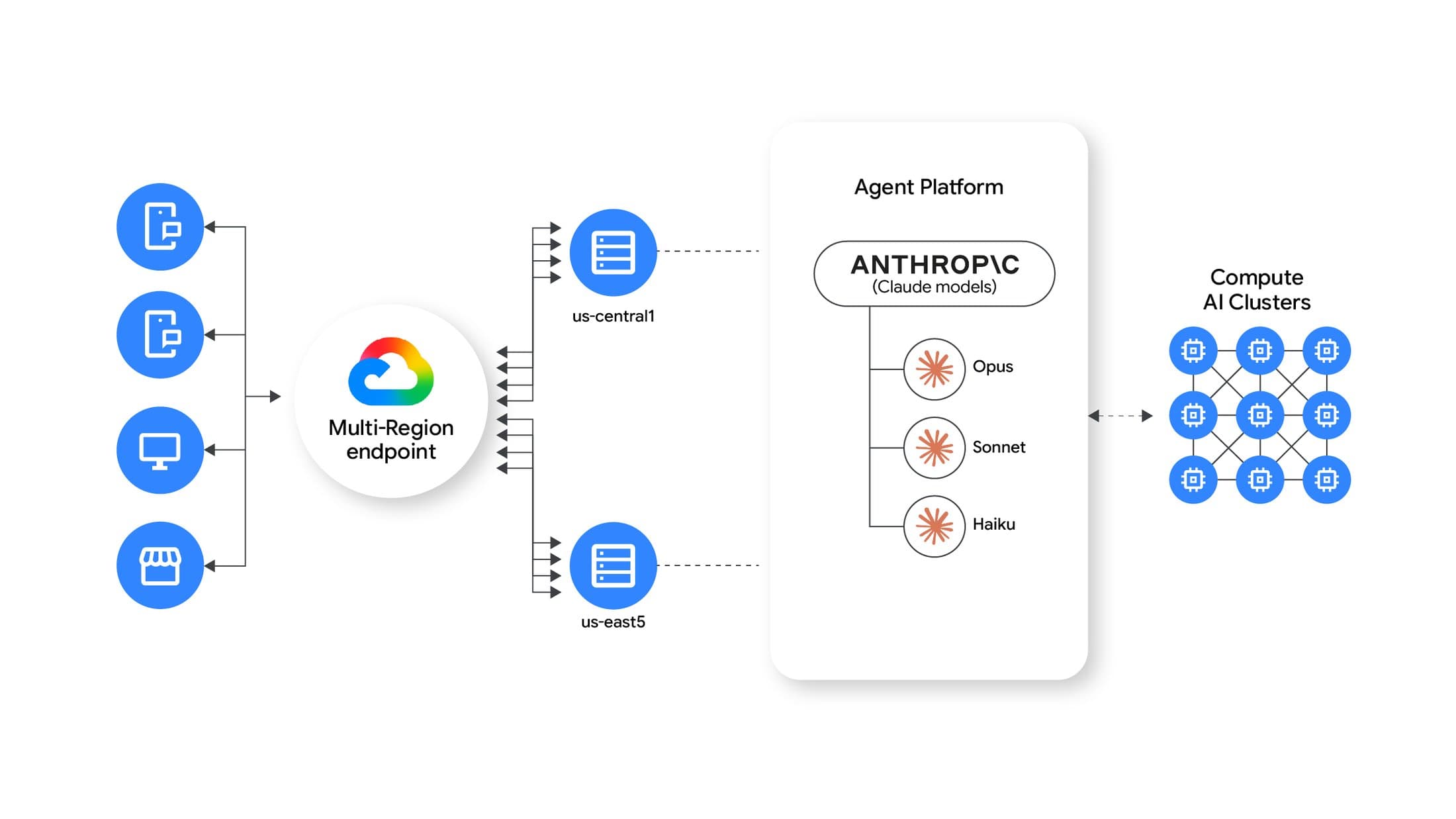
Multi-region endpoints split the difference. They offer U.S. or EU data residency without depending on a single region. Traffic routes dynamically across regional endpoints within the residency boundary, providing failover without crossing jurisdictional lines. For enterprises with both compliance requirements and uptime SLAs, this is likely the practical choice.
What the managed infrastructure actually handles
Claude runs on Agent Platform's Model Garden as a Model-as-a-Service offering. Google handles compute provisioning, auto-scaling, load balancing, and failover at frontier-model scale. These are functions that would otherwise require dedicated platform engineering headcount.
The serving layer exposes standard REST/JSON over HTTP/1.1 or HTTP/2. Authentication works through Application Default Credentials. Requests automatically inherit your project's IAM policies and VPC configuration. The observability stack pipes into Cloud Logging and Cloud Monitoring, which matters if your SRE team already has runbooks built around those services.
from anthropic import AnthropicVertex

client = AnthropicVertex(
    project_id="your-project-id",
    region="us"
)

message = client.messages.create(
    model="claude-opus-4-8",
    max_tokens=1024,
    messages=[{"role": "user", "content": "Analyze this system architecture."}]
)
The AnthropicVertex client handles prompt caching, tool use, structured outputs, streaming, and adaptive thinking. Batch inference routes through Vertex AI Batch Prediction. The integration points are intentionally familiar if you've worked with other GCP ML services.
Compliance posture for regulated workloads
Claude on Agent Platform inherits Google Cloud's full security posture. The documentation cites FedRAMP High and HIPAA compliance, enabling deployment in regulated sectors: financial services, healthcare, government. The critical point is that compliance extends to the inference layer, where prompts, completions, and intermediate state all flow through the serving stack.
For teams already operating under Google Cloud's compliance frameworks, this avoids the re-certification overhead that comes with adding external AI inference endpoints. VPC Service Controls apply to Claude calls the same way they apply to other GCP resources.
Where the 200K context window matters
Claude's extended context window, up to 200K tokens, enables enterprise document processing that shorter-context models can't handle in a single pass. Think legal contract analysis, codebase understanding, or processing long technical specifications. The infrastructure has to reliably serve these long-context requests without timeouts or degraded performance. That's part of what the managed serving layer is optimized for.
Long-context inference is expensive. The cost optimization features in the serving layer, including prompt caching, become more significant when tokens per request scale into six figures.
The tradeoff grid
| Endpoint Type | Data Residency | Failover | Latency | Best For |
|---|---|---|---|---|
| Global | Cross-region | Automatic | Higher tail latency | Maximum availability, cost optimization |
| Regional | Single region | None (single region) | Lowest | Strict compliance, latency-sensitive apps |
| Multi-region | US or EU boundary | Within boundary | Moderate | Compliance + uptime SLAs |
Logicity's Take
The endpoint architecture here is the real story. Most enterprise AI deployment friction comes from reconciling inference infrastructure with existing compliance and networking requirements. By making Claude invocations operationally identical to other GCP services, Google removed integration work that would otherwise absorb months of platform engineering time. For teams evaluating alternatives, AWS offers Bedrock with Claude integration, and Azure has its own model serving options. The choice likely comes down to where your existing IAM, VPC, and observability investments sit.
Practical considerations before deployment
Pricing follows Vertex AI's model serving rates, which vary by region and model variant. The claude-opus-4-8 model referenced in the code sample is presumably a newer variant. Teams should validate which model versions are available in their target regions before committing to an architecture.
The batch inference path through Vertex AI Batch Prediction is worth exploring for workloads that don't require real-time responses. Batch jobs typically run at lower cost per token than synchronous inference.
Frequently Asked Questions
How does Claude on Google Cloud handle authentication?
Authentication uses Application Default Credentials. Requests automatically inherit your project's IAM policies and VPC configuration without additional setup.
What's the difference between global and multi-region endpoints?
Global endpoints route across any available region for maximum availability but cross jurisdictional boundaries. Multi-region endpoints stay within U.S. or EU boundaries while still providing failover across regions within that boundary.
Can Claude on Google Cloud meet FedRAMP and HIPAA requirements?
Yes. Claude on Agent Platform inherits Google Cloud's FedRAMP High and HIPAA compliance posture, including at the inference layer where prompts and completions flow.
What client library should I use to invoke Claude on Google Cloud?
Use the AnthropicVertex client from the anthropic Python package. It handles prompt caching, tool use, structured outputs, streaming, and adaptive thinking.
A contrasting look at AI model security vulnerabilities in production environments
Need Help Implementing This?
If your team is evaluating Claude deployment on Google Cloud, we can connect you with integration partners who specialize in enterprise AI infrastructure. Reach out at consulting@logicity.in.
Source: Cloud Blog
Huma Shazia
Senior AI & Tech Writer
Produced with AI assistance and reviewed by the Logicity editorial team. Learn more in our Editorial Policy.