Key Takeaways
- Microsoft is moving third-party drivers from kernel mode to safer user-mode drivers
- AMD and Intel are partnering with Microsoft on joint accountability for driver stability
- Windows Update catalog will be cleaned of outdated and low-quality drivers
Why Microsoft Is Acting Now
Microsoft has a driver problem. Since the company stopped hosting WinHEC in 2018, Windows users have watched driver quality decline. Monthly updates frequently cause blue screens of death (BSODs) and visual artifacts in games. The culprit: drivers that connect Windows to hardware but sit deep inside the kernel where bugs can crash the entire system.
"Drivers sit at the heart of every Windows experience," Microsoft said in a blog post announcing the initiative. The company acknowledged that when drivers fail, "customers experience it as a device problem, regardless of where the root cause sits."
WinHEC 2026 marks Microsoft's return to hardware engineering conferences after an eight-year gap. The company shifted focus to cloud services during that period, but the resulting driver mess now demands attention.
The Four Pillars of DQI
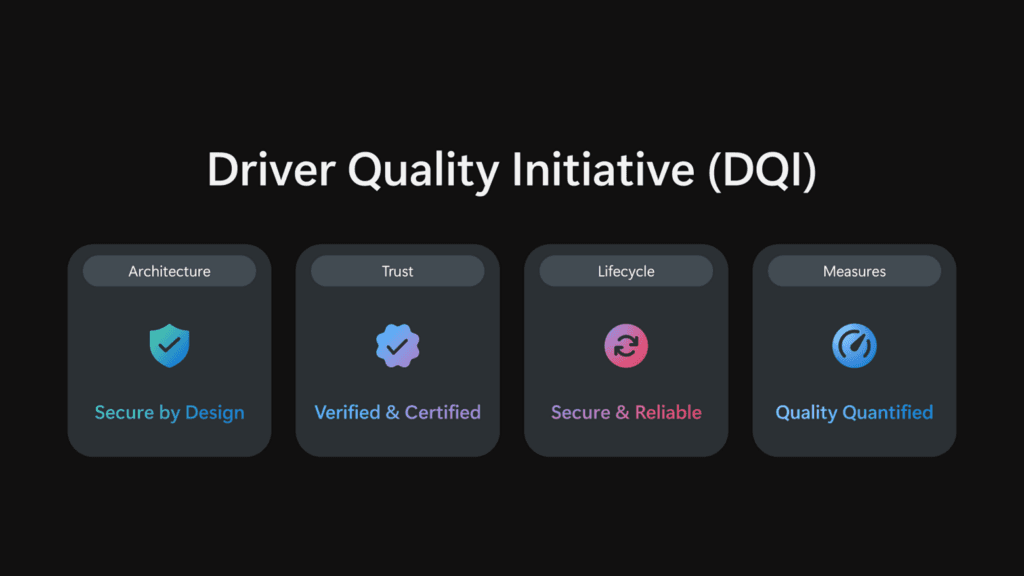
The Driver Quality Initiative rests on four pillars designed to catch problems before they reach your PC:
- Moving third-party drivers out of kernel mode into safer user-mode drivers or Microsoft's own class drivers
- Stricter partner verification with more automated checks and updated Windows Hardware Compatibility Program requirements
- Better Windows Update catalog hygiene, including removal of outdated or low-quality drivers
- Expanded monitoring of stability, features, performance, battery impact, and heat generation
The kernel-mode change matters most for stability. Kernel-mode drivers have full system access. When they crash, Windows crashes. User-mode drivers run in a sandbox. A bug there might break one app or device, but it won't take down the whole machine.

AMD and Intel Sign On
Microsoft is not doing this alone. AMD and Intel are both participating in DQI, sharing responsibility for driver quality across their hardware ecosystems.
“It's a shared commitment. Through our close collaboration with Microsoft, AMD is focused on building a culture of joint accountability to ensure security, stability, and predictable performance for our customers at scale.”
— David Harmon, Director of Software Engineering, AMD
The "joint accountability" language signals a shift from finger-pointing. Previously, Microsoft could blame AMD for a bad GPU driver while AMD blamed Microsoft for kernel changes. DQI creates a framework where both sides own the outcome.
Connection to Windows Resiliency Initiative
DQI builds on infrastructure from the Windows Resiliency Initiative (WRI), Microsoft's broader effort to make Windows more stable. WRI provided the data pipelines and monitoring tools that DQI will use to track driver health across the Windows install base.
Microsoft also outlined goals for "exceptional device experiences" covering media, display, camera, audio, connectivity, and peripherals. These aren't just stability targets. They include performance benchmarks and power consumption standards that partners must meet.
Understanding the infrastructure layer that supports software ecosystems
When to Expect Changes
Microsoft has not given a specific timeline. The company said changes will "gradually be reflected in the coming months" as work continues. Expect stricter certification requirements to appear first, followed by catalog cleanups that remove problematic drivers from Windows Update.
The kernel-to-user-mode migration will take longer. Hardware makers need to rewrite drivers, test them, and push them through the updated certification process. This is a multi-year effort, not a quick patch.
Logicity's Take
What This Means for IT Teams
Enterprise IT managers should expect fewer driver-related incidents over time, but the transition period could bring disruption. When Microsoft removes a driver from Windows Update, devices using that driver may need manual intervention. Start inventorying hardware that relies on third-party drivers, especially older peripherals and specialized equipment.
The catalog cleanup is good news for anyone tired of Windows Update pushing broken drivers. Microsoft is committing to "better data to investigate issues," which suggests more aggressive removal of drivers that cause crashes, even from major vendors.
Frequently Asked Questions
What is the Windows 11 Driver Quality Initiative?
DQI is Microsoft's program to improve driver reliability through stricter certification, moving drivers out of kernel mode, cleaning the Windows Update catalog, and monitoring performance metrics like stability and battery impact.
Why do bad drivers cause Windows blue screens?
Kernel-mode drivers have full system access. A bug in kernel-mode code can corrupt memory or cause system conflicts that force Windows to halt with a BSOD to prevent data damage.
When will Driver Quality Initiative changes take effect?
Microsoft said changes will roll out gradually over coming months. Certification requirements will likely tighten first, with catalog cleanups and driver migrations following over a multi-year period.
Will DQI affect my current hardware?
Older devices using outdated or low-quality drivers may be affected when Microsoft removes those drivers from Windows Update. Hardware with properly maintained drivers should see improved stability.
What is the difference between kernel-mode and user-mode drivers?
Kernel-mode drivers run with full system privileges and can crash Windows if they fail. User-mode drivers run in a restricted sandbox where bugs affect only specific applications or devices, not the entire system.
Need Help Implementing This?
Source: BleepingComputer
Manaal Khan
Tech & Innovation Writer
Produced with AI assistance and reviewed by the Logicity editorial team. Learn more in our Editorial Policy.