Key Takeaways
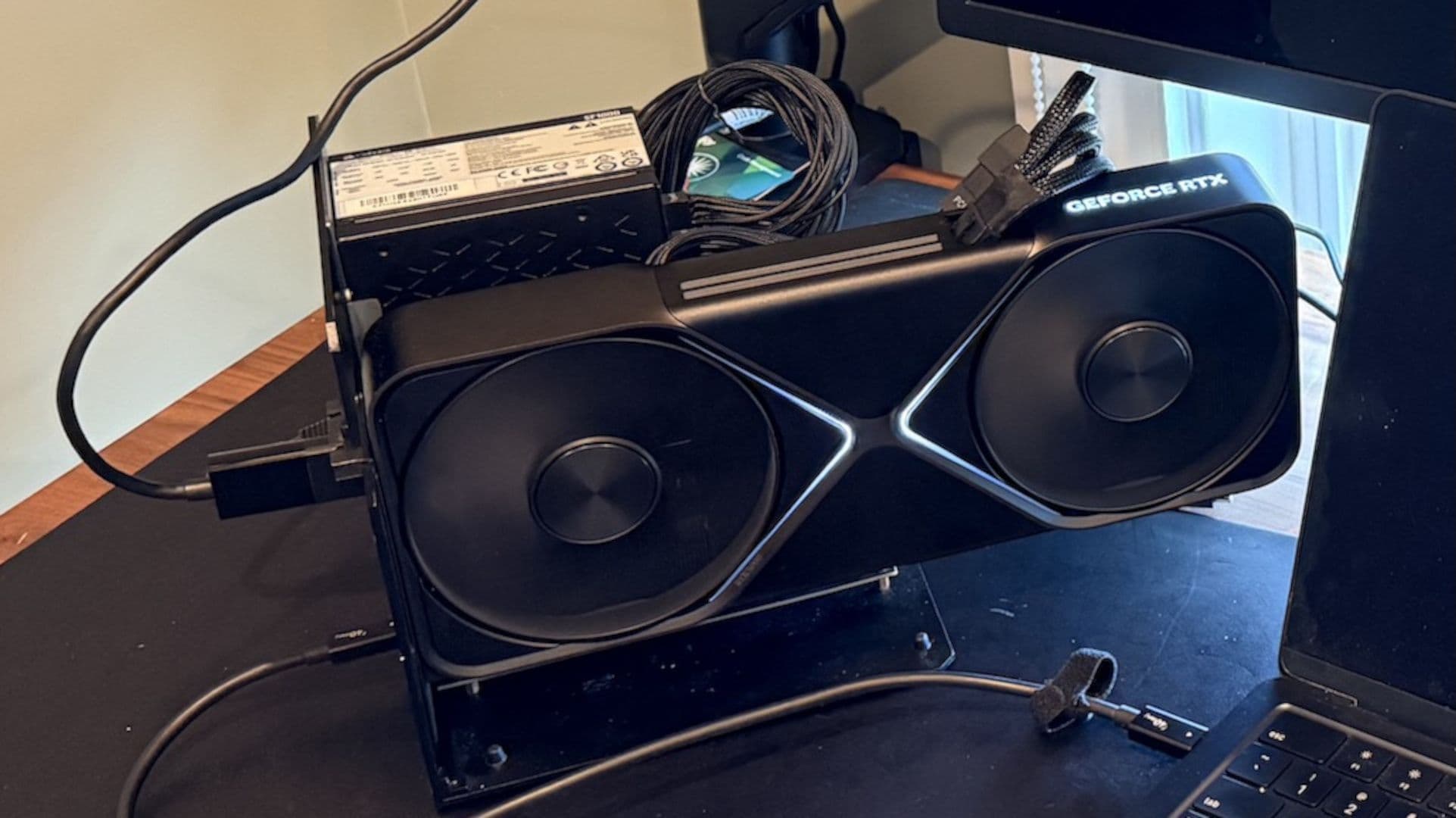
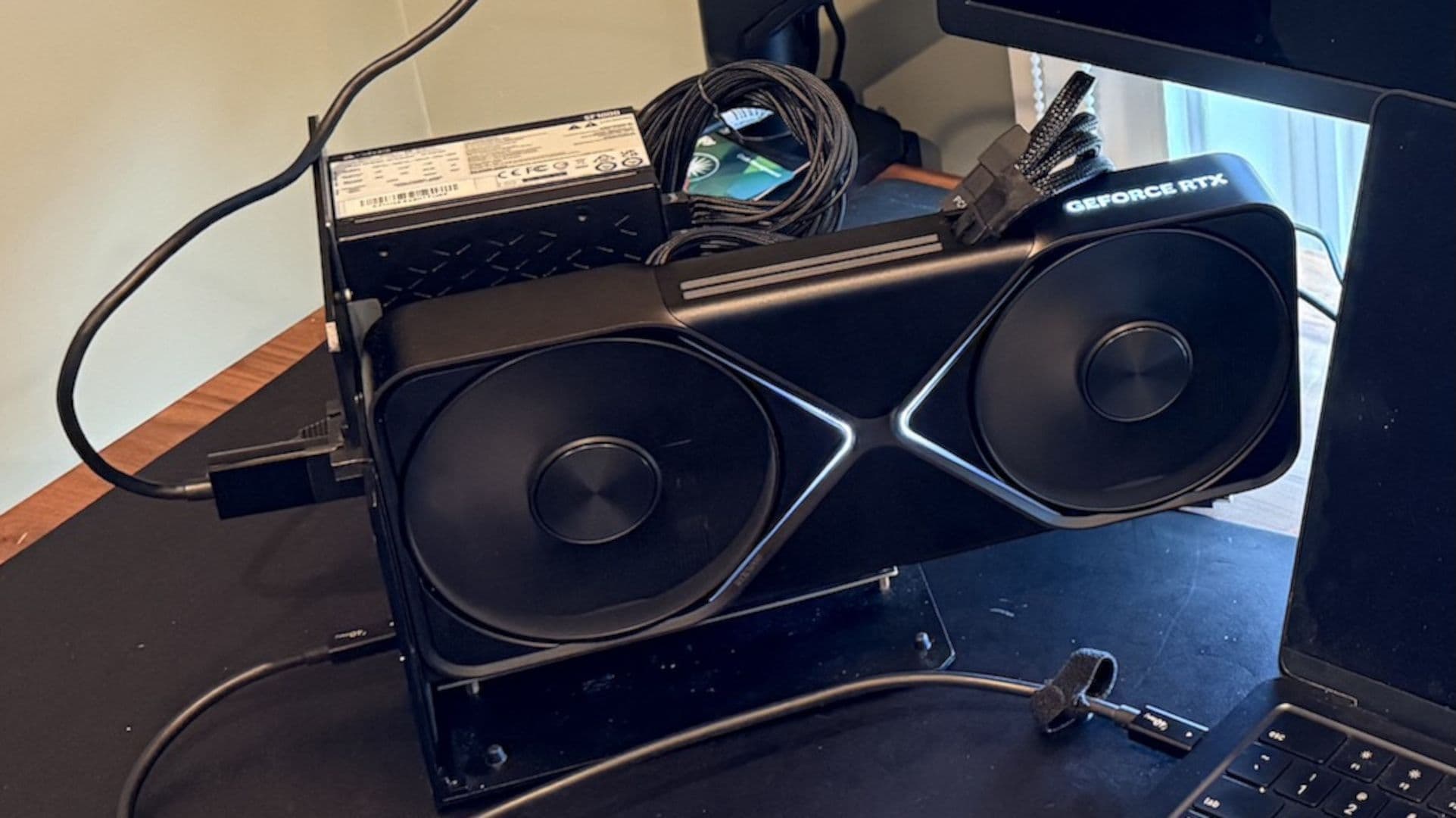
- The M5 Max MacBook Pro can run an RTX 5090 via eGPU dock using virtualization
- Cyberpunk 2077 hit over 100 FPS at RT Ultra preset with frame generation enabled
- The setup requires Linux virtualization and x86 translation layers since macOS lacks Nvidia driver support
Apple's M5 Max MacBook Pro can now run Nvidia's flagship RTX 5090 graphics card through an external GPU dock. Software engineer Scott J. Goldman documented the setup, which delivered over 100 FPS in Cyberpunk 2077 at maximum settings with frame generation enabled.
The catch: it required virtualization, instruction translation, and a lot of patience. ARM-based MacBooks don't officially support eGPU gaming with Nvidia hardware. Goldman had to work around multiple technical barriers to make it happen.
Why This Setup Exists at All
The M5 Max chip can compete with AMD and Intel flagship desktop CPUs in certain workloads. That makes it a capable gaming CPU. The problem is the GPU side. Apple's integrated graphics can't match dedicated desktop cards for AAA gaming.
An external GPU solves that problem on Windows laptops. Just plug in a Thunderbolt dock with a desktop GPU. On a Mac, two obstacles block this path. macOS has no Nvidia driver support. And Linux, which does have Nvidia drivers, doesn't natively support Thunderbolt on Apple silicon.
The Technical Workarounds
Goldman's solution uses virtualization to leverage the strengths of both operating systems. He runs a Linux virtual machine that can access the RTX 5090 through macOS's Thunderbolt stack.
Several other technical hurdles required fixes. Goldman had to configure PCI BAR settings and enable Direct Memory Access. One strange issue involved QEMU's default scheduler settings, which caused benchmark scores to jump around. The problem: the virtualization software didn't set any priority level for virtual CPU threads.
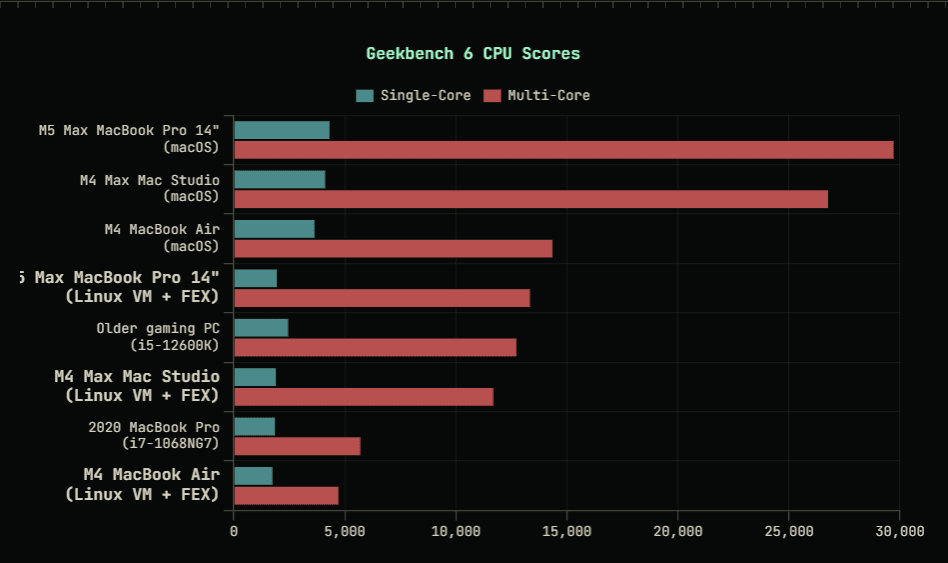
The final piece was FEX, a translation layer that converts x86 instructions into ARM instructions. Almost no PC games support ARM natively. Without FEX, the games couldn't run on Apple silicon at all.
The Benchmark Results
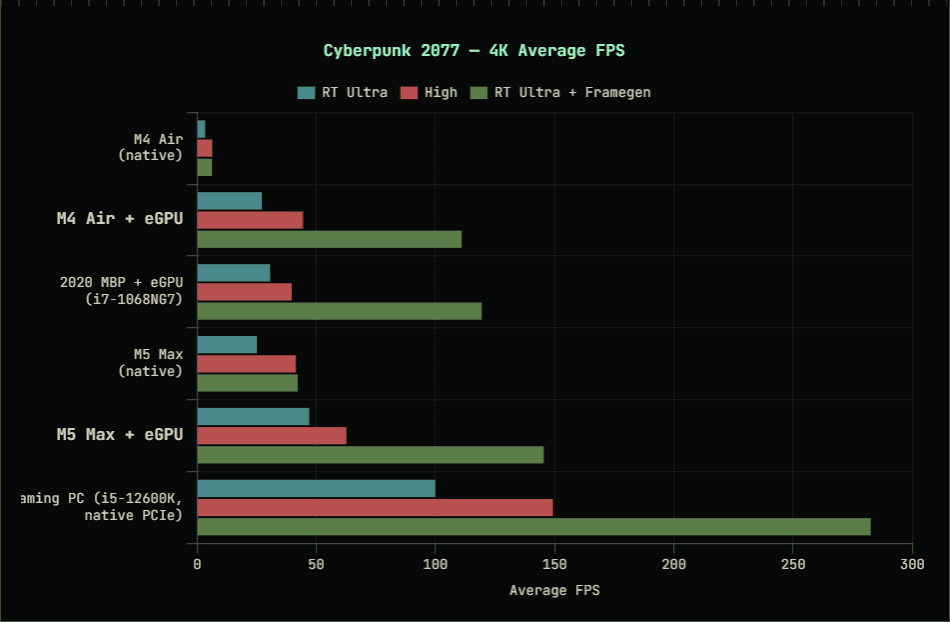
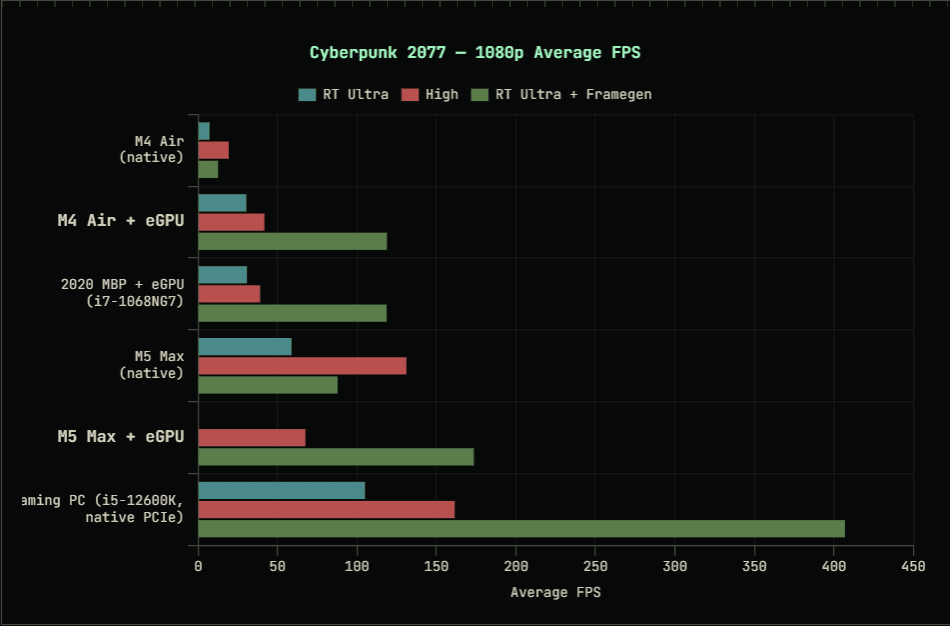
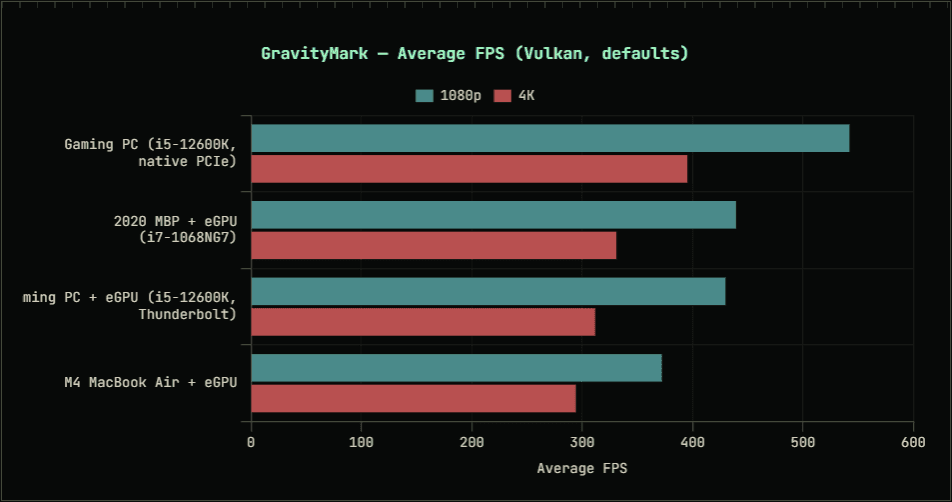
Goldman tested his M5 Max MacBook against several other systems running the same RTX 5090. The comparison included an M4 Air, a 2020 Intel MacBook Pro running native Linux, and an i5-12600K desktop PC.
With frame generation enabled, Cyberpunk 2077 ran at over 100 FPS on both the M5 Max and M4 MacBooks at the RT Ultra preset. This held up despite the overhead from FEX translation, the virtualized Linux environment, and the RTX 5090 running through Thunderbolt.
Turn off frame generation and the picture changes. Performance falls apart without it. Goldman also tested the M4 and M5 Max devices on their integrated GPUs for comparison.
Frame Generation Does the Heavy Lifting
The results show that frame generation is essential for this setup. Nvidia's DLSS 3 frame generation synthesizes additional frames between real rendered frames. This masks the latency and overhead from virtualization and instruction translation.
Without it, the stack of virtualization, Thunderbolt bottlenecks, and x86 translation creates too much overhead for smooth gameplay. Frame generation papers over these performance gaps.

Logicity's Take
What This Means for Mac Gaming
The experiment proves the M5 Max has enough CPU horsepower to drive high-end gaming when paired with capable graphics hardware. Apple's ARM chips can keep up with desktop Intel and AMD processors.
The barriers are software, not hardware. macOS dropped Nvidia support in 2019. Apple killed official eGPU support with Apple silicon. These decisions, not chip architecture, prevent Macs from becoming gaming machines.
More on Apple's chip strategy and manufacturing decisions
Frequently Asked Questions
Can you connect an RTX 5090 to a MacBook Pro?
Not officially. macOS has no Nvidia driver support. Goldman's setup uses Linux virtualization and multiple technical workarounds to make it work.
What FPS does the M5 Max MacBook get with an RTX 5090 eGPU?
Over 100 FPS in Cyberpunk 2077 at RT Ultra preset, but only with DLSS 3 frame generation enabled. Performance drops significantly without it.
Does Apple support external GPUs on M-series Macs?
No. Apple dropped official eGPU support when it transitioned to Apple silicon. The last Macs with eGPU support were Intel-based models.
Why doesn't macOS support Nvidia GPUs?
Apple and Nvidia ended their driver partnership in 2019. macOS only supports AMD and Intel integrated graphics, plus Apple's own GPU designs.
What is FEX translation?
FEX is a translation layer that converts x86 CPU instructions into ARM instructions. It allows x86 PC games to run on Apple silicon, though with some performance overhead.
Need Help Implementing This?
Source: Latest from Tom's Hardware
Huma Shazia
Senior AI & Tech Writer
Produced with AI assistance and reviewed by the Logicity editorial team. Learn more in our Editorial Policy.