Key Takeaways
- LAMBDA lets you create custom Excel functions using only the formula bar, no VBA required
- The function accepts parameters (inputs) and a calculation, then can be named and reused across your workbook
- Excel became Turing-complete with LAMBDA's introduction, meaning it can theoretically perform any calculation
If you've ever copied the same formula across dozens of cells, only to discover weeks later that one version references the wrong range, you know the pain of formula sprawl. Excel's LAMBDA function solves this by letting you define logic once and call it by name anywhere in your workbook.
LAMBDA arrived in Microsoft 365 and Excel 2024 with little fanfare but massive implications. Simon Peyton Jones, Senior Principal Researcher at Microsoft Research, put it bluntly: 'Excel has just released LAMBDA, in its full higher-order glory. It represents a qualitative change, not an incremental one: Excel just became Turing-complete.'
That's a technical way of saying Excel can now, in theory, perform any calculation that Python or C++ can. For most users, the practical benefit is simpler: you can stop copying formulas and start building functions.
What LAMBDA Actually Does
LAMBDA transforms a standard Excel formula into a function you can reuse. Instead of writing the same calculation in multiple cells, you define it once with named parameters, then call it like any built-in function.
The syntax has two parts: parameters (your inputs) and a calculation (what you do with those inputs).
=LAMBDA(parameter1, parameter2, ..., calculation)A simple example: say you need to add 20% markup to prices throughout your workbook. Instead of typing =A1*1.2 in every cell, you create a LAMBDA.
=LAMBDA(x, x*1.2)Here, x is the parameter. Whatever value you pass in gets multiplied by 1.2. But this formula alone doesn't do anything useful yet. You need to name it.
Naming Your LAMBDA Function
To make a LAMBDA reusable, you assign it a name through Excel's Name Manager. Go to Formulas > Name Manager > New. Give your function a name (like 'AddMarkup'), then paste your LAMBDA formula in the 'Refers to' field.
Once named, you can use it like any Excel function.
=AddMarkup(A1)Now every cell that needs a 20% markup uses the same logic. Change the LAMBDA definition once, and every call updates automatically. No more hunting through tabs to find the one formula you forgot to update.
Practical Example: Cleaning Text Data
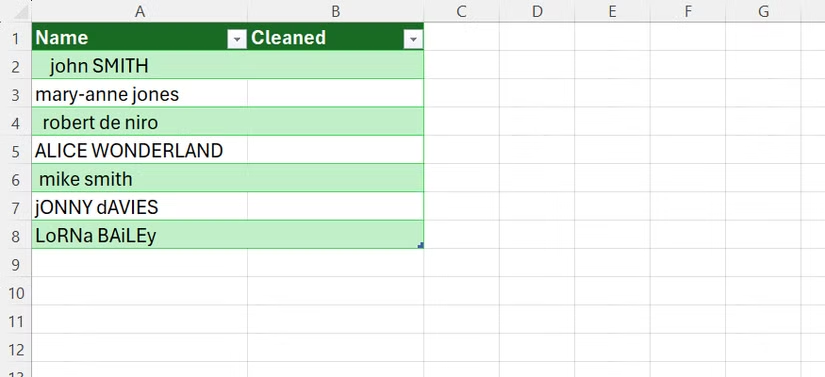
Text cleanup is a common use case. Say you receive names with inconsistent capitalization and extra spaces. You could write this formula in every cell:
Code sample: =PROPER(TRIM(A1))
Or you create a LAMBDA called 'CleanName':
Code sample: =LAMBDA(name, PROPER(TRIM(name)))
Now =CleanName(A1) handles the cleanup. If you later need to add more logic (like removing middle initials), you update one definition instead of hundreds of cells.
Practical Example: Conditional Logic
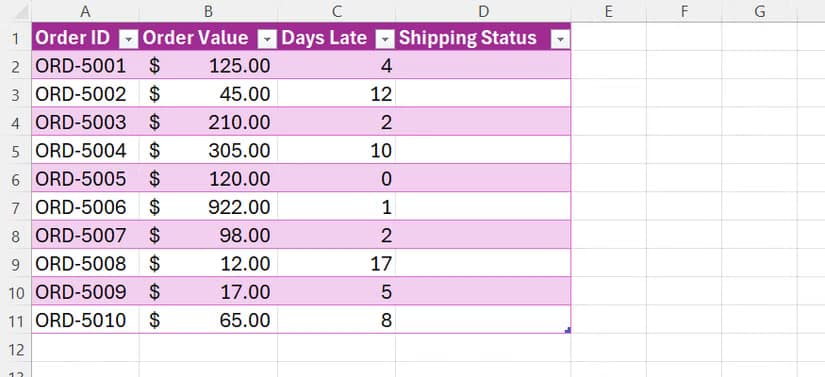
LAMBDA handles complex conditional logic well. Consider a shipping status function that checks how many days an order is late and its value.
Code sample: =LAMBDA(daysLate, orderValue,
IF(daysLate=0, "On Time",
IF(AND(daysLate>7, orderValue>1000), "Escalate",
IF(daysLate>3, "Review", "Monitor"))))
Name this 'ShippingStatus' and call it with =ShippingStatus(C2, D2). The logic stays centralized. When business rules change (say the escalation threshold moves from 7 days to 5), you edit one LAMBDA instead of every formula.
Why This Matters Beyond Convenience
Brian Jones, Head of Product for Microsoft Excel, framed the significance: 'Excel formulas are the world's most widely used programming language, yet the ability to define your own re-usable functions has been missing until now.'
The numbers back that claim. Estimates put Excel's user base between 750 million and 1.5 billion people. Before LAMBDA, creating custom functions required VBA macros. Many organizations block macros for security reasons. LAMBDA sidesteps that entirely since it lives in the formula bar.
LAMBDA also enables recursion, meaning a function can call itself. This opens up calculations that were previously impossible without VBA, like traversing hierarchical data or performing iterative calculations.
Where LAMBDA Works
LAMBDA is available in Excel for Microsoft 365 (Windows and Mac), Excel 2024 (Windows and Mac), and Excel for the web. If you're on an older perpetual license like Excel 2019, you won't have access.
Named LAMBDA functions are workbook-specific. If you email the workbook to a colleague who has a compatible Excel version, the functions work. If they open it in an older version, they'll see errors.
Common Mistakes to Avoid
- Forgetting to name your LAMBDA. An unnamed LAMBDA only works in the cell where you wrote it.
- Using spaces in function names. Stick to letters, numbers, and underscores.
- Creating circular references. A LAMBDA that calls itself without a terminating condition will crash.
- Overcomplicating simple tasks. If a formula works fine in one cell and you'll never reuse it, skip LAMBDA.
Logicity's Take
Frequently Asked Questions
What Excel versions support LAMBDA?
LAMBDA works in Microsoft 365 (Windows/Mac), Excel 2024, and Excel for the web. Older versions like Excel 2019 or 2016 do not support it.
Do I need to know VBA to use LAMBDA?
No. LAMBDA is written entirely in the formula bar using standard Excel syntax. It's designed as a macro-free alternative for custom functions.
Can I share workbooks with LAMBDA functions?
Yes, as long as recipients have a compatible Excel version. The named functions travel with the workbook file.
What does 'Turing-complete' mean for Excel users?
It means Excel can theoretically perform any calculation a full programming language can. In practice, it enables recursion and complex iterative calculations that previously required VBA.
How do I edit a LAMBDA function after creating it?
Go to Formulas > Name Manager, select your function name, and edit the formula in the 'Refers to' field. All cells using that function update automatically.
More Windows productivity tips
Need Help Implementing This?
Source: How-To Geek
Huma Shazia
Senior AI & Tech Writer
Produced with AI assistance and reviewed by the Logicity editorial team. Learn more in our Editorial Policy.