Key Takeaways
- A 70-gram steel chain fired at 80 m/s can entangle drone rotors and bring down a 1 kg quadcopter
- The system costs a fraction of laser or electronic warfare alternatives like the UK's $50,000-per-shot DragonFire
- Live firing trials at Germany's Sternenfels ballistics center confirmed the concept's viability
Ancient Weapon Physics, Modern Application
Researchers at Germany's Karlsruhe Institute of Technology have published a study proposing a purely mechanical anti-drone weapon. The system fires thin steel chains at drones, entangling their rotors and dropping them from the sky.
The work, led by Professor Claus Mattheck at KIT's Institute for Applied Materials, was published in the journals Aerospace & Defence and Konstruktionspraxis. The timing matters. Germany is dealing with a surge in unauthorized drone flights over critical infrastructure.
The concept borrows from the bola, a weighted throwing weapon used for centuries by South American herders to bring down livestock and game. Instead of weighted cords, the KIT team uses lightweight metal chains with link diameters of three to four millimeters. A 40mm caliber launcher fires them at 80 m/s.
On contact with a drone, the chain coils around the airframe and propeller blades. This locks the rotors and drops the aircraft.
How the Simulations Worked
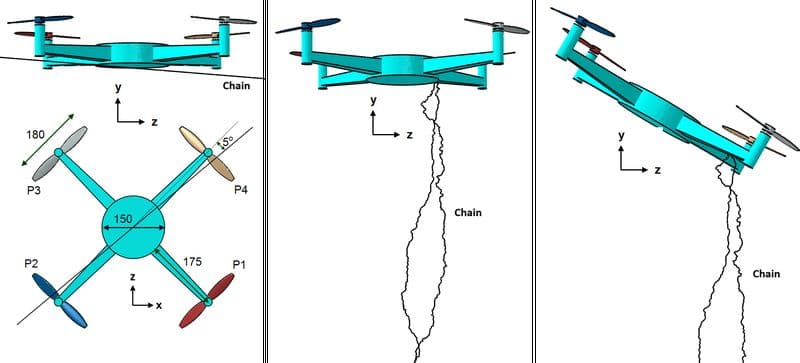
The team modeled chain-on-drone impacts using Abaqus, a commercial finite element analysis tool. They simulated a 70-gram chain measuring 2,000mm (about 6.5 feet) in length striking a 1 kg model quadcopter.
The simulations accounted for friction between the steel chain and drone body, propeller geometry, and rotational dynamics. Three scenarios were tested.
- A horizontally approaching chain hitting a stationary hovering drone
- The same scenario using a chain launched from the 40mm tube
- A variant where the drone was tilted 30 degrees and moving at 25 m/s
From Simulation to Live Fire
Mattheck's team also conducted live firing trials at the Sternenfels ballistics center in Baden-Württemberg using a catapult-based launcher. These were designed as basic viability tests, not field-ready demonstrations.
The researchers noted a limitation. They didn't factor air resistance into their computational models. The ring vortex generated at the launcher's muzzle could affect how the chain spreads after firing. More testing is needed to understand real-world performance.
How It Compares to High-Tech Alternatives
Firing chains at drones is the polar opposite of other anti-drone tech in development. Directed-energy and electronic warfare systems dominate current research, but they come with significant costs and infrastructure requirements.
The UK's DragonFire laser, scheduled for installation on Royal Navy destroyers by 2027, uses a 50 kW fiber-combined beam to burn through targets at the speed of light. That costs thousands of dollars per shot and requires substantial power infrastructure.
The KIT team's chain projectile weighs 70 grams and can be fired from a portable launcher. No external power source needed. No expensive electronics to maintain.
✅ Pros
- • Portable launcher requires no external power infrastructure
- • Each 70-gram chain projectile costs a fraction of laser or EMP shots
- • Falling chain poses less collateral damage risk than solid projectiles
- • Steel chains outperform textile nets in testing
❌ Cons
- • Limited range compared to directed-energy weapons
- • Air resistance effects not yet modeled, may affect accuracy
- • Requires line-of-sight targeting
- • Effectiveness against faster or larger drones not yet tested
Safety Advantages Over Solid Projectiles
Mattheck noted that a falling chain poses less risk of collateral damage than a solid projectile of equal mass. When the chain misses or passes through a target, it disperses energy across a wider area as it falls.
The steel chain also outperformed textile nets in initial testing. The metal links maintain their structure better on impact and more reliably entangle rotor blades.
What Comes Next
The research remains in early stages. Air resistance modeling, testing against faster drones, and developing a production-ready launcher are all on the roadmap. But the basic physics work. A cheap, portable, mechanical solution to drone threats may be closer than the high-tech alternatives.
Logicity's Take
Frequently Asked Questions
How does the chain anti-drone weapon work?
A 40mm launcher fires a 70-gram, 2-meter steel chain at 80 m/s. On contact with a drone, the chain wraps around the airframe and propeller blades, locking the rotors and causing the drone to fall.
How much does the chain projectile system cost compared to laser anti-drone weapons?
While exact costs aren't published, the chain system uses a portable launcher with no power infrastructure, versus laser systems like DragonFire that cost thousands of dollars per shot and require substantial power systems.
Has the chain anti-drone weapon been tested in real conditions?
Yes, live firing trials were conducted at the Sternenfels ballistics center in Germany using a catapult-based launcher. However, these were basic viability tests, and air resistance effects have not yet been modeled.
What size drones can the chain system bring down?
Testing used a 1 kg model quadcopter. Effectiveness against larger or faster drones has not yet been verified.
Why use chains instead of nets for drone defense?
According to the researchers, steel chains outperform textile nets because metal links maintain their structure better on impact and more reliably entangle rotor blades.
Need Help Implementing This?
Source: Latest from Tom's Hardware
Huma Shazia
Senior AI & Tech Writer
Produced with AI assistance and reviewed by the Logicity editorial team. Learn more in our Editorial Policy.