Key Takeaways
- CVE-2026-8461 scores 8.8 severity and affects any application using FFmpeg's libavcodec with MagicYUV enabled
- Attackers can achieve remote code execution on Jellyfin servers through automatic media library scanning
- FFmpeg 8.1.2 patches the flaw; Plex users are safe due to a custom build with disabled decoders
A heap out-of-bounds write in FFmpeg's MagicYUV decoder can let attackers run arbitrary code on self-hosted media servers like Jellyfin, or crash applications including Kodi, OBS Studio, and PhotoPrism. FFmpeg released version 8.1.2 on June 17 to fix the flaw, tracked as CVE-2026-8461 and nicknamed 'PixelSmash' by the JFrog researchers who discovered it.
The vulnerability carries a CVSS score of 8.8. It can be triggered by a malicious AVI, MKV, or MOV file. Any application built on libavcodec, FFmpeg's core decoding library, is potentially exposed. That list runs long: hundreds of open source and commercial products trust FFmpeg to handle untrusted video input.
How does PixelSmash work?
MagicYUV is a lossless video codec popular in professional editing and streaming. It processes video frames in slices, independent regions that can be decoded in parallel. JFrog found a mismatch between how FFmpeg's frame allocator and the MagicYUV decoder calculate chroma plane heights. The result: a one-row heap buffer overflow when certain crafted files are processed.
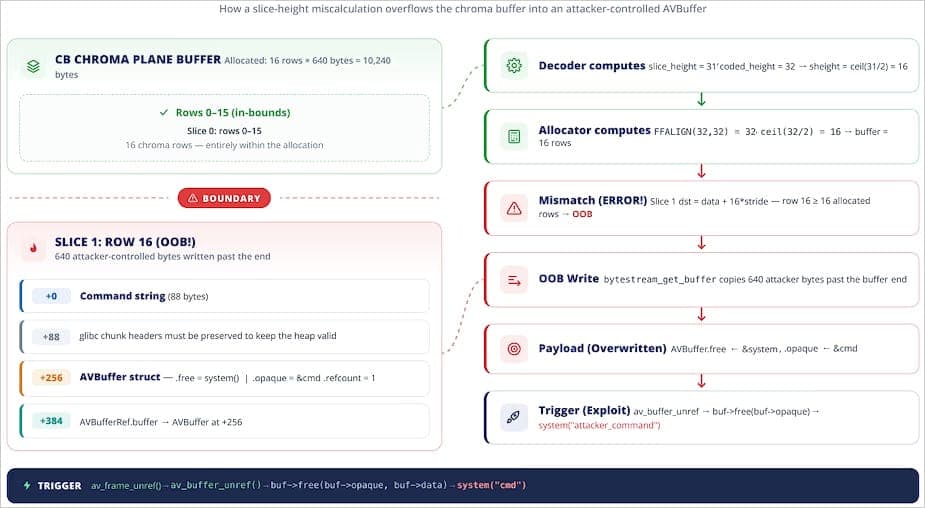
The bug fires in three scenarios. A user opens a malicious video file. A file manager generates a thumbnail for a folder containing the file. Or an automated media ingestion workflow processes the file without any user action at all.
JFrog lead researcher Yuval Moravchick demonstrated full remote code execution against Jellyfin 10.11.9, the second most popular self-hosted media server after Plex. The attack chain: drop a crafted MagicYUV AVI into the media library, wait for Jellyfin's file system monitor to trigger an ffprobe metadata scan, hijack AVBuffer.free to call system(), and run commands as the jellyfin service user.
What limits the RCE risk?
Remote code execution requires ASLR (Address Space Layout Randomization) to be disabled. Most modern systems enable ASLR by default, which randomizes memory addresses and blocks the exploit's hijacking technique. CVE-2026-8461 alone does not defeat ASLR.
However, JFrog notes that a separate information-disclosure bug in FFmpeg's FlashSV decoder could theoretically be chained with PixelSmash to bypass ASLR. Even without RCE, the vulnerability reliably causes denial-of-service crashes on vulnerable targets.
Which applications are affected?
JFrog confirmed that Kodi, OBS Studio, PhotoPrism, Emby, Nextcloud (with movie preview enabled), and the default thumbnail generators on GNOME, KDE, and XFCE are vulnerable. Slack, Discord, Telegram, and WhatsApp use FFmpeg for server-side video previews and may be susceptible, but the researchers did not test them.
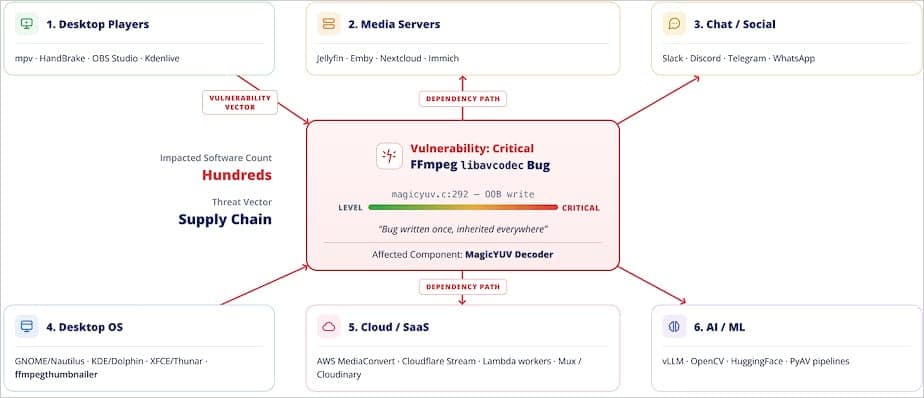
Plex users get a reprieve. The company ships a custom FFmpeg build with the MagicYUV decoder disabled and a strict allowlist of permitted decoders, blocking the attack path entirely.
Torrent downloads create a zero-click attack
One attack scenario requires no user interaction at all. An attacker seeds a malicious video on torrent networks targeting Jellyfin users who point their download folder to the application's media library. Jellyfin's real-time file system monitor detects the new file, triggers ffprobe, and fires the exploit during the scan. The attacker's reverse shell executes automatically.
What should you do now?
Update FFmpeg to version 8.1.2. Jellyfin has already updated its bundled FFmpeg, so update the application itself. PhotoPrism is adding a file format blocklist. The Nextcloud team received the report via HackerOne but declined to patch, saying the flaw exists outside Nextcloud's codebase.
For self-hosted media server operators: check whether your FFmpeg build includes the MagicYUV decoder. If you do not need lossless MagicYUV playback, disable it. Monitor your media library folders for unexpected file additions, especially from automated sources like torrent clients.
JFrog reported the vulnerability to FFmpeg's security team on May 13. The patch shipped 35 days later.
Logicity's Take
PixelSmash is a reminder that FFmpeg is critical infrastructure hiding in plain sight. It processes video for browsers, streaming services, desktop apps, and server backends. When a vulnerability lands here, the blast radius spans hundreds of downstream projects. The real question: how many of those projects will actually update their bundled FFmpeg, and how fast? History suggests the long tail of exposure will stretch for years.
Frequently Asked Questions
Is my Plex server vulnerable to PixelSmash?
No. Plex uses a custom FFmpeg build with the MagicYUV decoder disabled and a strict allowlist, blocking the exploit.
Can PixelSmash be exploited remotely without user interaction?
Yes. If a malicious video is downloaded to a Jellyfin media library folder, the server's automatic file scan triggers the exploit without any user action.
Does the PixelSmash exploit work on systems with ASLR enabled?
Not by itself. Remote code execution requires ASLR to be disabled or bypassed via a separate vulnerability. However, denial-of-service attacks work regardless of ASLR.
Which FFmpeg version fixes CVE-2026-8461?
FFmpeg 8.1.2, released on June 17, 2026, contains the patch.
Are messaging apps like WhatsApp and Telegram affected?
They may be susceptible because they use FFmpeg for server-side video previews, but JFrog did not test them and has not confirmed exploitation.
Need Help Implementing This?
If you run self-hosted media infrastructure and need help auditing your FFmpeg dependencies or hardening your media ingestion pipeline, reach out to our security consulting partners. Contact Logicity for recommendations.
Source: BleepingComputer
Huma Shazia
Senior AI & Tech Writer
Produced with AI assistance and reviewed by the Logicity editorial team. Learn more in our Editorial Policy.