Key Takeaways

- DOJ seized CFAKE.com and SOCFAKE.com, the first domain seizures under the 2025 TAKE IT DOWN Act
- The sites had 200,000 users and 4 million monthly views, hosting deepfake images of politicians and celebrities
- French authorities arrested a suspect and seized $48,000-$64,000 in cryptocurrency linked to the operation
The U.S. Department of Justice seized two websites that hosted AI-generated nonconsensual nude images, marking the first publicly announced domain seizure under the TAKE IT DOWN Act. CFAKE.com and SOCFAKE.com went offline Thursday after a federal judge found probable cause that the sites violated the 2025 law criminalizing deepfake pornography distribution.
According to the DOJ, the sites distributed sexually explicit deepfakes depicting politicians, first ladies, royalty, journalists, athletes, and entertainers from multiple countries. The operation involved coordinated enforcement by U.S. Homeland Security Investigations, French National Police, the Paris Prosecutor's Office, and Italy's Postal and Cybersecurity Police.

How big were these deepfake sites?
The numbers reveal the scale of the operation. French investigators found CFAKE had approximately 200,000 registered user accounts and averaged 4 million views per month. The site generated revenue through advertising, with authorities seizing between $48,000 and $64,000 in cryptocurrency linked to those earnings.
The investigation began after Italy's Postal and Cybersecurity Police alerted U.S. authorities. Italian investigators opened an inquiry in October 2025 following complaints about AI-generated sexually explicit images depicting women in politics, sports, entertainment, and other public-facing professions. Italian authorities blocked access to the sites within Italy while continuing their investigation.
What is the TAKE IT DOWN Act?
President Trump signed the bipartisan TAKE IT DOWN Act into law in May 2025. The legislation makes it a federal crime to publish sexually explicit altered images depicting identifiable individuals without their consent. It also requires online platforms to remove reported intimate images and deepfakes within 48 hours of receiving a valid request from a victim.
First Lady Melania Trump championed the legislation as part of her "Be Best" initiative. The law had previously been used against an Ohio man who pleaded guilty to charges related to creating AI-generated sexually explicit images, but the CFAKE and SOCFAKE seizures represent the first domain-level enforcement action.
“These domain seizures mark a significant victory in the fight against deepfake pornography. The TAKE IT DOWN Act gives us the tools we need to combat the abuse and exploitation of women and children through these fabricated images.”
— Todd Blanche, Acting U.S. Attorney General
International coordination led to an arrest
Evidence gathered by U.S. law enforcement was shared with French authorities, who conducted their own investigation. That probe led to the arrest of a suspect in Nice, France, on June 10. French police also seized the cryptocurrency connected to the site's advertising revenue.
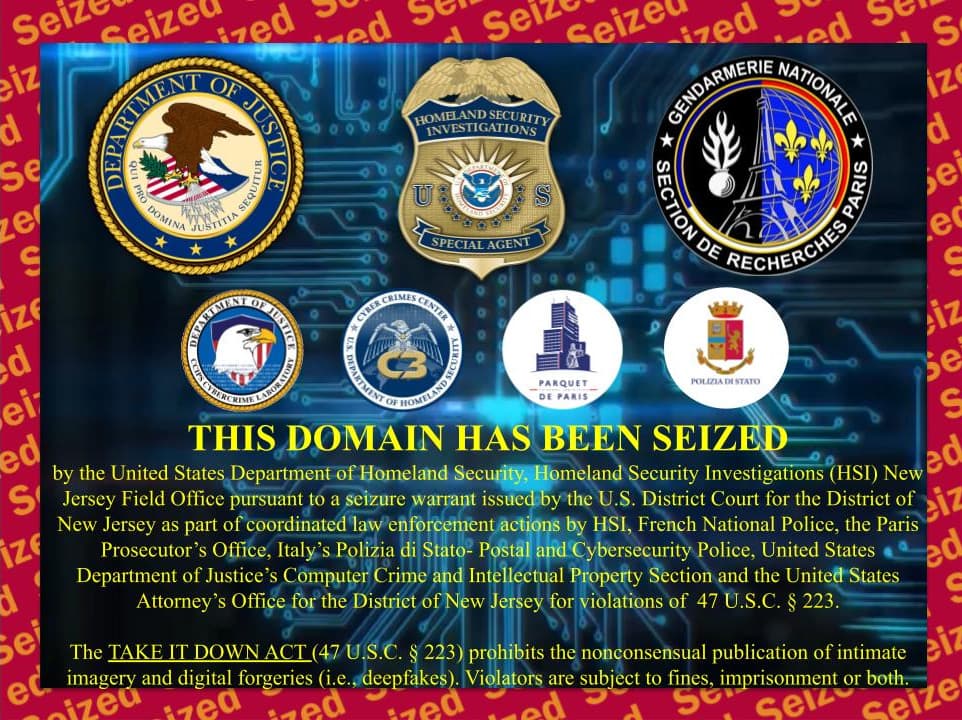
The domains now display a seizure notice explaining they were taken offline pursuant to a warrant issued by the U.S. District Court for the District of New Jersey. The banner warns that violators of the TAKE IT DOWN Act face fines, imprisonment, or both.
Will domain seizures actually stop deepfake distribution?
The tech community is skeptical about long-term effectiveness. Discussions on Hacker News and Reddit have focused on whether infrastructure-level seizures can permanently curb deepfake availability. Mirror sites and decentralized alternatives often reappear within days or weeks of such takedowns.
Still, many users applaud the move as a necessary first step. Domain seizures raise the operational cost for bad actors and signal that U.S. authorities will pursue enforcement. The question is whether this becomes a sustained campaign or remains symbolic.
Logicity's Take
This seizure matters less for the two domains than for the precedent. The TAKE IT DOWN Act now has teeth, and international coordination suggests future enforcement won't stop at U.S. borders. For platforms hosting user-generated content, the 48-hour removal requirement is the real compliance challenge. Expect to see content moderation infrastructure become a legal liability, not just a PR concern.
Frequently Asked Questions
What is the TAKE IT DOWN Act?
A 2025 federal law that criminalizes publishing sexually explicit altered images of identifiable individuals without consent. It also requires platforms to remove such content within 48 hours of a valid victim request.
What happened to CFAKE and SOCFAKE?
The DOJ seized both domains on June 13, 2026, after a federal judge found probable cause they violated the TAKE IT DOWN Act. The sites now display a seizure notice.
Was anyone arrested in connection with the sites?
French authorities arrested a suspect in Nice on June 10, 2026, and seized cryptocurrency linked to the site's advertising revenue.
Can domain seizures permanently stop deepfake sites?
Experts are skeptical. Mirror sites and decentralized alternatives often reappear quickly. However, seizures raise operational costs and establish legal precedents for enforcement.
How large were these deepfake sites?
CFAKE had roughly 200,000 user accounts and averaged 4 million monthly views. Authorities seized $48,000-$64,000 in cryptocurrency linked to advertising revenue.
Need Help Implementing This?
If your organization handles user-generated content and needs to comply with the TAKE IT DOWN Act's 48-hour removal requirements, contact Logicity for guidance on content moderation workflows and legal compliance frameworks.
Source: BleepingComputer
Huma Shazia
Senior AI & Tech Writer
Produced with AI assistance and reviewed by the Logicity editorial team. Learn more in our Editorial Policy.