Key Takeaways
- Proton VPN offers a genuinely usable free tier with no data limits and strict no-logs policy
- Handy lets you run the same AI transcription models as $10/month services locally for free
- Running FOSS alternatives saves hundreds annually without sacrificing core features
Subscription fatigue is real. Between streaming services, cloud storage, and productivity tools, the average professional now pays $200+ monthly for software they used to buy once. But a growing number of free and open-source apps have quietly caught up to, or surpassed, their paid competitors.
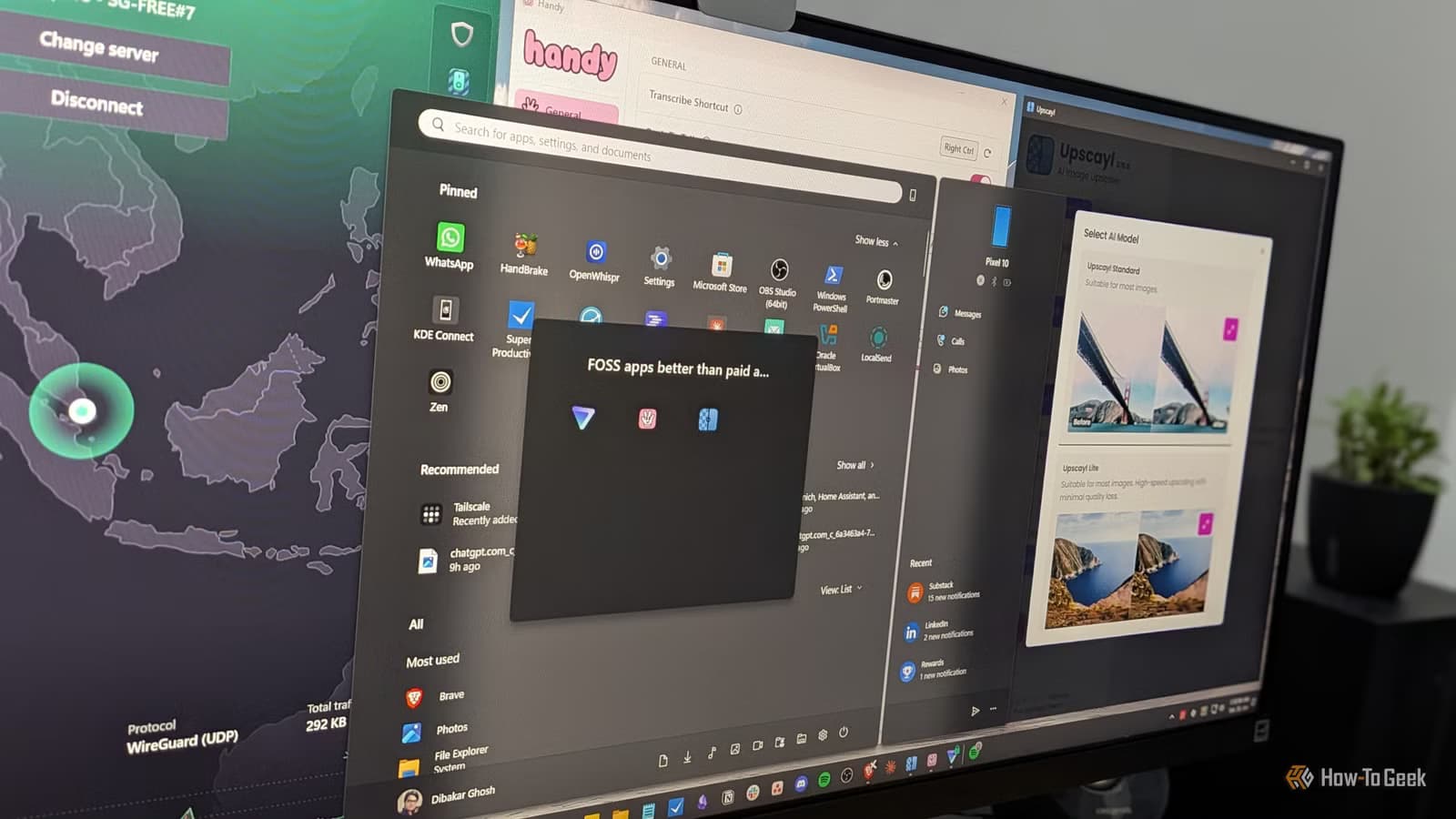
How-To Geek's Dibakar Ghosh recently tested three FOSS alternatives that genuinely replace software you might be paying for. The standouts: a VPN that doesn't sell your data, a transcription tool running the same AI models as premium services, and apps that skip the monthly extraction entirely.
Why Proton VPN's free tier actually works
Free VPNs have a reputation problem. Most log your data and sell it to advertisers. The ones that don't tend to throttle speeds into uselessness. Running VPN infrastructure across multiple countries costs real money, so the free tier usually exists to upsell you or exploit you.
Proton VPN breaks that pattern. The Swiss company, headquartered in Geneva, offers a free tier with no data caps, no ads, and a strict no-logs policy. You're limited to one device at a time and servers in 10 countries, randomly assigned. That rules out reliable geo-unblocking for streaming. But for basic privacy on public Wi-Fi, it's enough.
The paid plans unlock more servers and simultaneous connections, but the free version isn't crippled to force upgrades. Proton has built an entire ecosystem of privacy-focused open-source tools, including email and cloud storage, all designed as alternatives to Google and Microsoft services.
Switzerland's data privacy laws provide an additional layer of protection. Unlike US-based VPNs, Proton isn't subject to Five Eyes intelligence-sharing agreements.
Handy: $0 transcription using the same AI models
Here's a dirty secret about transcription apps: most of them are thin wrappers around OpenAI's Whisper model, which is free and open-source. Apps like Otter, WhisperFlow, and SuperWhisper charge $10/month to run a model you can run yourself.
Handy is a minimal FOSS app that lets you do exactly that. Install it, download a transcription model, and you get push-to-talk dictation. Press a shortcut, speak, release, and your words paste directly into whatever app you're typing in. No cloud processing. No subscription.
The catch is hardware. If you have a GPU with 6GB+ of VRAM, Whisper Turbo offers the best speed-accuracy balance. No GPU? NVIDIA's Parakeet models run on CPU but support fewer languages. Either way, you're getting premium-quality transcription without the premium price.
The economics behind FOSS catching up
Open-source software used to mean compromising on polish. That's no longer true for several categories. VLC has over 500 million downloads. LibreOffice serves an estimated 47 million active users. Linux runs 90%+ of the world's supercomputers.
The shift happened because maintaining open-source projects became sustainable. Corporate sponsorships, foundations like the Linux Foundation, and freemium models (like Proton's) fund development without requiring user payments. The AI boom accelerated this: companies release models like Whisper for free to build ecosystem dominance, and FOSS apps wrap them into usable products.
Meanwhile, commercial software keeps raising prices. Adobe Creative Cloud now costs $1,440/year. Microsoft 365 Family runs $120-160 annually. Users who don't need every feature are overpaying for capabilities they'll never touch.
Where FOSS still falls short
Not every category has viable free alternatives. Professional video editing, CAD software, and specialized enterprise tools still favor paid options. FOSS apps often lag on support, onboarding, and integration with corporate IT systems.
The Proton VPN free tier illustrates the limitations clearly: one device, random server selection, no streaming optimization. For personal use, that's fine. For a distributed team needing consistent access to region-locked services, you'll still pay.
Transcription tools like Handy require technical comfort. Installing models, configuring GPU acceleration, and troubleshooting when things break isn't for everyone. The $10/month apps exist because they handle that complexity.
Another case where running AI locally outperforms cloud services
How to decide if FOSS fits your workflow
Start with the apps you pay for monthly but use minimally. Password managers, note-taking apps, and basic office suites have strong FOSS alternatives. If you're comfortable with occasional rough edges, the savings compound fast.
For mission-critical work, test FOSS tools in parallel before switching. Run Handy alongside your current transcription service for a week. Try Proton VPN's free tier on public networks before canceling your paid VPN. The goal isn't ideology; it's finding tools that work without unnecessary costs.
Frequently Asked Questions
Is Proton VPN free tier actually safe to use?
Yes. Proton VPN's free tier uses the same no-logs infrastructure as its paid plans, audited by independent security firms. The limitations are features (device count, server selection), not security.
Can Handy transcription work without a GPU?
Yes, but you'll need to use lighter models like NVIDIA's Parakeet instead of Whisper Turbo. Accuracy remains good; speed depends on your CPU.
What's the difference between FOSS and freeware?
FOSS (Free and Open Source Software) publishes its source code for inspection and modification. Freeware is just free to use, often with hidden data collection or upsells. FOSS is generally more trustworthy.
Why do companies release AI models like Whisper for free?
Strategic positioning. OpenAI released Whisper to build developer ecosystem loyalty and establish their models as industry standards, which benefits their paid products.
Logicity's Take
The real story here isn't that FOSS apps are good now. It's that subscription pricing has pushed commercial software into a value gap. Adobe, Microsoft, and smaller SaaS vendors optimized for maximum extraction, not maximum utility. FOSS tools filled that gap because they only need to be useful, not profitable. For individual users and small teams, that's increasingly enough.
Need Help Implementing This?
Evaluating FOSS alternatives for your team's workflow? Logicity covers practical tech decisions for founders and engineering leaders. Subscribe to our newsletter for weekly breakdowns of tools worth your time.
Source: How-To Geek
Huma Shazia
Senior AI & Tech Writer
Produced with AI assistance and reviewed by the Logicity editorial team. Learn more in our Editorial Policy.