Key Takeaways
- Zapier launched the Zappy Awards in May 2026 to recognize builders automating workflows at their companies
- First winner Rachael Silvano built a seven-step gamification system for 140,000 community members using Zapier Copilot
- Second winner Jeff Hirsch implemented SSO, SCIM, and governance for five teams at Redis in weeks with no prior Zapier experience
Zapier announced its first two Zappy Award monthly winners, recognizing builders who solved real operational problems using the automation platform. The program hit 50 submissions faster than expected, prompting Zapier to move up its first awards ahead of schedule.
The winners aren't developers. One is a community strategist who built a gamification engine for 140,000 users in an afternoon. The other is a systems architect who'd never touched Zapier before deploying a governed enterprise rollout across five teams.
Who won the first Zappy Awards?
Rachael Silvano, Community Strategy Lead at Articulate, took the first spot. She manages E-Learning Heroes, a community platform with 140,000 active members. The platform lacks a native points economy, and vendors who could provide one quoted prices that exceeded the community's budget.
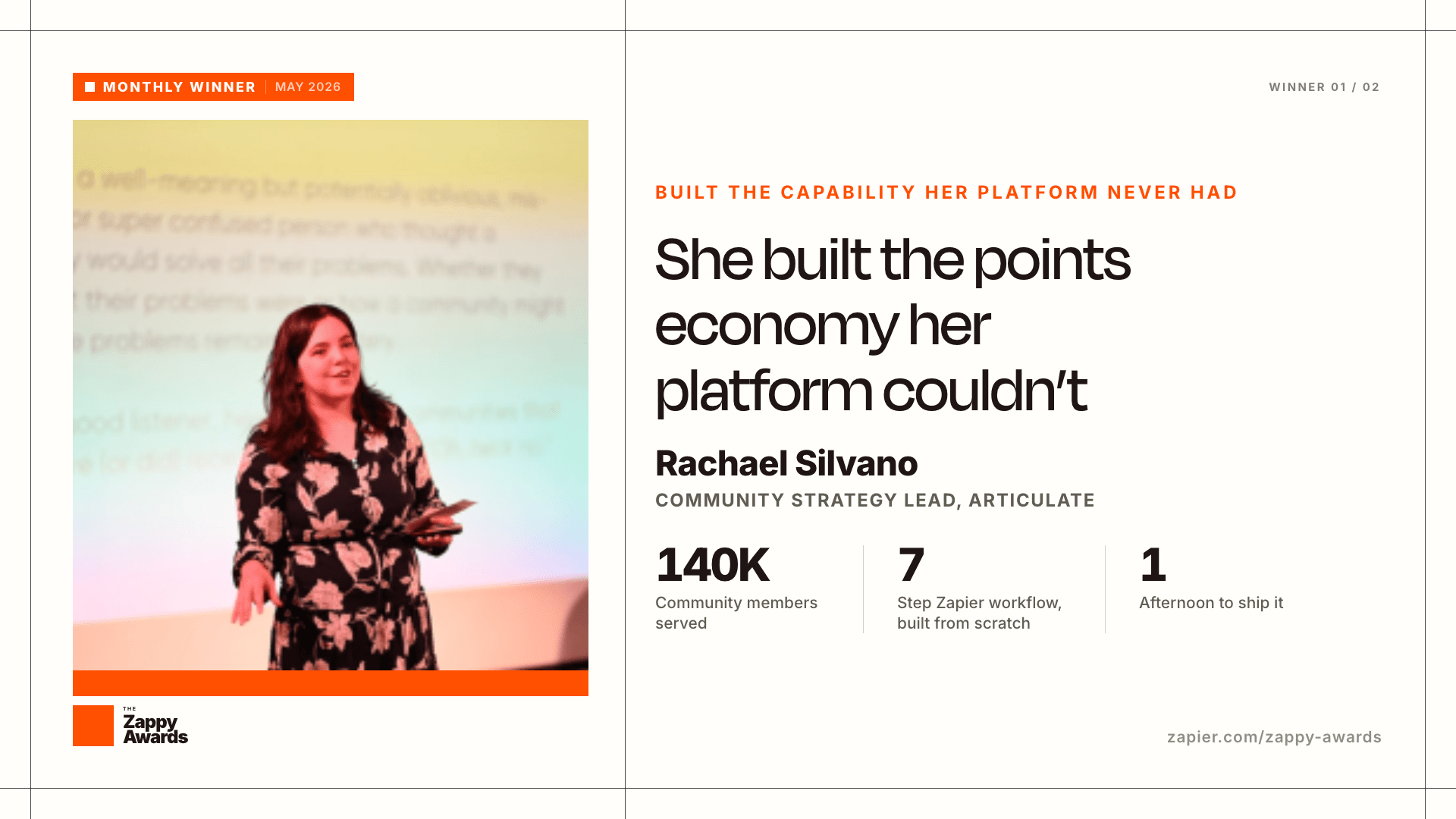
So Silvano built one herself. No development background. The system she created is a seven-step Zapier workflow that bridges Airtable and the community platform. When a member's point balance crosses one of six tier thresholds, the workflow triggers: JavaScript transforms the data, three webhook calls handle authentication, pull the User ID, and apply the new rank.
“Our current community platform doesn't offer a points economy. So I built one. The whole thing runs on Zapier and now we have a platform capability that didn't exist a year ago, on top of a tool that was never designed to support it.”
— Rachael Silvano, Community Strategy Lead at Articulate
She used Zapier Copilot to work through API calls she'd never written before. The program now runs across the full community. Peer answers in E-Learning Heroes offset support costs for Articulate, and the gamification layer rewards the behavior that makes that possible.
How Redis built enterprise governance from scratch
Jeff Hirsch, Systems Architect at Redis, took the second award. When he joined, Zapier wasn't broken. It just wasn't built. Multiple teams wanted to use it. No one owned it. No success criteria. No governance. Every use case was a one-off.
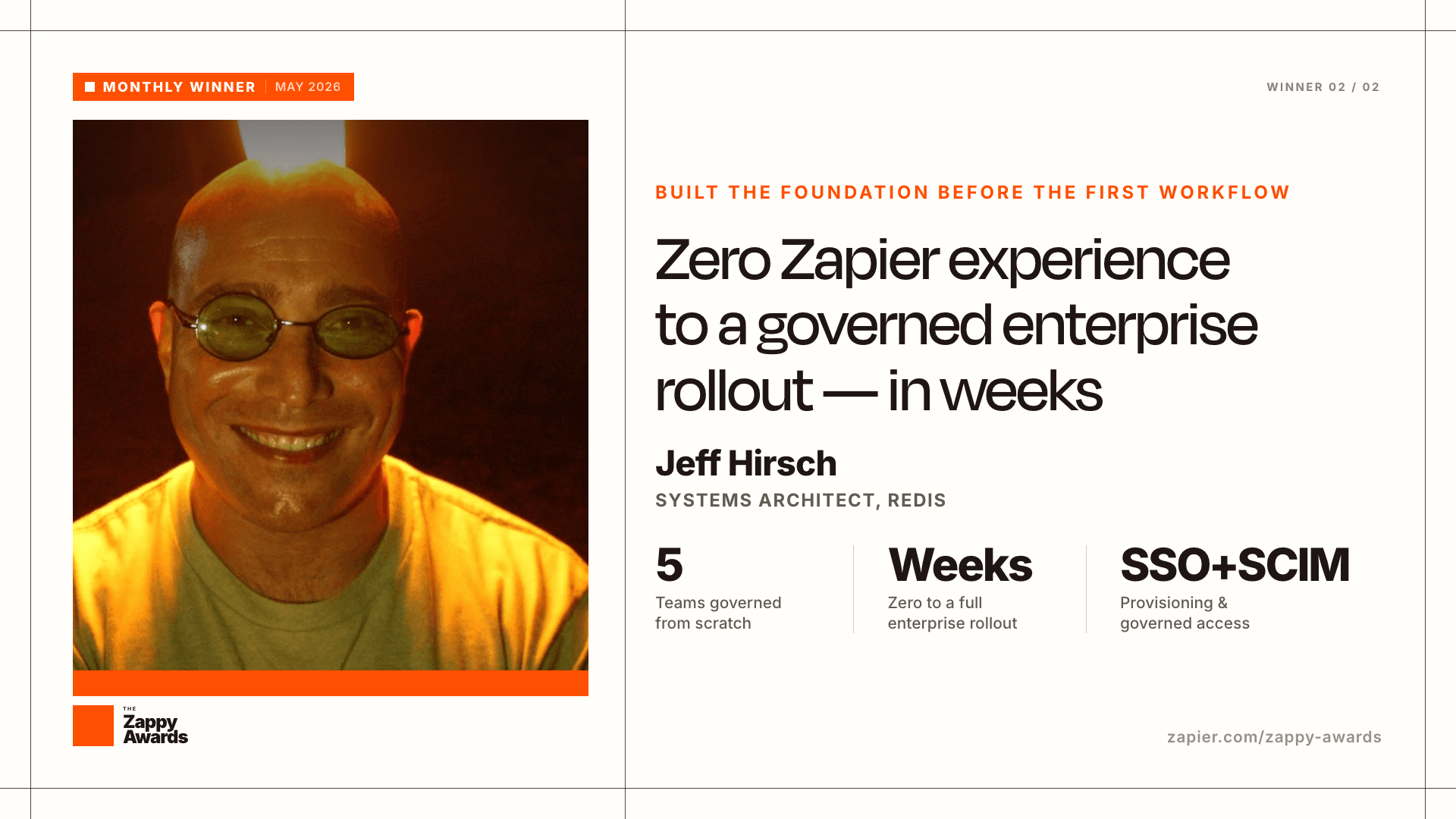
Hirsch didn't start with a workflow. He started with infrastructure: SSO, SCIM, and user provisioning across five teams. Then governance: shared folders, service accounts, restricted actions on sensitive apps. Then intake: a prioritization process so teams could bring use cases forward without IT becoming a bottleneck.
He went from zero Zapier experience to a fully governed enterprise implementation in weeks. He used the MCP and SDK to wire Zapier into the broader AI tooling Redis was building around it.
“I had never used Zapier before. A few weeks later, Redis had SSO, SCIM, governed access, critical app restrictions, and a path for teams to bring AI automation ideas forward.”
— Jeff Hirsch, Systems Architect at Redis
Hirsch credits Akissi Lewis, his project manager, for keeping the rollout on track, and Jason Illiscas for handling the Okta integration that enabled governed access. The metric he watches now: organic demand. Teams are requesting access and bringing use cases before formal enablement has started.
What makes a strong Zappy Award submission?
Zapier published observations from the first 50 submissions. The strongest entries shared common traits.
- Specificity: Winners named exact problems. Silvano cited 140,000 members with no reward mechanism. Hirsch cited five teams with no ownership or governance.
- Unexpected builders: Silvano is a community strategist. Hirsch had never used Zapier the week he started. Both delivered work their job descriptions never asked for.
- Numbers that hold up: 140,000 community members served by a system built in an afternoon. Five teams governed from scratch in weeks.
Submissions remain open through summer. Monthly winners will be named in June, July, and August, with annual award winners announced on stage at ZapConnect 2026.
Logicity's Take
The real story here isn't the awards. It's the builder profile. Both winners lacked technical backgrounds and both delivered enterprise-grade solutions in days, not months. That's a direct result of AI-assisted tooling like Zapier Copilot lowering the barrier. If this pattern holds, expect IT departments to shift from building to governing.
Frequently Asked Questions
What are the Zappy Awards?
The Zappy Awards are Zapier's program recognizing builders who use the platform to solve operational problems at their companies. Monthly winners are named through summer 2026, with annual winners announced at ZapConnect 2026.
Who won the first Zappy Awards in May 2026?
Rachael Silvano, Community Strategy Lead at Articulate, and Jeff Hirsch, Systems Architect at Redis, were the first monthly winners.
How do you submit a Zappy Award entry?
Submissions are open through summer 2026 via Zapier's website. Self-nominations and nominations of others are both accepted.
What is Zapier Copilot?
Zapier Copilot is an AI assistant within Zapier that helps users build workflows, including writing API calls and configuring complex automations without coding experience.
Need Help Implementing This?
Looking to build automation workflows at your company or establish governance for your team's Zapier usage? Contact us at Logicity.in for implementation guidance and vendor recommendations.
Source: The Zapier Blog
Manaal Khan
Tech & Innovation Writer
Produced with AI assistance and reviewed by the Logicity editorial team. Learn more in our Editorial Policy.