Key Takeaways
- Warp open-sourced its terminal client with OpenAI as founding sponsor, shifting to an 'Open Agentic Development' model
- GPT-5.5 uses 30% fewer tokens per coding task than GPT-5.4, making long-running agent workflows more efficient
- 90% of Warp's internal pull requests are now created by AI agents, not human developers
Warp, the Rust-based terminal that built a following among developers for its speed and AI features, has open-sourced its client. OpenAI is the founding sponsor of the repository. The company simultaneously launched what it calls Open Agentic Development, a framework where AI agents write code, run tests, and open pull requests while humans supervise.
The timing is not accidental. Warp's internal engineering team now uses agents to create around 90% of its pull requests. GPT-5.5, the model powering these workflows, uses 30% fewer tokens per task than its predecessor. For a company running long-horizon coding agents at scale, that efficiency gain matters.
What Open Agentic Development Actually Means
Warp's model flips the traditional open-source contribution workflow. Instead of humans writing code and submitting it for review, agents handle implementation. Developers define what they want built, review the output, and decide what ships. Those decisions become context for future agent runs, creating a feedback loop.
“We think we can ship a better Warp, more quickly, by working with our community to supervise a fleet of agents. OpenAI models help make that sustainable for the long-horizon coding work these systems require.”
— Zach Lloyd, CEO of Warp
The company argues that well-orchestrated agents can produce more consistent code than loosely coordinated human contributors. Open source becomes less about implementation work and more about product judgment. The humans provide vision. The agents provide velocity.
Oz: The Orchestration Layer
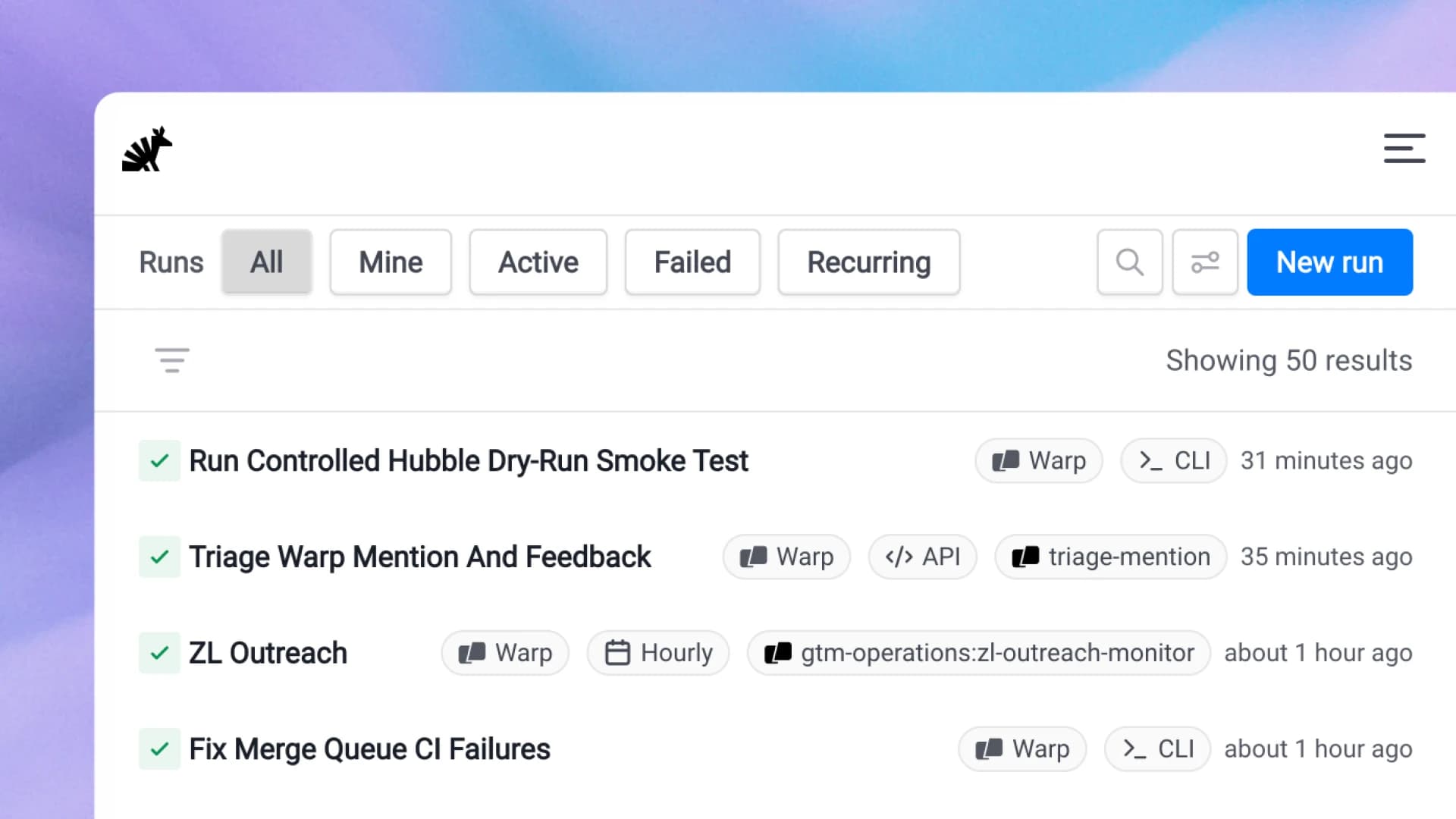
Running agents at scale requires more than a good language model. Warp built Oz, a cloud orchestration platform, to handle the infrastructure. Persistent agents need shared memory, reproducible environments, evaluation systems, permissions, and coordination mechanisms. Oz manages all of this.
The terminal itself becomes the natural interface for this work. Commands, context, collaboration, and review already happen there. Adding agent orchestration fits the existing developer workflow rather than creating a separate one.

Why GPT-5.5 Specifically
Warp's internal benchmarks show GPT-5.5 consumes 30% fewer tokens per agentic coding task compared to GPT-5.4. For workflows that run continuously across large codebases, token efficiency directly impacts cost and speed.
The model also handles larger problem spaces. Agent orchestration at Warp's scale means reasoning across multiple files, understanding project context, and preparing work that humans can actually review. Earlier models struggled with the reasoning depth required for this kind of planning.
Community Reception: Split Opinions
Developer reactions are mixed. On Hacker News, many praised the decision to open-source the high-performance Rust architecture. Others raised concerns about building core developer tooling on proprietary AI models. If OpenAI changes pricing or access terms, Warp's entire workflow depends on a vendor it doesn't control.
Reddit's r/programming has been debating the 90% pull request metric. Some see it as genuine productivity. Others wonder if it represents a flood of automated, potentially low-quality commits. The metric says nothing about merge rates or bug counts.
The Numbers Behind the Bet
Warp claims nearly 1 million developers use its terminal. More than 56% of Fortune 500 companies have Warp in their stack. The company is betting that open-sourcing with agent-first development will accelerate adoption.
- 30% reduction in tokens per task with GPT-5.5 versus GPT-5.4
- 90% of internal pull requests created by agents
- Nearly 1 million developers using Warp
- 56% of Fortune 500 companies using the terminal
What This Means for the Developer Tools Market
Warp is making a specific claim about the future of software development: the best developer tools will be agent orchestration layers, not just code editors or terminals. The terminal becomes the control plane for autonomous engineering.
If Warp's model works, open-source projects could scale in ways they currently cannot. A small team of human maintainers could supervise agent fleets that handle implementation across thousands of issues. The bottleneck shifts from coding capacity to judgment and vision.
If it fails, the company will have open-sourced its core product while building deep dependency on a vendor-controlled model. The risk is real. The bet is big.
Logicity's Take
Frequently Asked Questions
What is Warp's Open Agentic Development model?
A framework where AI agents write code, run tests, and open pull requests while human developers define objectives, review outputs, and decide what ships. The terminal serves as the orchestration layer.
Why did Warp choose GPT-5.5 for its agent workflows?
GPT-5.5 uses 30% fewer tokens per coding task than GPT-5.4 and handles larger problem spaces, making it more efficient and capable for long-running agent orchestration.
Is Warp fully open source now?
Warp open-sourced its terminal client under AGPLv3/MIT licensing in April 2026, with OpenAI as the founding sponsor. The Oz orchestration platform is a separate cloud service.
What concerns have developers raised about Warp's approach?
Critics worry about dependency on proprietary AI models and question whether the 90% agent-created pull request metric represents quality code or automated noise.
How many developers use Warp?
Warp claims nearly 1 million developers and adoption by more than 56% of Fortune 500 companies.
More on OpenAI's recent partnerships and platform initiatives
Need Help Implementing This?
Source: OpenAI News
Huma Shazia
Senior AI & Tech Writer
Produced with AI assistance and reviewed by the Logicity editorial team. Learn more in our Editorial Policy.