Uber will bring its robotaxi service to Houston by mid-2027, the company announced Tuesday. The city becomes the second U.S. market for Uber's partnership with EV maker Lucid and autonomous driving startup Nuro, following a San Francisco launch planned for later this year.
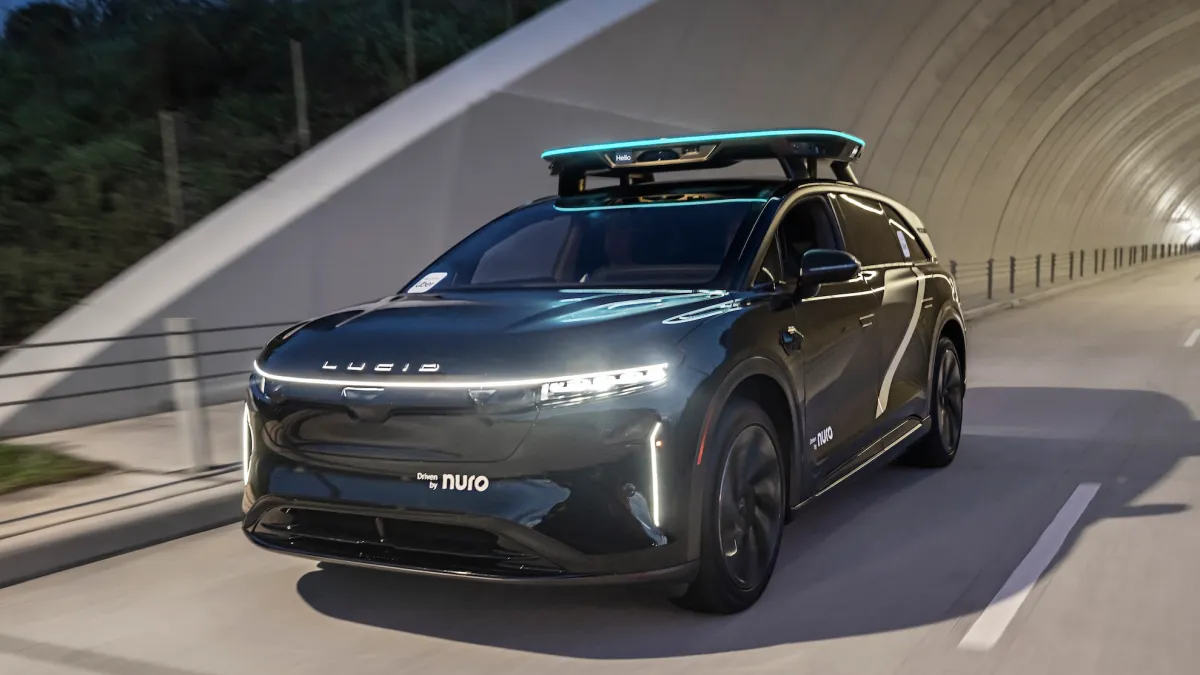
The move puts Uber on a direct collision course with Waymo in both cities. Alphabet's autonomous vehicle unit already operates commercial robotaxi services in San Francisco and Houston, giving it a significant head start. Uber's bet: that pairing Lucid's hardware with Nuro's self-driving software can close the gap.
What Uber is building in Houston
Uber isn't just sending cars to Texas. The company has secured a 50,000-square-foot depot in Houston that will serve as an operations hub for the robotaxi fleet. The facility includes a dedicated charging station with 40 fast chargers to keep the Lucid Gravity SUVs running.
"The launch in Houston marks a pivotal step in our strategy to scale autonomous mobility across multiple U.S. markets, delivering safer and more efficient transit options," Uber CEO Dara Khosrowshahi said.
A combined fleet of 100 autonomous vehicles is already testing on Houston's public roads with safety operators behind the wheel. Nuro supplements this with closed-course testing and simulation work to validate the self-driving system before public deployment.
The technology inside the Lucid Gravity robotaxi
The robotaxi itself is a modified Lucid Gravity SUV, unveiled in January. The vehicle carries high-resolution cameras, solid-state lidar sensors, and radar arrays. Together, these sensors feed Nuro's self-driving system, which handles perception and navigation.
Lucid is now manufacturing the first production versions of these robotaxis at its Arizona factory. The test fleet in Houston and San Francisco is expected to expand in the coming weeks as those vehicles come off the line.
While Nuro handles the autonomy stack, Uber has focused on the in-cabin experience. The company is designing how riders will interact with a vehicle that has no human driver, a UX challenge that Waymo has spent years refining.
Why the cars still have safety drivers
Here's the wrinkle: none of these vehicles are driverless yet. Despite Nuro receiving a California DMV permit last month that would allow it to remove safety drivers, the robotaxis still operate with a human behind the wheel.
In San Francisco, Uber employees can hail the Lucid robotaxis, but only as supervised test rides. The transition to fully driverless operation, which determines whether this is a viable business or an expensive R&D project, hasn't happened.
This is where skeptics focus their attention. Online discussions on r/SelfDrivingCars and Hacker News show appreciation for Uber's infrastructure investment, but doubts persist about whether Lucid's hardware and Nuro's software can match the reliability Waymo has established over years of deployment.
The money behind the deal
Uber has committed serious capital to make this work. The company invested roughly $500 million in Nuro, as TechCrunch first reported in May. It has also committed $500 million to Lucid, tied to a purchase agreement for at least 35,000 robotaxi-ready vehicles.
For Nuro, this partnership represents a lifeline. The startup pivoted in 2024 away from building its own delivery robots, choosing instead to license its self-driving technology to automakers. Uber's investment validated that strategy.
Lucid needed the deal too. The EV maker has struggled to sell vehicles at scale, a familiar problem for startups competing in a market Tesla still dominates. A guaranteed order of 35,000 vehicles provides revenue visibility that public EV sales haven't.
Where this goes next
Uber says it plans to expand the robotaxi program to "dozens of cities" in the coming years. For now, San Francisco launches first, then Houston by mid-2027. Both markets test whether Uber can build a robotaxi operation from scratch while competing against an incumbent with years of operational data.
The next milestone to watch: when Nuro removes the safety drivers. Until that happens, everything else is preparation.
Logicity's Take
Uber is essentially building a robotaxi company by acquisition, stitching together Lucid's manufacturing capacity, Nuro's autonomy software, and its own logistics expertise. This approach trades speed for control. Waymo spent a decade developing both hardware and software in-house. Uber is betting three companies can coordinate faster than one company can iterate. The $1 billion committed suggests Uber believes this, but the safety drivers still in the vehicles suggest nobody has proved it yet.
Frequently Asked Questions
When will Uber launch robotaxis in Houston?
Uber plans to launch its robotaxi service in Houston by mid-2027, following an initial rollout in San Francisco later in 2026.
What vehicles will Uber use for its robotaxi service?
Uber will use modified Lucid Gravity SUVs equipped with Nuro's self-driving technology, including high-resolution cameras, solid-state lidar, and radar sensors.
How much has Uber invested in the robotaxi partnership?
Uber has invested approximately $500 million in Nuro and committed $500 million to Lucid, along with a purchase agreement for 35,000 vehicles.
Are Uber's robotaxis fully driverless?
Not yet. Despite receiving regulatory permits, the robotaxis currently operate with safety drivers behind the wheel during testing.
Will Uber compete with Waymo in Houston?
Yes. Waymo already operates commercial robotaxi services in Houston, making it a direct competitor when Uber launches there in 2027.
Another high-stakes tech bet with a fixed timeline and significant capital at risk
Need Help Implementing This?
If you're building autonomous systems, fleet management software, or transportation infrastructure, our team can help you navigate the technical and regulatory landscape. Contact Logicity's consulting arm for a strategy session.
Source: TechCrunch / Kirsten Korosec
Huma Shazia
Senior AI & Tech Writer
Produced with AI assistance and reviewed by the Logicity editorial team. Learn more in our Editorial Policy.




