
Key Takeaways
- TCS reports flat sequential growth but expects Q2 improvement as manufacturing and life sciences recover
- The company's AI revenue pipeline stands at $2.6 billion in pure-play transformation projects
- B Capital predicts Indian IPO pricing will loosen further as foreign institutional investors return
Tata Consultancy Services expects a stronger second quarter as pressure lifts from stressed verticals and its AI deal pipeline matures. CEO K Krithivasan and COO Aarthi Subramanian made the case in a post-earnings call, framing Q1's flat sequential growth as a speed bump, not a stall.
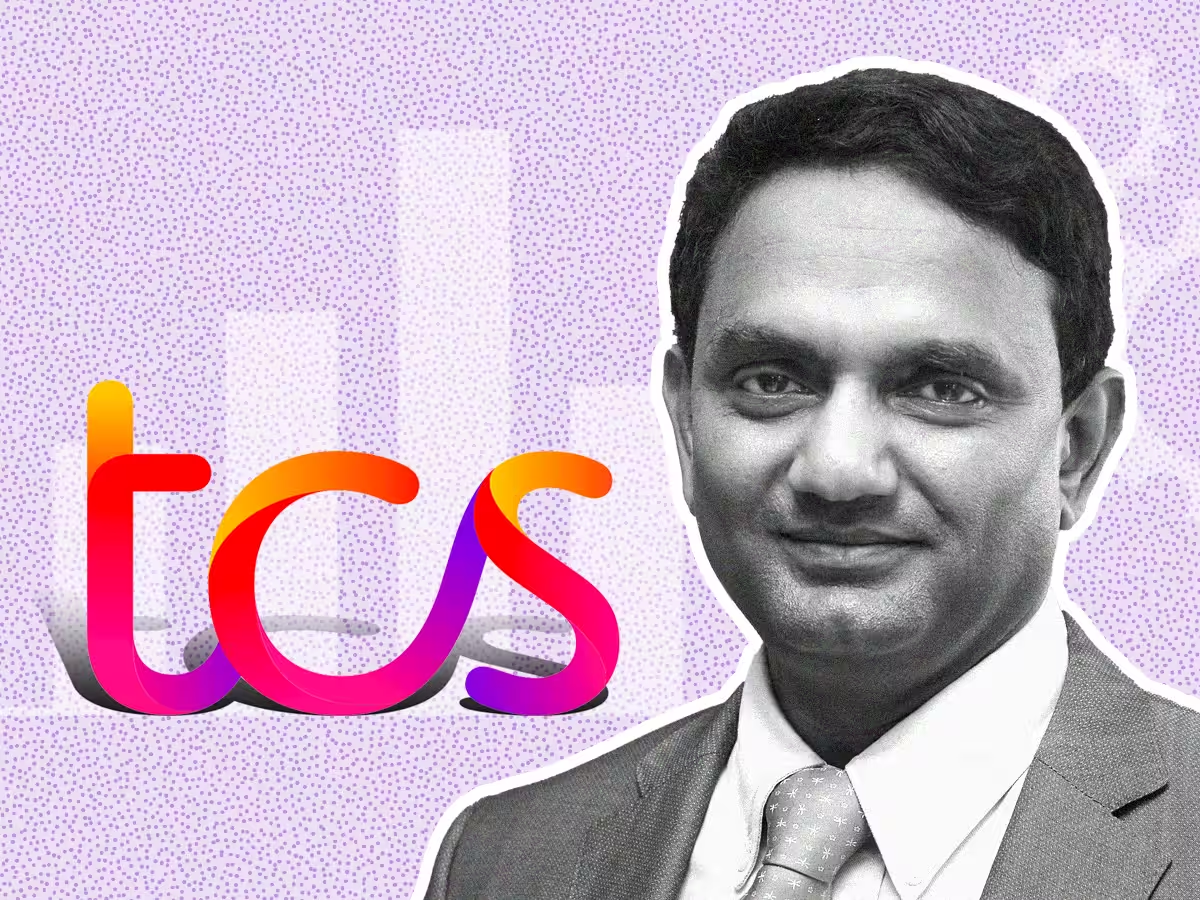
The IT giant posted a 13.9% year-on-year increase in rupee terms on Thursday. That headline number looks solid until you compare it to the flat quarter-over-quarter trajectory. Krithivasan attributed the caution to macro conditions that have lingered since March 2024. The West Asia conflict he expected to ease has not.
Which sectors will drive the Q2 rebound?
Subramanian pointed to manufacturing and life sciences as the turnaround candidates. Both sectors have faced budget freezes and delayed decision cycles for over a year. She expects them to turn positive in the coming quarters, though she stopped short of promising double-digit growth.
The company's headcount strategy reflects this cautious optimism. Krithivasan said TCS constantly evaluates where to hire based on customer requirements and calibrates against visible demand. Translation: no aggressive hiring until clients sign, not just talk.
What does the $2.6 billion AI revenue figure actually mean?
Subramanian clarified a number that has circulated in analyst notes. The $2.6 billion refers specifically to pure-play AI transformation projects. This is not AI sprinkled into existing contracts. It counts only new deals where artificial intelligence is the core deliverable.
Enterprises ran numerous pilots through 2024 and into 2025. Last year, those pilots started scaling into production workloads. TCS sees that momentum continuing. The company did not break out margins on AI work versus traditional services, but transformation projects typically command premium rates.
B Capital: India's IPO market is maturing

In a separate conversation, B Capital's Howard Morgan and Karan Mohla offered a bullish read on India's public markets. Morgan, the firm's cofounder and general partner, noted that IPO pricing for venture-backed companies has largely stabilized. A few years ago, going public in India meant volatile pricing and thin liquidity. Not anymore.
“A few years ago, it was very hard to do an IPO in India, and the pricing wasn't very stable. Now, the market has gotten deeper, so there is decent pricing.”
— Howard Morgan, Cofounder and General Partner, B Capital
Domestic mutual funds have added a support layer that did not exist a decade ago. Indian retail and institutional investors now have more experience valuing tech companies beyond traditional profitability metrics. Mohla expects further loosening on IPO pricing once foreign institutional investors return. He predicts that inflow in the second half of 2025.
B Capital recently closed Ascent Fund III at roughly $500 million, nearly doubling its previous fund. The firm has been vocal about AI startup investments, and the larger fund gives it more firepower for growth-stage deals in India and Southeast Asia.
Quick commerce under regulatory scrutiny

Separate from the TCS and B Capital news, regulators are circling quick commerce. The All India Consumer Products Distributors Federation has asked the government to examine whether Amazon and Flipkart's quick commerce expansion complies with FDI rules. Zepto's corporate structure has also triggered investor questions.
India's FDI regime allows foreign-owned ecommerce platforms to run marketplaces but bars them from owning inventory or influencing prices. Dark store networks complicate that line. Who actually owns the inventory sitting in a Blinkit dark store? Who sets the price? These questions have surfaced before around exclusive seller partnerships and deep discounting. They are resurfacing now as platforms chase higher-margin categories.
Late-stage private funding surges
Private late-stage cheques are getting bigger in India. While the source did not detail specific rounds, the pattern matches a global trend: as IPO windows tighten, growth-stage companies raise larger private rounds to extend their runway. For B Capital and peers, this creates both opportunity and competition. More capital chasing fewer proven companies tends to compress returns.
Logicity's Take
TCS's $2.6 billion AI figure deserves scrutiny. It sounds large, but against annual revenue exceeding $29 billion, it represents under 9% of the business. The real question is growth rate: if pure-play AI projects double year-over-year while traditional services stay flat, the mix shift matters. For CIOs evaluating vendors, the takeaway is that TCS is building AI-specific capacity, not just relabeling existing work. Compare this to Infosys and Wipro, which have disclosed similar AI revenue metrics with varying definitions. The definition matters as much as the number.
Frequently Asked Questions
What was TCS's Q1 FY26 revenue growth?
TCS reported flat sequential growth and a 13.9% year-on-year increase in rupee terms for Q1 FY26.
What is TCS's AI revenue pipeline?
TCS disclosed $2.6 billion in AI revenue from pure-play transformation projects, not AI features added to existing contracts.
Why does B Capital expect India IPO pricing to improve?
B Capital expects foreign institutional investors to return in H2 2025, adding liquidity and loosening pricing for venture-backed IPOs.
What regulatory concerns affect quick commerce in India?
Industry bodies have asked the government to examine whether quick commerce expansions by Amazon, Flipkart, and others comply with FDI rules restricting inventory ownership by foreign platforms.
Another Indian tech company preparing for public markets as IPO sentiment improves
Need Help Implementing This?
If you're evaluating IT service partners for AI transformation or tracking India's tech IPO landscape for investment decisions, Logicity's research team can help. Contact us for custom briefings.
Source: Tech-Economic Times
Manaal Khan
Tech & Innovation Writer
Produced with AI assistance and reviewed by the Logicity editorial team. Learn more in our Editorial Policy.




