Key Takeaways
- Nadella argues companies pay for AI twice: once with money, once with proprietary knowledge fed into models
- Model providers learn from customer corrections and prompts, creating one-way information flow
- Enterprises need private learning environments and control over their own data to compound value
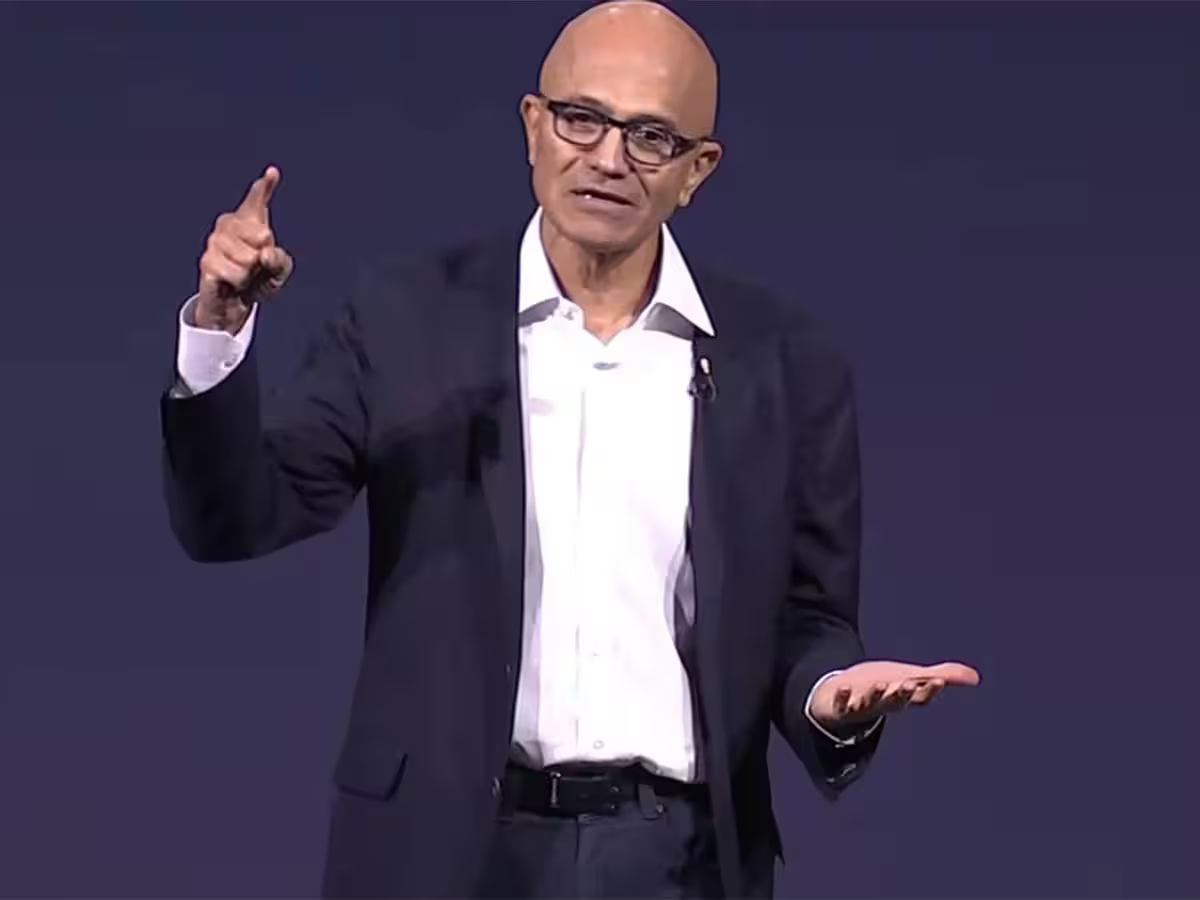
Microsoft CEO Satya Nadella is warning enterprises about a problem he calls the reverse information paradox. The core issue: companies using AI models must feed them proprietary knowledge to get useful results. That knowledge then flows to the vendor, not back to the buyer.
In a detailed post on X, Nadella inverted a classic economics concept. Nobel laureate Kenneth Arrow described a paradox where sellers risk giving away knowledge just to sell it. AI flips that dynamic. Now buyers risk giving away knowledge just to use what they bought.
“You essentially pay for intelligence twice, once with money, and again with something even more valuable: the proprietary knowledge you must reveal to make that intelligence useful. The better you want the model to perform, the more of that knowledge you have to feed it.”
— Satya Nadella, Chairman and CEO, Microsoft
How AI vendors learn from your corrections
Nadella's argument goes beyond standard data privacy concerns. He points out that AI models learn continuously from what he calls "exhaust." This includes user prompts, the tools agents access, and the corrections users make when a model gets something wrong.
Every time an employee fixes an AI output, that correction gets distilled into institutional knowledge. The vendor's model improves. The customer's competitive edge leaks out, trace by trace.
"It's the kind of knowledge a competitor could never buy, and the kind that leaks almost imperceptibly," Nadella wrote. "In consuming intelligence, you are creating intelligence. And what you create should belong to you."
The information asymmetry compounds over time. Vendors learn more about their customers with every interaction. Customers learn almost nothing about what vendors are learning from them.
The fair use double standard
Nadella highlighted an irony in how AI companies operate. Model providers train on public data using fair use rights. Then they impose restrictive terms on customers, prohibiting distillation and reserving the right to learn from usage patterns.
When learning flows in only one direction, economic value concentrates at the infrastructure layer. Knowledge creators lose out to infrastructure owners. Microsoft, worth roughly $3.1 trillion and having invested $13 billion in OpenAI, sits squarely in that infrastructure layer, which makes Nadella's candor notable.
His proposed solution: distribute learning infrastructure to every firm so each company controls its own learning loop.
What enterprises need to protect themselves
Nadella outlined five principles for securing what he called the "trust boundary." Companies need control, capability, choice, cost efficiency, and the ability to compound value over time.
- Create private evaluations that stay within the organization
- Retain ownership of organizational memory and institutional knowledge
- Build proprietary learning environments within tenant boundaries
- Decouple orchestration layers from any single model provider
The last point matters for long-term cost control. If your AI workflows depend entirely on one vendor's model, switching costs become prohibitive. Decoupling the orchestration layer, where tools like Zapier, Make, or n8n operate, lets enterprises swap models without rebuilding entire systems.
Disclosure
Some links in this post are affiliate links — Logicity earns a commission if you sign up, at no extra cost to you. We only link products we have used or actively recommend.
Palantir's CEO agrees: customers want production control
Nadella quoted Palantir CEO Alex Karp to reinforce his point. Technical customers increasingly demand autonomy over their entire stack.
“What the technical customers want is control over their compute, their models, their data stack, and their alpha. They want to know they own the means of production, and it's not being transferred to someone else.”
— Alex Karp, CEO, Palantir
This sentiment tracks with broader enterprise concerns. Surveys in 2024 showed roughly 77% of enterprise companies worried about data privacy when using AI tools. The reverse information paradox puts a finer point on that anxiety. It's not just about data breaches. It's about competitive knowledge bleeding out through normal, sanctioned usage.
Why this matters for CTOs making AI decisions
Nadella's warning has immediate implications for anyone evaluating AI vendors. Contract terms deserve scrutiny. Does the provider train on your data? Do they retain prompts? Can they use your corrections to improve models that competitors will also use?
Architecture choices matter too. Running models within your own tenant, using private deployments, or selecting vendors with strong data isolation commitments all address the paradox Nadella described.
The timing of Nadella's post is interesting. Microsoft sells both the AI models through Azure OpenAI Service and the enterprise tools, like Copilot, that use them. A cynic might say he's positioning Microsoft as the vendor that respects trust boundaries. A more generous read: he's describing a real structural problem that every enterprise AI buyer should understand.
Logicity's Take
Nadella is describing a problem Microsoft itself creates. Azure OpenAI Service retains prompts for 30 days by default, though enterprises can opt out. The candor is useful, but watch what vendors do, not just what their CEOs say. Companies serious about this should evaluate on-premises options like Ollama or private cloud deployments. For orchestration, open-source tools like n8n offer more control than proprietary alternatives, though with steeper setup costs.
Frequently Asked Questions
What is the reverse information paradox in AI?
It's the risk that buyers leak proprietary knowledge to AI vendors just by using the models. Unlike traditional transactions where sellers reveal information to make a sale, AI buyers must reveal their own knowledge to get useful results.
How do AI models learn from user corrections?
When users fix AI outputs, those corrections can be used to fine-tune models. Prompts, tool usage patterns, and feedback all become training signals that improve the vendor's models.
How can enterprises protect proprietary knowledge when using AI?
Nadella recommends private evaluations, retaining ownership of organizational memory, building proprietary learning environments within tenant boundaries, and decoupling orchestration from any single model provider.
Does Microsoft retain customer prompts in Azure OpenAI?
By default, Azure OpenAI Service retains prompts for 30 days for abuse monitoring. Enterprises can request to disable this retention through Microsoft's compliance process.
How AI is changing the knowledge work landscape that Nadella warns about
Need Help Implementing This?
Evaluating AI vendors with your data privacy in mind? Contact our team at Logicity.in for guidance on building enterprise AI architectures that protect proprietary knowledge while still delivering results.
Source: Tech-Economic Times / ET
Huma Shazia
Senior AI & Tech Writer
Produced with AI assistance and reviewed by the Logicity editorial team. Learn more in our Editorial Policy.




