Starcloud, the startup building satellites that run AI inference in orbit, has tacked a $250 million extension onto its March Series A, pushing its valuation to $2.3 billion. The money will fund a bigger manufacturing facility and accelerate Starcloud-3, the company's largest orbital data center spacecraft, designed to fly on SpaceX's still-unproven Starship rocket.
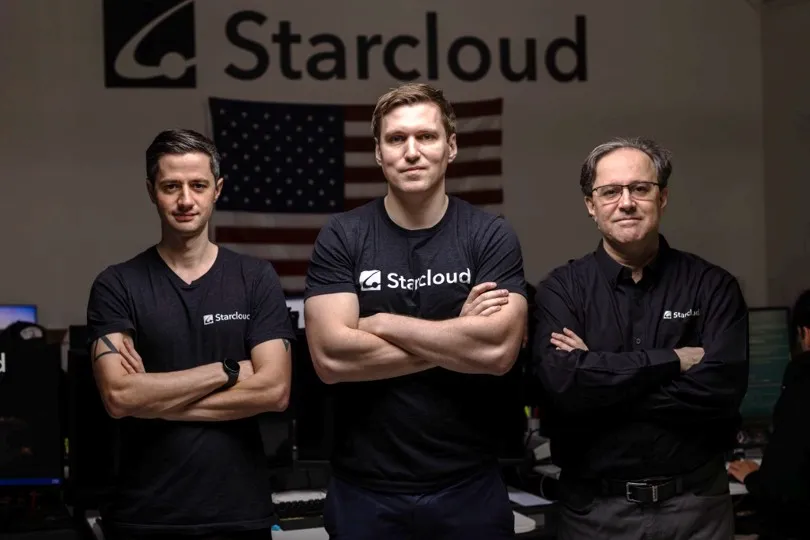
But CEO Philip Johnston isn't just chasing production scale. He's stockpiling capital to lock in launch contracts before the market tightens further. SpaceX plans to retire Falcon 9 by 2028, and alternatives aren't ready.
Why launch capacity is suddenly a strategic priority
"We can see what's coming—we're going to need to book an enormous amount of launch," Johnston told TechCrunch. "One of the biggest costs is now on securing your launch capacity... launch is pretty constrained right now because Falcon 9 program is scheduled to end in 2028."
The problem isn't just that Falcon 9 is retiring. It's that nothing else is flying regularly. Blue Origin's New Glenn and ULA's Vulcan haven't reached steady cadence. Rocket Lab's Neutron hasn't left the pad. SpaceX's own Starship, intended as the replacement workhorse, remains unproven for commercial payloads.
This week, Elon Musk said SpaceX will delay its next attempt to catch a returning Starship booster for "a few months," pushing a potential re-flight to late 2026 or early 2027.
"Obviously if we can't book any SpaceX launch capacity in 2029, that will be challenging for us," Johnston said. The candor is unusual. Most space startups speak optimistically about Starship's timeline. Johnston is betting on it while hedging against it.
Nvidia's $25 million bet on space GPUs
Manhattan West Ventures led the extension. Nvidia and Cisco participated, with Nvidia contributing $25 million, according to a person familiar with the deal. Other backers included Benchmark, EQT, Soma, NFX, 776, Cedar Capital, Goanna Capital, and Standard Capital.
Johnston frames the Nvidia investment as validation of Starcloud's technical lead. The company claims to be the only one currently operating an Nvidia H100 data center GPU in orbit, and the first to train a model using it. Most competing space chips target edge processing, not full inference workloads.
“The reason they've chosen to do this investment now is because of all of this data that we got from Starcloud One. They, more than any other VC, did way more technical duty on this than anybody else.”
— Philip Johnston, CEO of Starcloud
Starcloud is feeding operational data back to Nvidia as the chipmaker develops its first purpose-built space GPU: the Vera Rubin Space-1. The chip hasn't been built yet. Starcloud hopes to fly it in late 2028.
Near-term plans: 2027 rideshares, government contracts
Before Starship comes online, Starcloud is focused on launching two Starcloud-2 satellites, each drawing 8 kW for compute, on rideshare flights in 2027. Customers include US government agencies. The company is also weighing a dedicated Falcon 9 mission and signing contracts with other providers.
Johnston says his engineers are tracking three design problems with the Vera Rubin chip: the relationship between running temperature and radiator size, placement of radiation shielding, and the ruggedization needed to survive launch forces. The company, currently 25 employees, is building production lines at a 100,000 square foot facility in Woodinville, Washington, near SpaceX and Amazon satellite factories.
Another startup hitting unicorn status in a capital-intensive tech sector this month
The orbital compute thesis depends on launch economics
Starcloud's long-term pitch is straightforward: if Starship drives launch costs low enough, orbital inference can compete with terrestrial data centers for certain workloads. The physics are appealing. Space offers free cooling and solar power without permitting battles. Latency to LEO is comparable to cross-continental hops.
But the economics remain unproven. At least one orbital data center competitor has decided to build its own rockets rather than depend on SpaceX's timeline. Starcloud is betting it can secure enough capacity to scale without that vertical integration.
Logicity's Take
Starcloud's raise is real, but the interesting signal is Johnston's bluntness about launch risk. Most space startups treat Starship's timeline as a given. He's treating it as a variable to hedge. That's either prudent capital allocation or an early warning that Starship won't hit commercial readiness fast enough for the orbital compute wave to catch. Either way, the bottleneck has shifted from GPU availability to rocket availability. That's new.
Need Help Implementing This?
Logicity's team covers emerging infrastructure markets. If you're tracking space compute, cloud alternatives, or enterprise AI deployment options, subscribe for weekly briefings.
Source: TechCrunch / Tim Fernholz
Manaal Khan
Tech & Innovation Writer
Produced with AI assistance and reviewed by the Logicity editorial team. Learn more in our Editorial Policy.