Key Takeaways
Why Training Quality Beats Model Size in AI

- Soofi S activates only 3.2B of its 31.6B parameters per token, giving it 8x faster throughput than dense models at 40K context
- The model tops benchmarks for German, English, and code among fully open-source models, beating OLMo 3 32B and Apertus 70B
- Trained entirely on Deutsche Telekom's Munich AI cloud with 27 trillion tokens weighted heavily toward German data
A German research consortium has released Soofi S 30B-A3B, an open-source language model that claims the top spot on both English and German benchmarks among fully open models. The model, trained entirely on Deutsche Telekom's Industrial AI Cloud in Munich, beats larger competitors like OLMo 3 32B from the Allen Institute and ETH Zurich's Apertus 70B despite activating only a fraction of its parameters during inference.
The release marks a significant step for European AI sovereignty. Germany's KI Bundesverband coordinated the project, and the decision to train on domestic infrastructure signals the country's commitment to reducing dependence on US and Chinese compute resources.
How does Soofi S stay fast at long contexts?
Soofi S is a mixture-of-experts model containing 31.6 billion parameters total, but it activates only 3.2 billion per generated token. That puts its compute cost closer to a 3B model than a conventional 30B one.
The consortium adopted Nvidia's Nemotron 3 Nano architecture without modification. It combines Mamba-2 layers with standard attention layers in a hybrid design. The practical difference from typical transformers shows up in memory behavior. Conventional models maintain a KV cache storing previous tokens for attention computation. That cache grows linearly with context length. With long inputs and many parallel requests, reloading it becomes the bottleneck.
Soofi S sidesteps this problem. Only 6 of its 52 layers maintain such a cache. At 40,000 tokens with 32 parallel requests, the model generates roughly eight times more tokens per second per GPU than dense models in the 14 to 24 billion parameter range. While throughput drops significantly for conventional models as context grows, Soofi S stays nearly flat from 4,000 to 256,000 tokens.
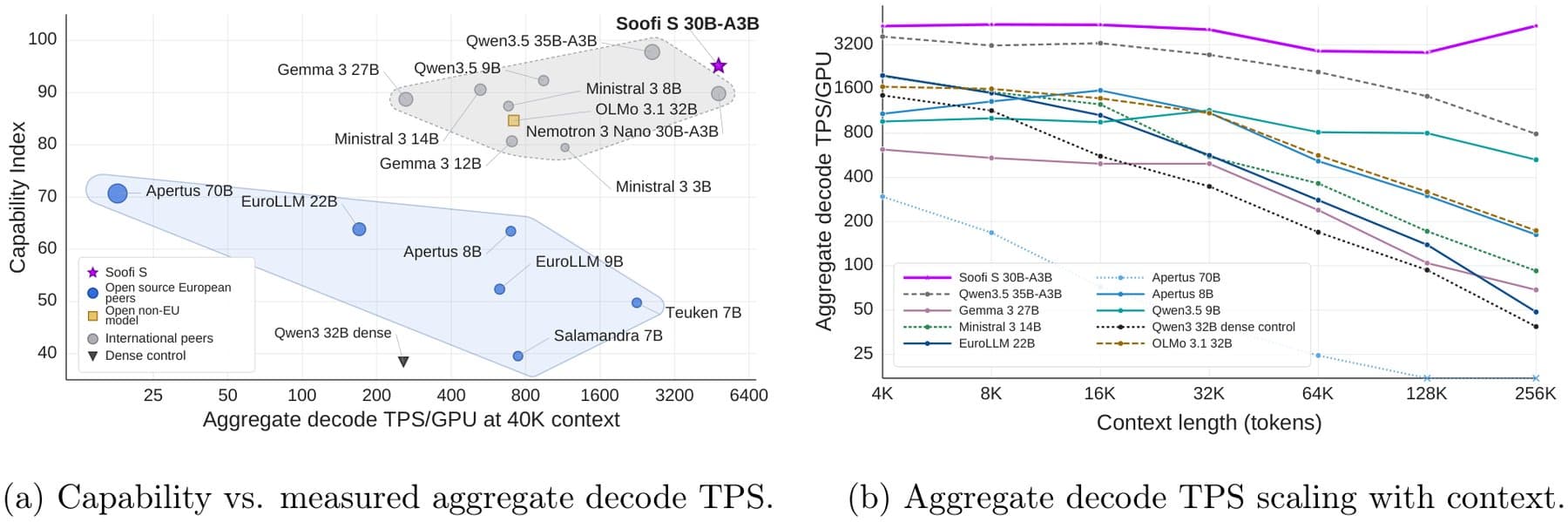
The only model showing similar throughput behavior in the measurements is Alibaba's Qwen3.5 35B-A3B, which also uses a hybrid architecture.
Why weight training data toward German?
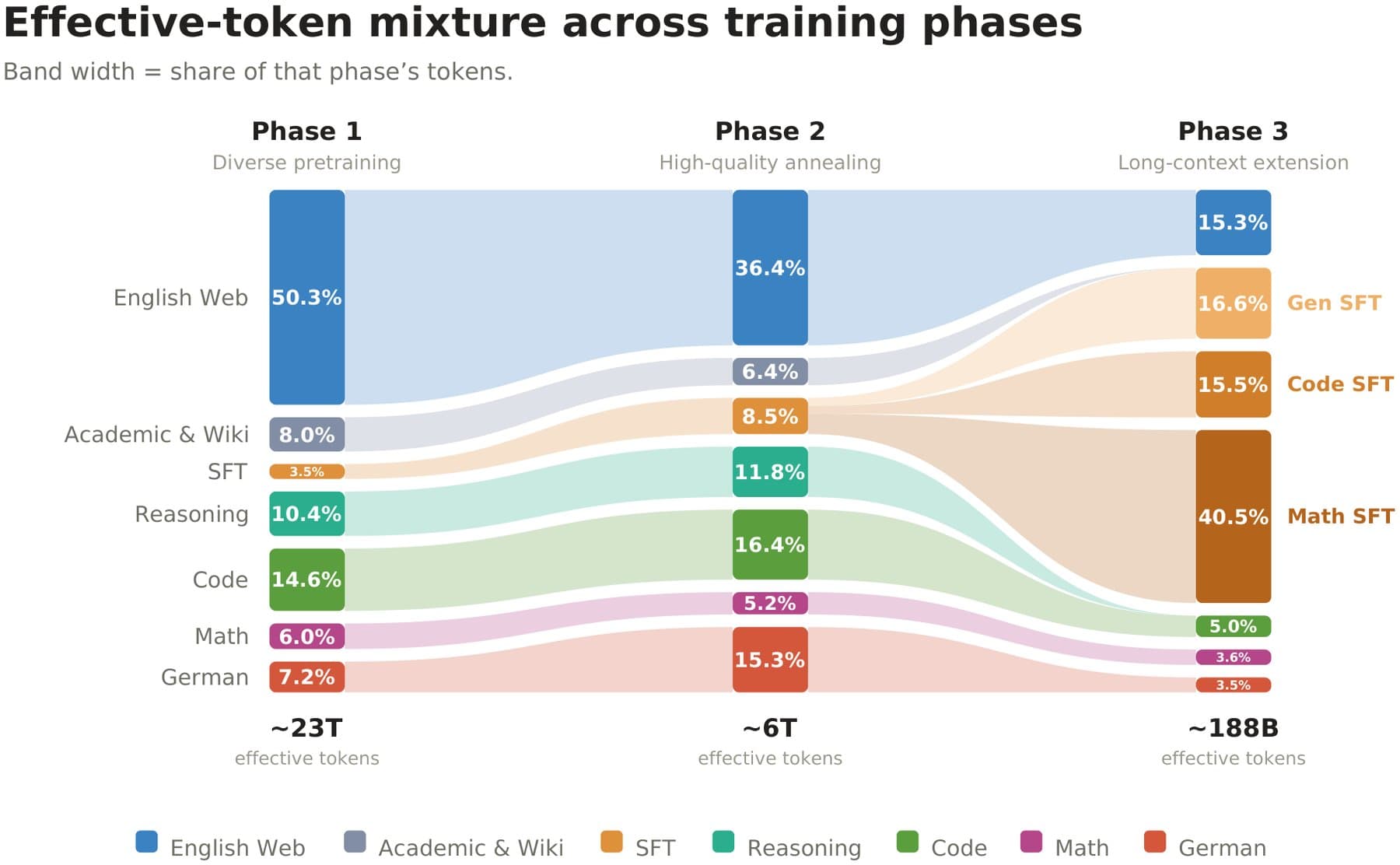
The consortium processed about 27 trillion tokens across three phases. In the first phase, roughly 20 trillion tokens cover language fundamentals from web, code, math, and domain-specific texts. A second phase adds 6 trillion tokens from higher-quality sources. A third phase extends the context window by training on documents up to one million tokens long.
German gets disproportionate weight. In phase one, German makes up 7.2 percent of the training mix. In phase two, that share rises to 15.3 percent. For comparison, Nvidia's Nemotron reference recipe allocates only about 5 percent to all non-English languages combined.
The German data comes from several sources: web text from HPLT, the openly licensed German Commons corpus, German portions of FinePDFs and FineWiki, and the commercially licensed Genios corpus containing 193 million newspaper articles from 916 German publications. Machine-translated and synthetically generated German texts round out the mix.
Benchmark results: German, English, and code
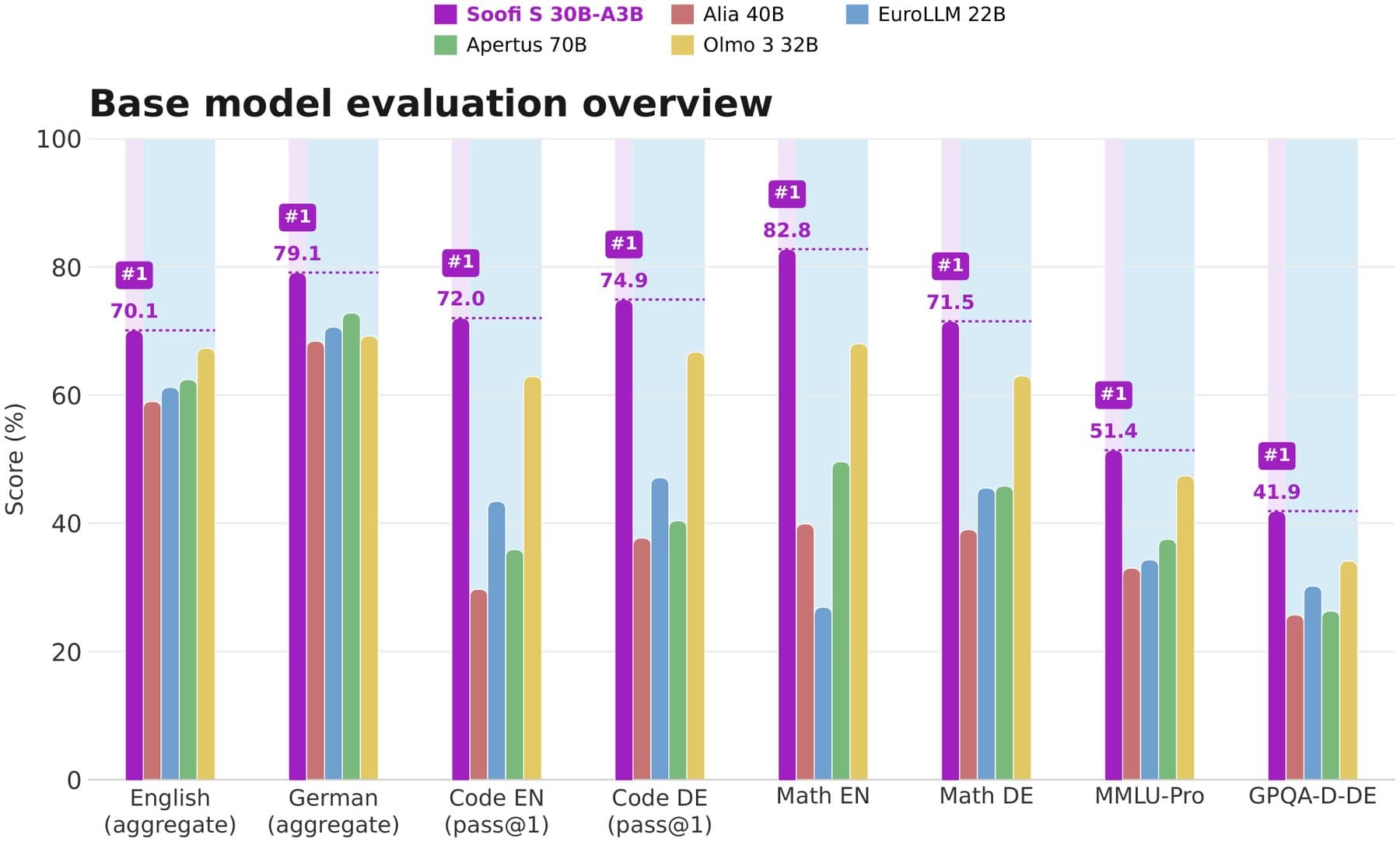
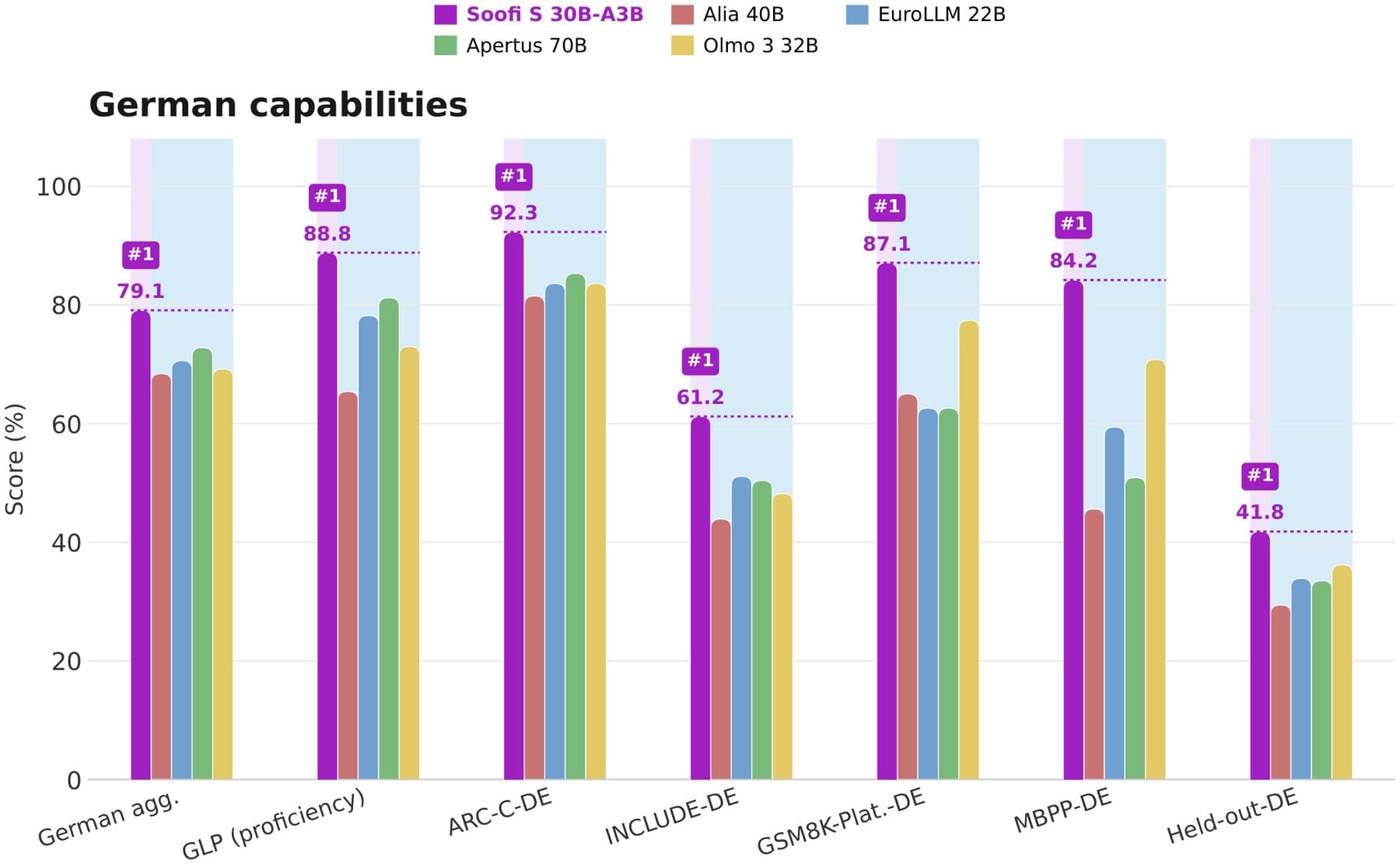
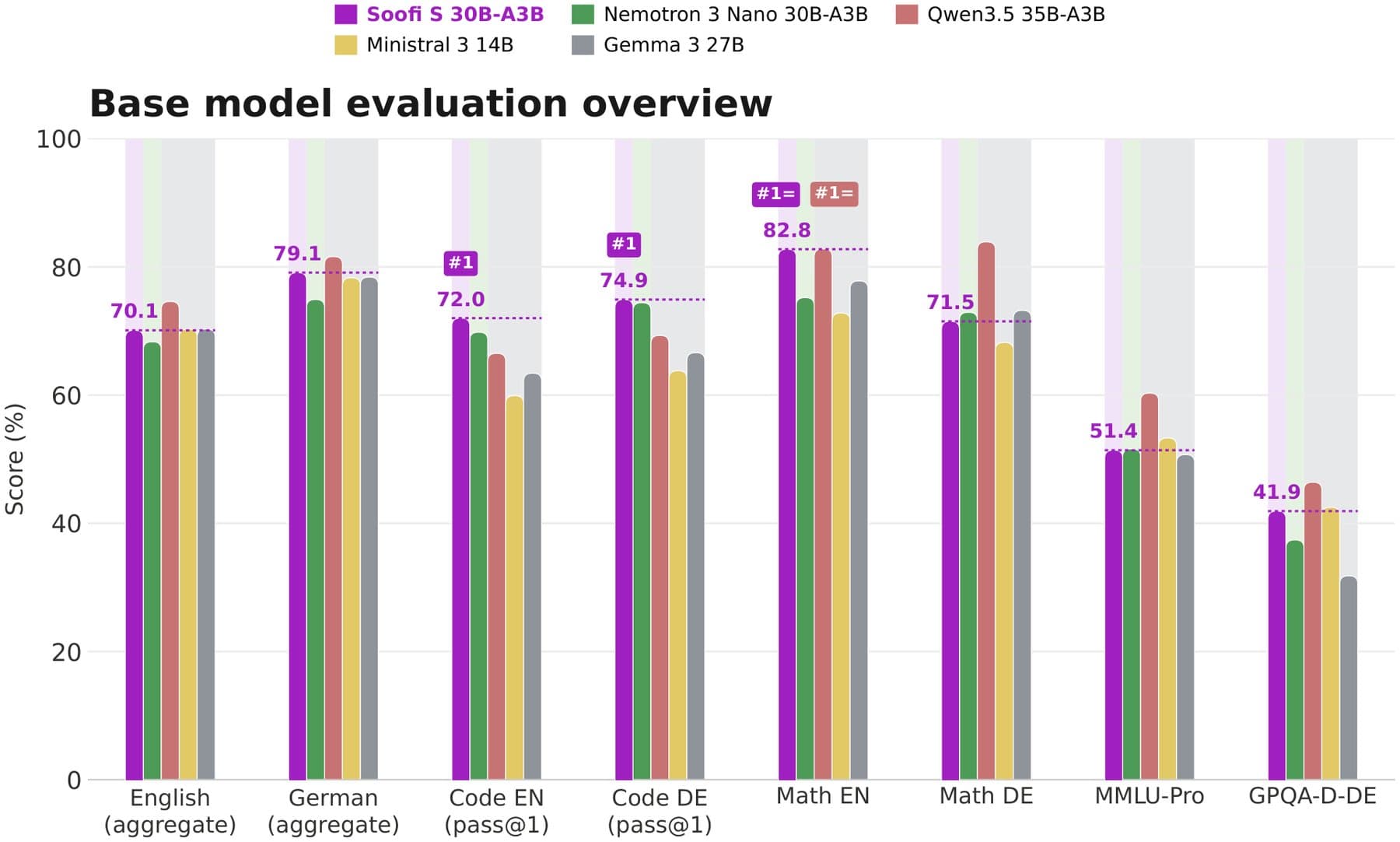
Against 16 other open models, Soofi S leads on aggregate scores for both German and English, according to the pretraining report. It beats OLMo 3 32B, Apertus 70B, Alia 40B, and EuroLLM 22B across the board. Against every European sovereign baseline, the model comes out ahead on all German benchmarks, sometimes by double-digit margins.
The German-specific results stand out. Soofi S scores 88.8 on GLP-DE, 92.3 on ARC-Challenge-DE, and 84.2 on the German MBPP coding benchmark. On INCLUDE-DE, a test for Germany-specific regional knowledge, it ties for first at 61.2 points with the larger Qwen3.5 35B-A3B.
On code benchmarks, Soofi S scores 73.8 percent on HumanEval, 70.2 on MBPP, and 84.2 on the German MBPP variant. These are the best results among open-source peers.
What does this mean for teams building in Europe?
For companies subject to GDPR or data residency requirements, Soofi S offers a strong open-source option that can run on-premises. The mixture-of-experts architecture keeps inference costs manageable. You get 30B-class capability at 3B-class compute.
The German-language performance matters for anyone building products targeting DACH markets. Most leading LLMs optimize for English first, treating German as a secondary language. Soofi S inverts that priority.
The throughput advantage at long contexts opens specific use cases: document analysis, legal review, customer service transcripts. Where dense models choke on 40K-token inputs, Soofi S maintains speed.
Logicity's Take
Soofi S is the most capable open model for German-language tasks we've seen. But the real story is the architecture. Mixture-of-experts models that activate 10% of parameters per token are becoming the default for efficient inference. Expect Anthropic, OpenAI, and Google to ship more models in this style. For product teams evaluating open models, Soofi S should be on your shortlist if you need German fluency, long-context support, or want to run inference in the EU. Compare it against Qwen3.5 35B-A3B for similar throughput characteristics, or Apertus 70B if you have the compute budget and need maximum capability.
Frequently Asked Questions
Is Soofi S fully open source?
Yes. The model weights, training code, and pretraining report are publicly available under open licenses.
What hardware do I need to run Soofi S?
The model activates only 3.2B parameters per token, so inference requirements are closer to a 3B model than a 30B one. A single high-end GPU can handle it, though multiple GPUs will improve throughput for parallel requests.
How does Soofi S compare to GPT-4 or Claude?
The benchmarks compare Soofi S only to other fully open models. It beats OLMo 3 32B and Apertus 70B but has not been directly compared to proprietary models like GPT-4 or Claude in the published report.
Can I fine-tune Soofi S for my use case?
Yes. As an open model, you can fine-tune it on your own data. The mixture-of-experts architecture may require some tuning adjustments compared to dense models.
Why was it trained on Deutsche Telekom infrastructure?
The project is part of Germany's push for AI sovereignty, reducing dependence on US cloud providers. Deutsche Telekom's Industrial AI Cloud in Munich provided the compute.
The compute infrastructure behind models like Soofi S relies on advanced chips from foundries like TSMC
Need Help Implementing This?
If you're evaluating open LLMs for your product or need help deploying Soofi S in a European infrastructure, reach out to the Logicity team. We can connect you with engineers who've deployed mixture-of-experts models in production.
Source: The Decoder / Jonathan Kemper
Huma Shazia
Senior AI & Tech Writer
Produced with AI assistance and reviewed by the Logicity editorial team. Learn more in our Editorial Policy.