Key Takeaways

- Air conditioning uses 7% of global electricity and is set to triple by 2050, driving urgent interest in alternatives
- Solid-state cooling systems avoid harmful refrigerants but struggle to match the efficiency of compressor-based units
- Even capturing 5% of the AC market could yield significant climate impact, but room-scale prototypes are years away
Solid-state cooling could eliminate the refrigerants that make air conditioners a climate liability, but the technology faces a basic physics problem: it cannot yet move enough heat to compete with compressors at room scale. That gap has not stopped a wave of startups from testing prototypes in apartments and supermarkets, betting that even partial adoption could matter as global AC installations are projected to triple by 2050.
Traditional air conditioners work by compressing and expanding a refrigerant, a cycle that efficiently transfers heat but relies on chemicals with global warming potential more than 2,000 times that of carbon dioxide. Solid-state systems replace that cycle with materials that change temperature when exposed to electric currents, magnetic fields, or mechanical pressure. No compressor. No refrigerant. Fewer moving parts.
The trade-off is efficiency. Most modern HVAC systems achieve a coefficient of performance (COP) of around 3, meaning they move three units of heat for every unit of energy consumed. Thermoelectric solid-state devices tend to perform worse at high temperature differentials, explains Jeff Snyder, a professor at Northwestern University who studies thermal conductivity. That limitation confines them to niche applications: cooling a car seat, chilling a mini fridge, managing heat in high-end gaming PCs.
Who is testing solid-state cooling right now?
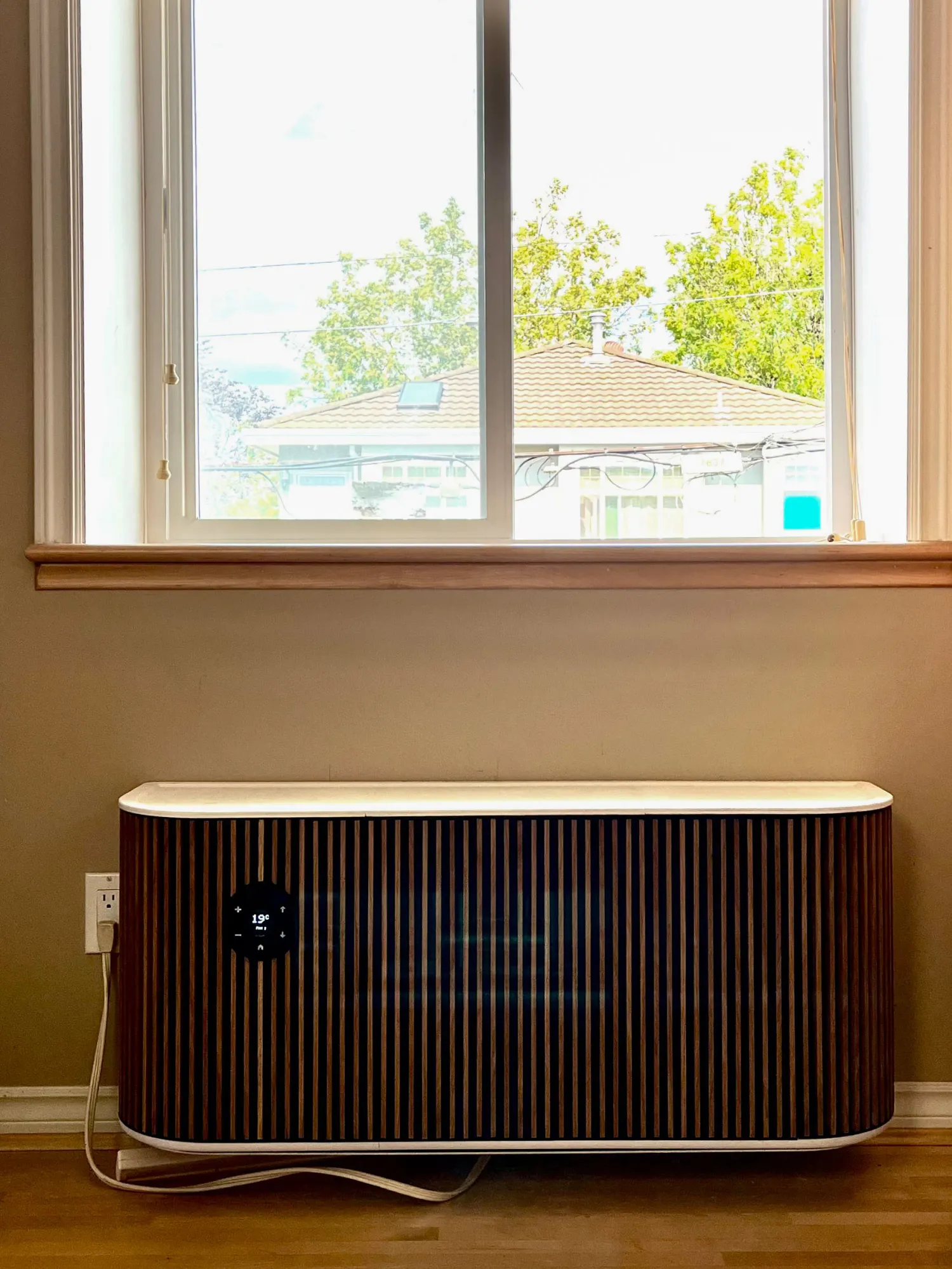
Brooklyn-based Mimic Systems is running a pilot of its thermoelectric room-scale unit in a Vancouver apartment. The German company Magnotherm is preparing to test a magnetocaloric system in a supermarket chain. A Hong Kong research team claims its elastocaloric device, which heats and cools as a material expands and contracts, can dip below 0°C. The UK's Barocal is developing a barocaloric approach that manipulates temperature through pressure shifts.

Each approach has different strengths on paper. Magnetocaloric systems use materials like gadolinium that heat up when magnetized and cool when the field is removed. Elastocaloric devices rely on shape-memory alloys that release heat when compressed. Barocaloric systems exploit pressure-induced phase changes. All avoid refrigerants. None have proven they can cool a living room as cheaply as a $400 window unit.
Why efficiency remains the core challenge
"One of the key questions that remain is why are the solid-state coolers not as efficient as typical thermodynamic cycles?" asks Pramod Reddy, a professor of mechanical engineering at the University of Michigan. The answer involves thermal management. Solid-state materials can generate a temperature change, but transferring that cold to a large volume of air requires moving heat quickly through interfaces, a problem compressors solve with forced airflow and liquid refrigerants.
Engineers on Hacker News and Reddit's r/technology forums have voiced similar skepticism. The "thermal bottleneck" is well understood in lab settings: caloric materials work beautifully for small objects, but the sheer volume of air exchange required for residential cooling makes scaling difficult. A mini fridge and a bedroom are different problems.
The case for trying anyway
Efficiency metrics do not capture the full picture, argues Lindsay Rasmussen, a manager at the Rocky Mountain Institute's climate tech accelerator Third Derivative, which backs both Magnotherm and Mimic. Most US air conditioners use R410A refrigerant, a potent greenhouse gas that leaks during use and disposal. Solid-state units also have fewer moving parts, potentially making them more durable.
Rasmussen notes that comparing long-term energy consumption, not just COP, matters. Mimic claims its room-scale prototype should match the annual energy draw of a conventional AC unit. If true, that changes the calculus: equal energy use without the refrigerant liability. The company has not published independent verification.
Elastocaloric and barocaloric systems are earlier in development. Room-scale prototypes are probably two to three years away, according to Rasmussen. That timeline means these technologies are not arriving in time for the current surge in AC demand, but could matter for the next wave of installations.
What a 5% market share would mean
Air conditioning accounts for 7% of global electricity consumption and 3% of greenhouse gas emissions. The International Energy Agency projects AC units will triple by 2050, driven largely by rising temperatures and economic growth in India and Southeast Asia. One Lancet study estimated that AC prevented nearly 200,000 premature deaths in 2019 alone. The demand is not negotiable.
No one expects solid-state cooling to replace compressor-based AC entirely. The likelihood is slim, given the efficiency gap. But even modest adoption could matter at scale. "If solid-state could take over even a 5% market share," Rasmussen says, "that is a really large potential impact." Five percent of a tripled global fleet is still hundreds of millions of units.
The bottom line for the industry
Solid-state cooling is a bet on materials science outpacing thermodynamics. The startups running pilots today are not claiming they have solved the efficiency problem. They are arguing that refrigerant-free operation and mechanical simplicity might offset a COP gap, especially as regulations tighten on hydrofluorocarbons.
For building operators and HVAC decision-makers, the technology is not ready to specify. Watch the Vancouver and supermarket pilots for independent data. The physics skeptics may be right. But if solid-state systems can get close enough on efficiency, the regulatory and durability advantages could carve out a real market, even if it is not the whole market.
Background on the energy stakes driving solid-state cooling research
Frequently Asked Questions
How does solid-state cooling differ from traditional air conditioning?
Traditional AC uses compressors and refrigerants to transfer heat through vapor compression. Solid-state cooling uses materials that change temperature when exposed to electric currents, magnetic fields, or mechanical pressure, eliminating the need for chemical refrigerants.
Why are solid-state air conditioners less efficient than compressor-based systems?
Solid-state materials can generate temperature changes, but transferring that cold to large volumes of air efficiently remains difficult. The thermal management challenge, moving heat from the material to the air, limits performance at room scale.
When will solid-state cooling be available for residential use?
Thermoelectric prototypes are in pilot testing now. Elastocaloric and barocaloric room-scale systems are estimated to be two to three years away from prototype stage, with commercial availability likely further out.
What is the environmental benefit of solid-state cooling?
Solid-state systems eliminate refrigerants like R410A, which has a global warming potential over 2,000 times that of CO2. They also have fewer moving parts, potentially reducing maintenance and disposal issues.
Logicity's Take
The solid-state cooling story is less about physics breakthroughs than regulatory arbitrage. As HFC phase-downs accelerate under the Kigali Amendment, any technology that avoids refrigerants gains a cost advantage, even if its raw efficiency lags. The smart money is not betting on solid-state systems replacing compressors everywhere. It is betting they can win in markets where refrigerant compliance costs tip the economics, think EU commercial buildings and California new construction. The 5% market share threshold Rasmussen mentions is achievable without beating compressors on efficiency. It just requires being good enough in the right regulatory environments.
Need Help Implementing This?
Logicity works with technology leaders navigating energy and sustainability decisions. If you are evaluating HVAC alternatives or need analysis on emerging climate tech, reach out to our research team for a briefing tailored to your operations.
Source: MIT Technology Review
Huma Shazia
Senior AI & Tech Writer
Produced with AI assistance and reviewed by the Logicity editorial team. Learn more in our Editorial Policy.