Key Takeaways
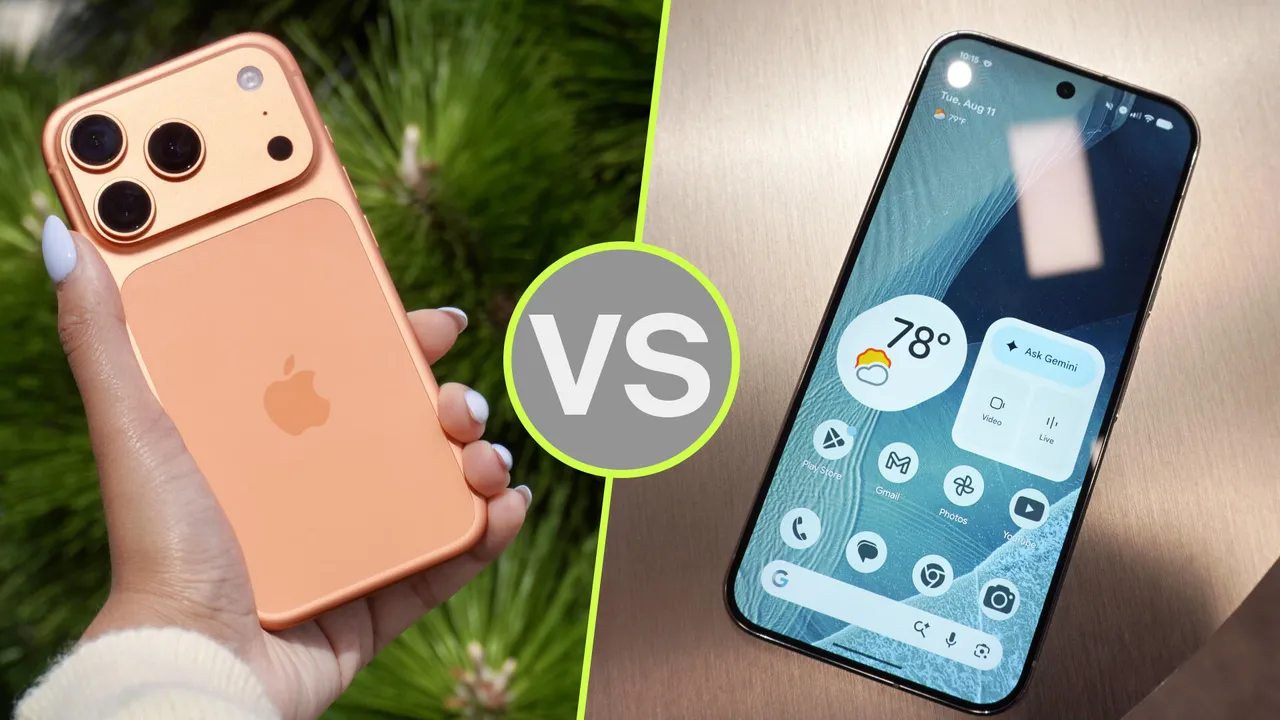
- Both phones share 6.3-inch AMOLED displays and 12GB RAM, but Pixel hits 3,600 peak nits vs iPhone's 3,000
- Pixel 11 Pro ships with Gemini calling businesses on your behalf; iPhone 17 Pro awaits iOS 27 for similar Siri features
- iPhone 17 Pro charges faster (40W vs 30W) while Pixel offers a larger 4,850mAh battery
Google's Pixel 11 Pro and Apple's iPhone 17 Pro both launch at $1,099, target power users who want flagship performance without a 6.9-inch slab, and share nearly identical screen sizes. The differences show up in processor philosophy, AI assistant maturity, and camera systems. Here's where each phone pulls ahead.
| Spec | Google Pixel 11 Pro | Apple iPhone 17 Pro |
|---|---|---|
| Display | 6.3-inch AMOLED, 3,600 peak nits | 6.3-inch AMOLED, 3,000 peak nits |
| Battery | 4,850mAh | 4,252mAh |
| Wired charging | 30W | 40W |
| Wireless charging | 25W | 30W |
| Main camera | 50MP | 48MP |
| Telephoto | 48MP / 5x optical | 48MP / 8x optical |
| Selfie camera | 42MP | 18MP Center Stage |
| Processor | Tensor G6 | A19 Pro |
| RAM / Storage | 12GB or 16GB / 256GB-1TB | 12GB / 256GB-1TB |
| Starting price | $1,099 | $1,099 |
Where the Pixel 11 Pro wins
Google co-designed the Tensor G6's silicon with DeepMind specifically to run on-device AI with lower latency. The practical payoff: Gemini can now dial businesses and complete tasks while you watch a live transcript. If the call goes sideways, you take over mid-sentence. Apple's Siri will gain comparable capabilities in iOS 27, but that update won't land until September. Buyers who want autonomous AI agents today get them on Pixel, not iPhone.
Pixel also brings back the notification LED in a new form called HiLight, an ambient LED array built around the camera flash. It sounds minor until you remember how useful a glanceable alert was before phones buried everything under always-on displays. The 11 Pro's display itself peaks at 3,600 nits, 600 nits brighter than the iPhone 17 Pro, which matters in direct sunlight.
Battery capacity tilts toward Google as well. The Pixel 11 Pro packs 4,850mAh against the iPhone's 4,252mAh. Apple partially compensates with faster wired charging (40W vs 30W), but if your use case demands all-day runtime over quick top-ups, Google has the edge.
Deeper look at the AI strategy behind this year's Pixel lineup
Where the iPhone 17 Pro wins
Apple's telephoto lens offers 8x optical zoom against Google's 5x. For portrait shooters and anyone who crops heavily, that extra reach matters more than megapixel counts. The iPhone also introduces an 18MP Center Stage selfie camera that keeps subjects framed automatically during video calls, a feature Apple has refined on iPads for years.
Charging speed is another clear Apple advantage. The iPhone 17 Pro's 40W wired and 30W wireless charging outpace Pixel's 30W and 25W respectively. If your workflow means grabbing 15-minute charges between meetings, the iPhone refills faster.
Ecosystem lock-in cuts both ways. iPhone owners already inside Apple's walled garden, with AirPods, Apple Watch, and Mac handoffs, get seamless continuity that Google still can't fully match. The A19 Pro chip also tends to hold a raw benchmark lead over Tensor, though real-world differences are negligible for most tasks outside sustained video exports.
AI assistant: Gemini vs Siri in 2026
This is the biggest functional gap. Gemini on Pixel 11 Pro can pull contextual data across your apps and act on it. Rambler, a new voice-to-text feature, strips filler words and formats your dictation before you send it. The assistant calling feature, where Gemini phones a business and handles the interaction, ships now.
Apple promises similar upgrades for Siri in iOS 27, but promises aren't software. If you're buying in August 2026, the Pixel's AI stack is production-ready while the iPhone's is still in preview. Google also bundles six months of Google AI Pro with the purchase, covering expanded Gemini limits, 5TB of cloud storage, and Google Health Premium, a $119 value.
Logicity's Take
The real split is philosophical. Google is selling an AI-first device where hardware exists to run Gemini well. Apple is selling premium hardware that will eventually run better AI. If you need agentic features now, buy the Pixel. If you're locked into Apple's ecosystem and can wait for iOS 27, the iPhone 17 Pro's camera and charging speed justify the same $1,099.
Which should you buy?
For CTOs and founders evaluating device policies, the Pixel 11 Pro's AI capabilities make it a stronger productivity tool today. The ability to delegate calls and automate routine tasks through Gemini is genuinely useful for executives who spend hours on logistics. The HiLight notification LED and brighter display are small conveniences that add up.
The iPhone 17 Pro makes more sense if you already own an Apple Watch, use AirDrop constantly, or prioritize telephoto zoom. Its faster charging also suits travel-heavy schedules. Both phones are excellent. The decision comes down to whether you're buying into Google's AI bet or Apple's ecosystem play.
The wearable comparison that completes this ecosystem decision
Frequently Asked Questions
Do the Pixel 11 Pro and iPhone 17 Pro cost the same?
Yes, both start at $1,099 for the base storage tier (256GB). Higher storage options scale similarly on both devices.
Which phone has better battery life?
The Pixel 11 Pro has a larger 4,850mAh battery compared to the iPhone 17 Pro's 4,252mAh. However, Apple's more efficient chipset may close the gap in real-world use.
Can Siri do what Gemini does on the Pixel 11 Pro?
Not yet. Apple has announced similar features for iOS 27, expected in September 2026. Until then, Gemini's calling and contextual AI features are Pixel-exclusive.
Need Help Implementing This?
Looking to standardize device policies for your team? Reach out to Logicity's consulting partners for enterprise mobile strategy guidance.
Source: Latest news
Huma Shazia
Senior AI & Tech Writer
Produced with AI assistance and reviewed by the Logicity editorial team. Learn more in our Editorial Policy.