Key Takeaways
ChatGPT Work for Sales: Account Research and Customer Outreach
- 43.5% of job-specific ChatGPT queries involve tasks traditionally assigned to other professions
- Marketing and engineering tasks cross over most frequently, with non-specialists handling contract reviews, data analysis, and website troubleshooting
- The effect is strongest at small companies where dedicated specialist teams are less common
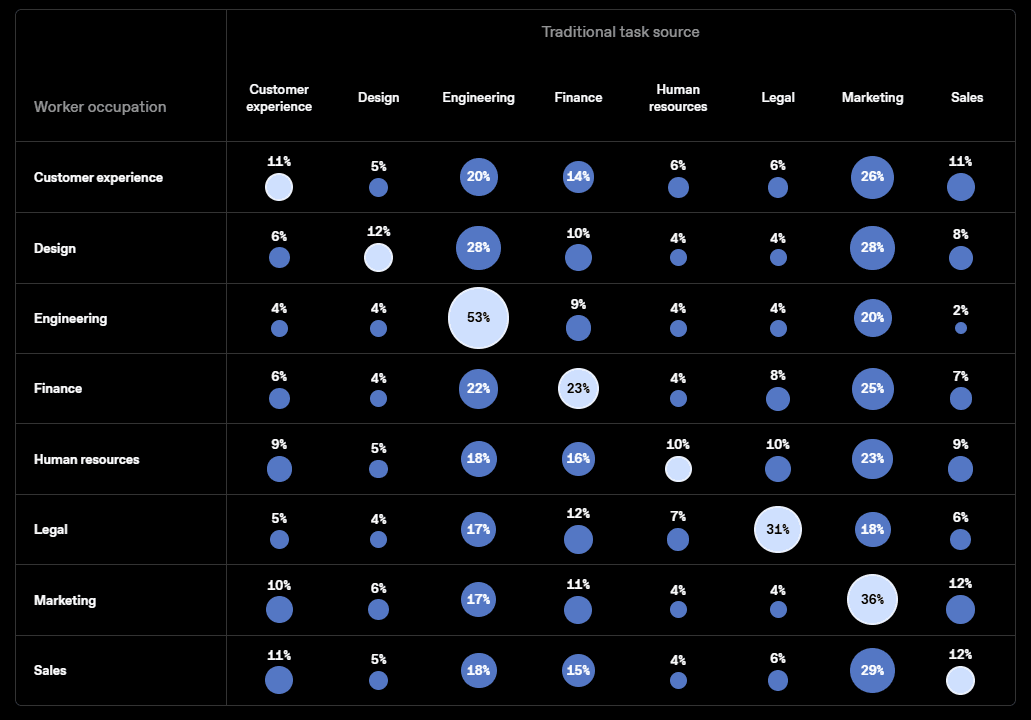
OpenAI published an analysis of more than 800,000 work-related ChatGPT messages and found that 43.5 percent of job-specific queries involved tasks belonging to a different profession. The company calls this phenomenon "task crossover," and it sees the pattern as an early signal that job profiles are shifting before job titles or descriptions catch up.
Marketing and engineering tasks crossed over most often. Users are handling work once left to specialists: contract reviews, data analysis, website troubleshooting. At smaller companies, where dedicated specialist teams are rare, non-specialists are especially likely to use AI for marketing tasks.
How OpenAI measured task crossover
OpenAI classified tasks using the U.S. occupational database O*NET, which maps activities to standard job profiles. The methodology excluded common tasks like writing, summarizing, and scheduling. What remained were the job-specific queries, the kind of work that traditionally required subject-matter expertise or a specialist hire.
By filtering out generic requests, OpenAI isolated the queries where users explicitly asked ChatGPT to perform work that belongs, by formal classification, to another occupation. A founder asking ChatGPT to troubleshoot a server configuration counts. A founder asking ChatGPT to summarize meeting notes does not.
The 43.5 percent figure is striking because it suggests nearly half of all specialized work queries come from people outside that specialty. The remaining 56.5 percent came from users asking about tasks within their own professional domain, using AI as an accelerant rather than a substitute for expertise they lack.
Why small companies see more crossover
The effect is strongest at smaller companies, and the reason is structural. A 500-person company has a legal team, a dedicated marketing department, and DevOps engineers. A 15-person startup has a founder who does contracts, a generalist who handles marketing, and one engineer who manages infrastructure between feature sprints.
At small scale, everyone wears multiple hats. ChatGPT makes those hats fit better. The founder who used to spend two hours reviewing a contract with Google searches and template comparisons can now get a first-pass analysis in minutes. The generalist can generate campaign copy that would have previously required a freelancer or agency.
This does not mean the quality matches a specialist's output. But for many small-company decisions, 80 percent quality at 10 percent of the cost and time is a rational tradeoff. The question is whether companies recognize when they have crossed from "good enough" into "dangerously inadequate," particularly for high-stakes tasks like legal review.
Marketing and engineering dominate the crossover chart
Marketing and engineering tasks crossed over most frequently in OpenAI's data. This makes sense. Marketing is a discipline where the barrier to entry is low, the feedback loop is fast, and the cost of a mediocre first draft is minimal. Writing ad copy, drafting email sequences, outlining content calendars: these are tasks that non-marketers can attempt, and ChatGPT can help them reach competence faster.
Engineering crossover is more interesting. Non-engineers are asking ChatGPT to troubleshoot websites, debug code snippets, and configure systems. The AI cannot replace a senior engineer's judgment, but it can explain error messages, suggest fixes, and walk a non-technical user through a diagnostic process. For small teams, that capability is transformative.
Contract review also appeared prominently. Legal work has always been expensive and gatekept by professional licensing. ChatGPT cannot practice law, but it can highlight unusual clauses, explain standard terms, and flag provisions that warrant attention from actual counsel. For routine agreements, that pre-screening reduces legal spend.
OpenAI's recent open-source security tool shows the company expanding its developer-facing capabilities
What this means for specialists
The optimistic framing: specialists can focus on higher-value work while AI handles routine tasks. The realistic framing: some specialist roles will shrink because non-specialists can now handle a larger share of the work.
This is not a new dynamic. Spreadsheets eliminated bookkeeping jobs. Desktop publishing killed typesetting. But the speed of AI adoption is different. A technology that makes non-specialists competent at 43.5 percent of specialized queries, within two years of launch, is moving faster than previous automation waves.
For specialists, the defensible position is work that requires judgment, accountability, or physical presence. A lawyer reviewing a contract with ChatGPT's help is still valuable because the lawyer bears liability. A DevOps engineer is still valuable because when the production server goes down at 2 a.m., someone needs to fix it, and that someone needs to understand the system deeply enough to improvise.
The vulnerable position is work that is repeatable, low-stakes, and does not require professional licensing. Entry-level marketing tasks, basic data analysis, routine documentation: these are the tasks where AI-assisted non-specialists can deliver acceptable results.
The gap between task shift and title shift
OpenAI's most interesting observation is that job profiles are shifting before job titles or descriptions catch up. Companies are not yet rewriting job descriptions to say "must be comfortable using AI for tasks outside your specialty." But that is functionally what many roles now require.
The lag creates friction. HR departments hire based on old job descriptions. Managers evaluate performance against outdated expectations. Employees who embrace AI for cross-functional work may be seen as overstepping their role, even when they are adding value.
The companies that adapt fastest will formalize what is already happening. They will update job descriptions to reflect the reality that a marketing manager who can also troubleshoot WordPress, review vendor contracts, and analyze campaign data is more valuable than one who can only write copy. They will build internal playbooks for when AI-assisted work is acceptable and when it requires specialist review.
Enterprise consulting firms are seeing revenue growth from AI implementation projects
Implications for AI product teams
For teams building AI products, the task crossover data suggests a design principle: build for non-specialists. The users who will benefit most from your product are not experts looking to accelerate; they are generalists looking to become competent in adjacent domains.
This has concrete implications. Your onboarding should not assume domain knowledge. Your error messages should explain, not just report. Your documentation should cover the common mistakes that non-specialists make. You should test with users who are new to the domain, not just power users who already know the work.
The market opportunity is also clear. Vertical AI products that help non-specialists perform specialist tasks have a larger addressable market than products that help specialists work faster. A legal AI product for lawyers competes for a small audience; a legal AI product for founders reviewing their first contract competes for everyone starting a company.
Logicity's Take
OpenAI's data quantifies something founders and operators have known anecdotally: AI is collapsing the boundaries between roles faster than org charts can adapt. The 43.5 percent crossover figure is a floor, not a ceiling. As models improve and context windows expand, the share of specialist tasks accessible to non-specialists will grow. For AI product teams, the strategic implication is to stop building for experts and start building for the curious generalist who needs to be competent by Friday. That audience is larger and growing faster.
The accountability question
One question OpenAI's data does not answer: who is accountable when AI-assisted non-specialists make mistakes? If a founder reviews a contract with ChatGPT's help and misses a critical clause, that is the founder's problem. But what about employee liability?
As task crossover becomes normal, companies will need policies. When can an employee use AI to handle work outside their expertise? When does that work require review by a qualified colleague? Who signs off, and who bears responsibility if something goes wrong?
These are not hypothetical concerns. A marketing manager who configures a cloud service incorrectly could expose customer data. A sales rep who drafts a contract clause could create unintended legal liability. The productivity gains from task crossover come with risk, and most companies have not yet built the governance to manage that risk.
Frequently Asked Questions
What is task crossover in OpenAI's analysis?
Task crossover refers to users asking ChatGPT to perform work that formally belongs to a different profession, such as a founder asking for help with legal contract review or a marketer troubleshooting website code.
Which tasks cross over most frequently?
Marketing and engineering tasks showed the highest crossover rates. Common examples include contract reviews, data analysis, and website troubleshooting.
Why do small companies show more task crossover?
Small companies typically lack dedicated specialist teams, so employees handle multiple functions. AI makes it easier for generalists to perform tasks that would otherwise require hiring a specialist.
Need Help Implementing This?
If you're building AI products for cross-functional users or developing internal AI governance policies, Logicity can connect you with consultants who specialize in enterprise AI deployment. Contact us at consult@logicity.in.
Source: The Decoder / Matthias Bastian
Huma Shazia
Senior AI & Tech Writer
Produced with AI assistance and reviewed by the Logicity editorial team. Learn more in our Editorial Policy.