Key Takeaways
Start Up To Scale Up: CEO of Open Secret on Transforming Indian Snacking for better Health
- Open Secret raised ₹50 Cr ($5.2 Mn) combining ₹30 Cr equity from Desai Brothers Group plus institutional debt
- The startup claims ₹200 Cr ARR with EBITDA profitability and targets ₹1,000 Cr ARR in three years
- Fresh capital will fund expansion beyond 500 retail outlets and scale its savoury snacks line
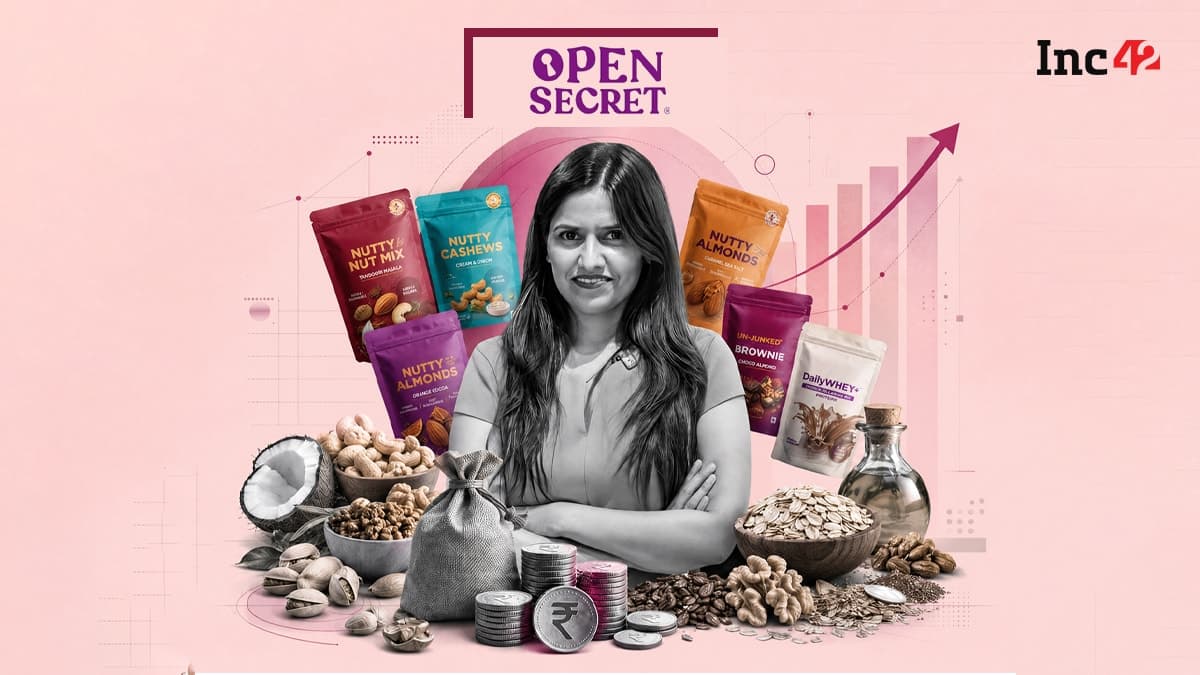
Open Secret, the Mumbai-based healthy snacking brand, has raised over ₹50 Cr ($5.2 Mn) in a round led by Desai Brothers Group. The investment splits into ₹30 Cr of primary equity and the rest as institutional debt. The five-year-old company will use the capital to expand its retail footprint and grow its savoury snacks portfolio.
This deal matters because it signals a strategic shift. Open Secret built its brand through D2C and quick commerce channels. Amazon, Flipkart, Blinkit, Zepto. Now it's betting on physical retail. Desai Brothers Group, a legacy FMCG distributor, brings exactly the network needed to make that happen.
What does Open Secret's current business look like?
Founded in 2019 by Ahana Gautam, Open Secret sells cookies, baked vegetable chips, protein powders, dry fruits, namkeen, cereals, and gift hampers. The common thread: no refined sugar, no maida, no artificial preservatives. The company calls this "clean label" positioning.
The startup claims to have crossed ₹200 Cr in annual recurring revenue with 10% month-on-month growth. More notable is the profitability claim. Open Secret says it has achieved EBITDA profitability, a milestone that eludes most D2C food brands burning cash on customer acquisition.
"Our goal is to hit ₹1,000 Crore ARR within three years, all while maintaining our profitability. This is Open Secret 2.0," founder and CEO Gautam said. That's a 5x growth target in 36 months. Ambitious, but the offline pivot could unlock distribution scale that pure-play digital can't.
Why pivot to offline now?
Open Secret currently sells through more than 500 retail outlets. That's modest. Established FMCG snack brands measure distribution in lakhs of outlets. The company plans to expand this physical footprint aggressively.
The logic is straightforward. Quick commerce works for urban India, but the bulk of snacking purchases still happen in kirana stores and modern trade. Desai Brothers Group has decades of experience moving products through these channels. For Open Secret, this partnership buys distribution infrastructure that would take years to build independently.
The startup is also doubling down on savoury snacks, specifically chips and namkeen. This segment, Open Secret says, is the fastest-growing part of its portfolio. That makes sense. India's savoury snacks market dwarfs the packaged sweets and cookies segment.
How competitive is the healthy snacking market?
Open Secret competes with Wellbeing Nutrition, Phab, The Whole Truth, Yoga Bar, and Snackible. Each has carved out a niche. The Whole Truth emphasizes ingredient transparency. Yoga Bar dominates the protein bar segment. Phab targets the protein-snacking crowd.
Recent funding in this space has picked up. Phab raised $4 Mn in a pre-Series A round last month. Good Monk secured $2 Mn earlier this year. Salad Days closed a ₹30 Cr Series A. Investors see a structural shift: rising disposable incomes, growing fitness awareness, and quick commerce making these products accessible beyond metros.
The prize is substantial. India's healthy snacks market is projected to reach $8.1 Bn by 2033, according to industry estimates. That's enough headroom for multiple winners. The question is which brands can achieve the distribution density and repeat purchase rates needed for profitability.
What's the AI angle?
Open Secret mentioned plans to deploy AI across its supply chain, though details were sparse. For a food brand scaling offline, AI could mean demand forecasting to reduce wastage, route optimization for distribution, or inventory management across thousands of retail touchpoints. The company didn't specify which applications it prioritizes.
Logicity's Take
The Desai Brothers investment is more strategic than financial. A legacy FMCG distributor backing a D2C-native brand suggests a playbook: use digital to build brand, then leverage traditional distribution to scale. Open Secret's profitability claim is the differentiator here. Most D2C food brands remain unprofitable because customer acquisition costs on digital channels keep rising. If Open Secret can maintain margins while expanding offline, it becomes a case study. The ₹1,000 Cr target in three years requires roughly 60% annual growth. Difficult, but the savoury snacks pivot could help. That category has better unit economics and higher purchase frequency than cookies or protein powders. Finance teams watching this space should note the hybrid model: venture capital for equity, institutional debt for working capital, and strategic investors for distribution access.
Frequently Asked Questions
How much funding did Open Secret raise?
Open Secret raised over ₹50 Cr ($5.2 Mn), comprising ₹30 Cr in primary equity from Desai Brothers Group and the remainder as institutional debt.
Is Open Secret profitable?
The company claims EBITDA profitability with ₹200 Cr in annual recurring revenue and 10% month-on-month growth.
What products does Open Secret sell?
Open Secret offers cookies, baked vegetable chips, protein powders, dry fruits and nuts, namkeen, cereals, and gift hampers. All products are positioned as clean-label alternatives without refined sugar or artificial preservatives.
Who are Open Secret's main competitors?
Open Secret competes with Wellbeing Nutrition, Phab, The Whole Truth, Yoga Bar, and Snackible in India's healthy snacking market.
Where can I buy Open Secret products?
The brand sells through Amazon, Flipkart, Blinkit, Zepto, and over 500 retail outlets across India. The company plans to expand its offline presence significantly.
Need Help Implementing This?
If you're a fintech or finance team tracking consumer brand investments in India, get in touch. Logicity covers D2C funding rounds, unit economics breakdowns, and the intersection of commerce and financial services.
Source: Inc42 Media / Shrishti Bisht
Manaal Khan
Tech & Innovation Writer
Produced with AI assistance and reviewed by the Logicity editorial team. Learn more in our Editorial Policy.