Key Takeaways
- Omega Walls tracks risk across entire sessions, not just individual prompts
- It can block, freeze, or quarantine content before it reaches your AI model
- The library is designed for indirect prompt injection and distributed attacks
- Available now on PyPI and GitHub under open-source license
- Built specifically for RAG pipelines, copilots, and tool-using AI agents
Read in Short
Synqra Tech released Omega Walls as open source, a Python runtime defense layer that sits between your RAG retrieval and your AI model. It tracks accumulated risk across multiple turns and documents to catch attacks that slip past traditional single-input filters.
Here's the thing about prompt injection defenses: most of them are fighting yesterday's war. They scan each input, check if it looks sketchy, and either let it through or block it. Clean and simple. But attackers figured this out a while ago.
The really nasty attacks don't happen in one prompt. They build slowly across retrieved documents, memory carry-over, tool outputs, and later execution steps. No single piece looks malicious on its own. It's only when you connect the dots that you realize your agent just got played.
That's the gap Omega Walls is trying to fill. And today, the team at Synqra Tech made it available to everyone.
What Makes Omega Walls Different
Most security tools for AI systems work like bouncers at a club. They check your ID at the door and that's it. Once you're in, you're in. Omega Walls works more like casino security, constantly watching patterns across time to spot card counters who look perfectly innocent on any single hand.
The library sits at two critical points in your AI pipeline:
- Before final context assembly: Every chunk, email, ticket, attachment, and tool output gets inspected before touching your model
- At tool execution: Tool calls can be blocked or constrained when accumulated risk gets too high
So instead of asking "is this one chunk dangerous?" it asks "given everything this session has seen, should we be worried?" That's a fundamentally different question. And it catches attacks that traditional scanners miss entirely.
The Attack Patterns It's Built For
Let's get specific about what kind of threats we're talking about here. The Omega Walls team designed it to handle:
- Indirect prompt injection: Malicious instructions hidden in documents your RAG system retrieves
- Distributed attacks: Payloads spread across multiple chunks or conversation turns
- Cocktail attacks: Combinations of takeover attempts, data exfiltration, tool abuse, and evasion techniques
- Multi-step flows: Attack chains where no single step looks obviously malicious in isolation
Why This Matters Now
As AI agents get more capable and handle more sensitive tasks, the attack surface expands dramatically. An agent with access to your email, calendar, and internal tools is a juicy target. Traditional prompt scanning catches the obvious stuff but misses sophisticated multi-turn attacks.
Think about it. Your support agent pulls in customer emails, searches your knowledge base, and has tools to update tickets. An attacker who can slip instructions into any of those sources might be able to chain together actions that look harmless individually but add up to something bad.
How It Actually Works
When Omega Walls detects risk building up across a session, it doesn't just log a warning and hope for the best. It takes deterministic runtime actions:
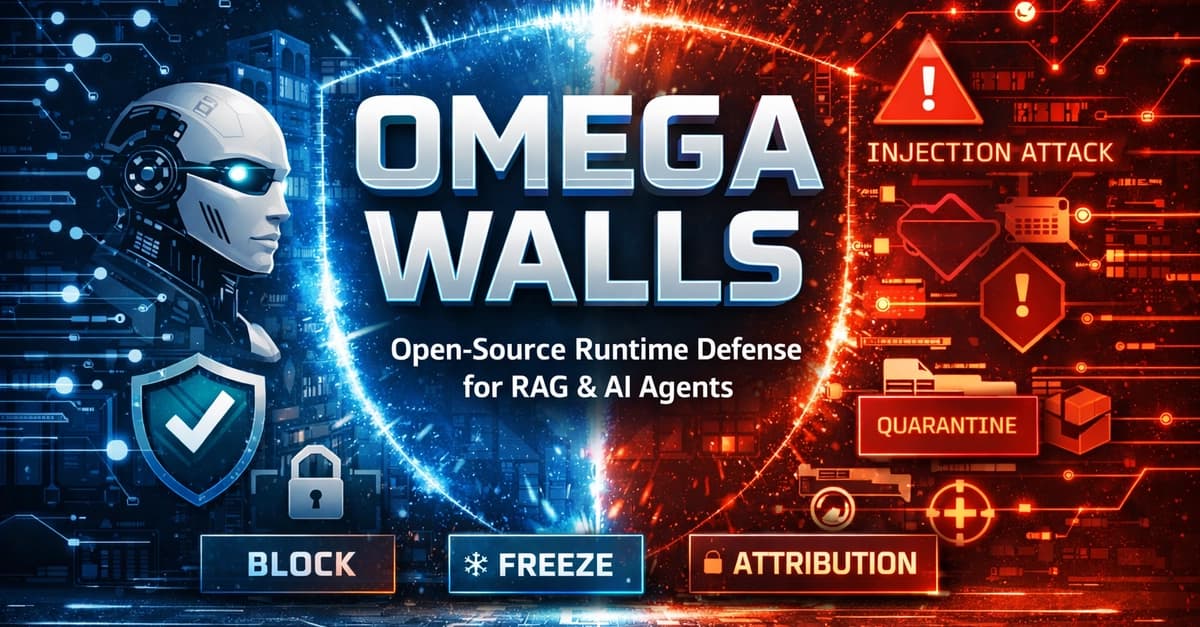
- Block: Stop the content from reaching the model entirely
- Freeze: Pause execution for human review
- Quarantine: Isolate suspicious content for analysis
- Attribution flags: Tag content with reason codes so you know why something got flagged
# Basic Omega Walls integration example
from omega_walls import OmegaWalls

defense = OmegaWalls()

# Check retrieved chunks before assembly
for chunk in retrieved_chunks:
    result = defense.inspect(chunk, session_id=user_session)
    if result.action == "block":
        # Handle blocked content
        continue

# Constrain tool execution based on accumulated risk
@defense.guard_tool
def execute_database_query(query: str):
    # Tool execution with runtime protection
    pass
The API looks pretty straightforward. You inspect content before it goes into context, and you can wrap tool functions with guards that check accumulated session risk before allowing execution.
The Latency Question
Okay, here's the elephant in the room. Any security layer adds latency. In the DEV Community discussion, one commenter raised this exact concern: "even 50ms extra per query adds up fast when you're doing retrieval + reranking + generation."
It's a fair point. Production RAG pipelines are already juggling multiple steps, and users notice when things get slow. The team hasn't published detailed benchmarks yet, which honestly would be my first ask if I were evaluating this for a real deployment.
But here's the tradeoff you're making. A stateless check is faster. A stateful check catches more attacks. You probably can't have both. The question is whether the attacks Omega Walls catches are worth the performance hit for your specific use case.
If you're building AI agents that integrate with Google Workspace, these API changes affect how you handle authentication and data access.
Why Open Source This?
The Synqra Tech team said something interesting in their announcement: they think agent security needs more work on runtime trust boundaries, not just better prompt scanning.
“We think agent security needs more work on runtime trust boundaries, not only better prompt scanning.”
— Synqra Tech team
By open-sourcing this, they're basically inviting the community to poke holes in it. Tell us where it breaks. Tell us what attack patterns matter most. Tell us where this layer should sit in a real stack.
That's actually a smart play. Security tools get better when more people try to break them. And agent security is still early enough that there's genuine uncertainty about what the right abstractions even are.
Who Should Try This
Based on what they've shared, Omega Walls seems built for teams working on:
- RAG pipelines that pull from untrusted or semi-trusted sources
- Internal copilots with access to sensitive company data
- Support agents or inbox automation that processes external emails
- Tool-using workflows where agents can take real actions
- Agent infrastructure at the platform level
If you're building a chatbot that just answers questions from a curated knowledge base you control completely, this is probably overkill. But if your agent touches external data or has tools that can do real things? Worth a look.
Getting Started
The library is available right now through multiple channels:
- Install via pip: pip install omega-walls
- Check out the GitHub repo for documentation and examples
- Visit the official site for architecture deep-dives
Quick Links
GitHub: github.com/synqratech/omega-walls | PyPI: pypi.org/project/omega-walls/ | Website: synqra.tech/omega-walls
My Take
Look, I'm cautiously optimistic about this. The core insight is solid: single-turn defenses miss multi-turn attacks. That's just true. And someone needed to build tooling around session-level risk tracking.
But the proof is in the deployment. Does it catch real attacks without killing your latency budget? Does it play nice with existing RAG frameworks? Can you tune it without a PhD in prompt injection taxonomy?
Those questions only get answered when people actually use the thing. So if you're building AI agents and security keeps you up at night, give Omega Walls a spin. And then tell them what broke. That's how this stuff gets better.
Frequently Asked Questions
Is Omega Walls free to use?
Yes, it's open source. Check the GitHub repo for the specific license terms.
What Python versions does it support?
Check the PyPI page for current compatibility info, but modern Python 3.x should work.
Can I use this with LangChain or LlamaIndex?
The architecture suggests it should integrate with any RAG pipeline, but check their docs for specific integration examples.
Does it work with streaming responses?
The team hasn't clarified this yet. Worth asking if you rely heavily on streaming in production.
Source: DEV Community
Manaal Khan
Tech & Innovation Writer
Produced with AI assistance and reviewed by the Logicity editorial team. Learn more in our Editorial Policy.