Key Takeaways
- Microsoft is building a 2GW data center campus in Pecos, Texas with its own gas-fired power plant to bypass grid constraints
- The project spans 5-7 years with 6,000 peak construction jobs, making it one of Microsoft's largest single capacity additions
- Chevron will supply the gas turbines, with operations expected around 2028
Microsoft is constructing a 2-gigawatt data center campus in Pecos, Texas, and it's building its own gas-fired power plant to feed it. The company has decided the public grid cannot deliver what it needs, so it will generate electricity on site. Chevron will supply the gas turbines.
This is one of the largest single capacity additions in Microsoft's history. Cloud chief Noelle Walsh confirmed the multibillion-dollar project will take five to seven years, employ over 6,000 workers at peak construction, and create hundreds of permanent roles. Operations should begin around 2028.
Why Microsoft is dodging the grid
The US power grid cannot keep pace with AI-driven demand. Training and running large language models requires GPU clusters that consume far more electricity than traditional servers. An NVIDIA H100 chip draws over 700 watts. Multiply that by tens of thousands of chips in a single facility, and you get power requirements that local utilities struggle to provision.
Microsoft is not alone in this approach. Amazon has signed nuclear power agreements. Google is investing in geothermal. The common thread: hyperscalers have concluded that waiting years for grid hookups is unacceptable when the AI race runs in months.
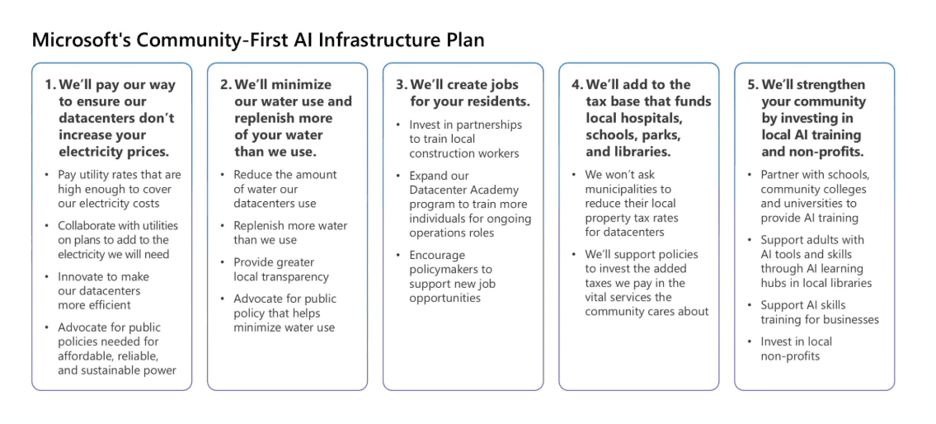
The local pitch: no higher bills, net-positive water
Data centers have become politically toxic in many US communities. According to Data Center Watch, dozens of projects were killed in 2026, often with bipartisan opposition. The complaints are consistent: rising electric bills and strained water supplies.
Microsoft's open letter to Pecos and Reeves County addresses both. The company promises it won't drive up local power prices. It claims closed-loop cooling will keep total lifecycle water use to "only a fraction of that consumed annually by a typical fast-food restaurant." It also pledges to put back more water than it consumes and to engage residents early.
Whether these commitments hold will matter beyond West Texas. If Microsoft can build a hyperscale facility without alienating locals, the template will spread. If disputes emerge, the backlash could harden.
What 2 gigawatts actually means
A typical hyperscale data center runs at 500 megawatts or less. Microsoft's Pecos campus is four times that size. Two gigawatts could power roughly 1.5 million average American homes.
For context, Microsoft announced over $50 billion in data center spending for fiscal year 2024 alone. The Pecos project represents a significant chunk of that investment concentrated in one location. The scale signals how seriously Microsoft views compute capacity as a competitive moat for Azure and its AI services.
Why Texas keeps winning these projects
Texas offers hyperscalers several advantages. Its deregulated energy market means companies can negotiate directly with power suppliers or build their own plants. Land is cheap and abundant. The state has significant renewable energy capacity, particularly wind. And Texas regulators tend to move faster than those in other states.
The tradeoff is grid reliability. ERCOT, the state's independent grid operator, has struggled during extreme weather events. By building its own power plant, Microsoft insulates itself from grid failures while still benefiting from Texas's business environment.
Logicity's Take
For AI builders, Microsoft's decision has a clear implication: compute constraints are real, and they're upstream of your code. The hyperscalers are spending tens of billions to secure the physical capacity that cloud pricing depends on. If you're planning workloads that require sustained GPU access over multi-year timelines, watch where these facilities land. Proximity to inference endpoints affects latency, and regional capacity affects availability. Azure, AWS, and Google Cloud all publish region-specific capacity roadmaps. They're worth reading before you architect.
The emissions question Microsoft isn't answering
Microsoft has pledged to be carbon negative by 2030. Building a natural gas plant in 2026 complicates that story. The company has not disclosed how it will reconcile on-site fossil fuel generation with its climate commitments.
One possibility: carbon capture or offset purchases. Another: the gas plant serves as a bridge until renewable capacity catches up. Neither explanation appears in the public announcements. Expect scrutiny from climate researchers and competitors alike.
Frequently Asked Questions
How big is Microsoft's Pecos data center?
The campus will have approximately 2 gigawatts of power capacity, equivalent to roughly four typical hyperscale data centers. It's one of the largest single capacity additions in Microsoft's history.
Why is Microsoft building its own power plant?
The US electrical grid cannot provision power fast enough to meet AI-driven demand. Building an on-site gas plant lets Microsoft bypass years-long waits for grid hookups.
When will Microsoft's Texas data center open?
Operations are expected around 2028, with full buildout taking five to seven years.
How many jobs will the Pecos data center create?
The project will employ over 6,000 construction workers at peak and create hundreds of permanent roles.
Will the data center raise local electricity prices?
Microsoft has pledged it will not drive up local power prices in Pecos. The company is generating its own electricity on site rather than drawing from the public grid.
Need Help Implementing This?
If you're building AI products and need to understand cloud infrastructure tradeoffs, Logicity covers the tools, platforms, and strategic decisions that matter. Subscribe for weekly analysis.
Source: The Decoder / Matthias Bastian
Manaal Khan
Tech & Innovation Writer
Produced with AI assistance and reviewed by the Logicity editorial team. Learn more in our Editorial Policy.