Key Takeaways
- Premium subscribers can test multiple AI models without paying for separate subscriptions
- Industry-specific leaderboards help identify which AI performs best for your sector
- Zero token limits mean unlimited testing before committing to expensive enterprise contracts
According to [Engadget](https://www.engadget.com/ai/linkedins-crosscheck-feature-lets-premium-subscribers-test-ai-models-for-free-183949210.html?src=rss), LinkedIn has launched Crosscheck, a new feature that lets Premium subscribers test competing AI models from OpenAI, Anthropic, Google, and other providers without worrying about token limits or paying for additional subscriptions.
Read in Short
LinkedIn's Crosscheck feature eliminates the biggest headache in enterprise AI adoption: figuring out which model actually works best for your business without spending thousands on trials. Premium subscribers in the US can now run unlimited blind tests across models from OpenAI, Anthropic, Google, Mistral, and Amazon. The catch? LinkedIn shares anonymized usage data with AI vendors. For most CTOs, that's a fair trade for free, unlimited evaluation access.
Why Should CTOs Care About LinkedIn Crosscheck?
If you've tried to evaluate AI models for your organization, you know the pain. OpenAI's API requires credit card details and charges per token. Claude Pro costs $20/month per seat. Google's Gemini Advanced runs similar pricing. For a proper evaluation across multiple models, you're looking at hundreds of dollars before anyone writes a single line of production code.
LinkedIn just changed that math entirely. Crosscheck offers unlimited text-based testing across major AI platforms for anyone with a LinkedIn Premium subscription you might already be paying for. No token counting. No separate billing. No signup friction for each platform.
The business case is straightforward: before you commit $50,000 to an enterprise AI contract, you can run real-world tests using your actual business prompts. Ask the models to draft sales emails, summarize meeting notes, analyze market data, whatever your team will actually use AI for. Then pick the winner based on real performance, not marketing claims.
How Does LinkedIn AI Model Testing Actually Work?
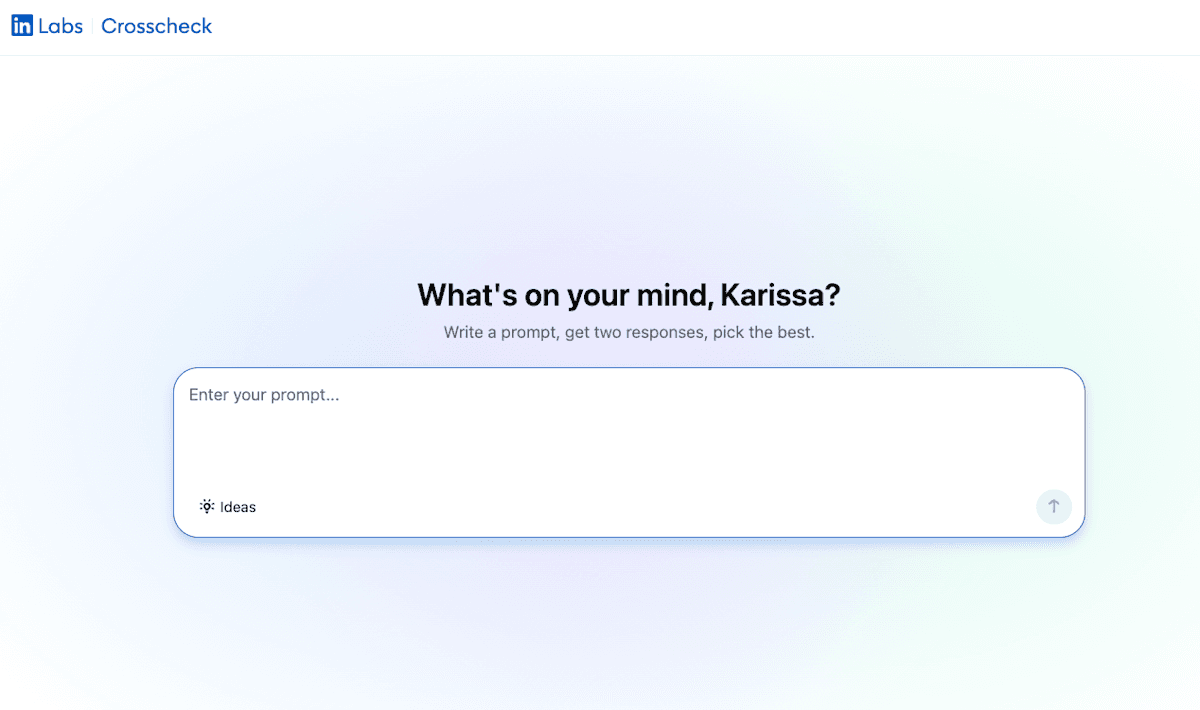
LinkedIn's Chief Product Officer Hari Srinivasan describes Crosscheck as a "blind taste test" for AI. Here's what that means in practice:
- You enter a prompt, just like you would in ChatGPT or Claude
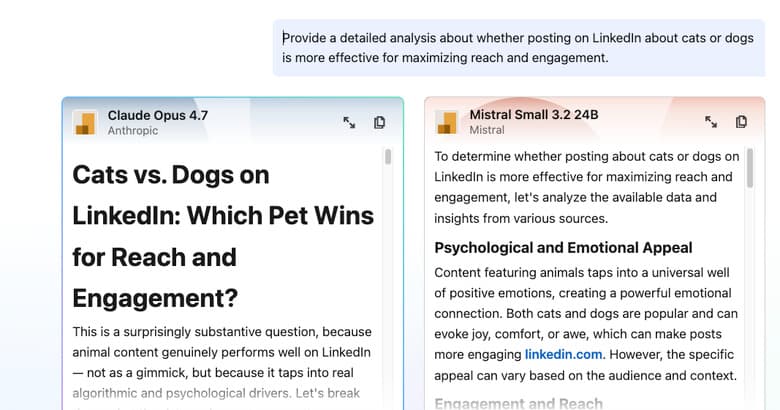
- Crosscheck generates two responses from different AI models
- You don't see which model created which response
- You pick the answer that better solves your problem
- Only after choosing do you see which models were behind each response
This blind methodology matters. When executives know they're testing GPT-4, there's a tendency to rate it higher because of brand familiarity. Remove the labels, and you get honest performance data.
Models Currently Available in Crosscheck
Based on initial testing, Crosscheck includes models from Anthropic (Claude), Google (Gemini), OpenAI, Mistral, MoonshotAI, and Amazon (likely Bedrock-hosted models). LinkedIn plans to add more models as the feature develops.
Industry Leaderboards: Which AI Works Best for Your Sector?
Here's where Crosscheck gets interesting for business strategy. LinkedIn is building leaderboards that track how different industries rate each model. So instead of relying on generic benchmarks, you'll eventually see how finance professionals, healthcare executives, or manufacturing leaders rate each AI's performance on their specific tasks.
This industry-specific data doesn't exist anywhere else at scale. Sure, individual consultancies publish AI evaluations. But those are typically based on standardized tests, not real-world usage by thousands of professionals in your exact industry.
For CTOs making AI procurement decisions, this changes the conversation. Instead of "the vendor claims 95% accuracy," you can point to "professionals in our industry prefer Model X for this task type 73% of the time."
What Are the Limitations of LinkedIn Crosscheck?
Before you cancel all your AI subscriptions, understand what Crosscheck won't do:
✅ Pros
- • Unlimited text-based prompts with no token limits
- • Access to multiple premium AI models with one subscription
- • Blind testing removes brand bias from evaluations
- • Industry-specific performance data coming soon
- • No additional cost beyond existing LinkedIn Premium
❌ Cons
- • Text-only: no image generation or file uploads
- • No access to advanced features like code interpreters or web browsing
- • Currently US-only for Premium subscribers
- • LinkedIn shares anonymized data with AI vendors
- • Still an early product with performance issues
Srinivasan acknowledges that Crosscheck is still an "early product" with "work to do to make it faster." Translation for business leaders: don't use this for production workflows. Use it for evaluation and comparison.
Understanding data handling practices is critical when evaluating any AI tool for enterprise use.
The Data Trade-Off: What LinkedIn Shares with AI Vendors
Nothing is truly free. In exchange for unlimited AI testing, LinkedIn shares data back to AI vendors. The company states: "Anonymized data is shared with model builders to help them understand how their models are performing amongst different occupations. No personally identifiable information is shared with model builders."
For most business use cases, this is acceptable. You're not sharing proprietary information, just prompt patterns and preference data. But if your organization has strict data governance requirements, check with your legal team before running sensitive business scenarios through Crosscheck.
Data Privacy Consideration
While LinkedIn doesn't share personally identifiable information, the prompts you enter and your preference choices are aggregated and shared with AI vendors. Avoid testing with proprietary business data, customer information, or trade secrets.
The security posture here is actually better than many alternatives. When you sign up directly for Claude or GPT-4, those companies can see everything you type. With LinkedIn as an intermediary, at least there's a layer of anonymization. For security-conscious organizations exploring AI capabilities, this might be a safer evaluation path than direct API testing.
Data security considerations apply to every third-party tool your organization adopts.
How to Build an AI Evaluation Framework Using Crosscheck
If you're a CTO or IT leader evaluating AI tools, here's a practical framework for using Crosscheck effectively:
- Document your top 10 AI use cases: List the specific tasks your team would actually use AI for, ranked by business impact
- Create standardized test prompts: Write 5-10 representative prompts for each use case that mirror real work
- Run blind tests systematically: Test each prompt through Crosscheck, tracking which model wins for which task type
- Build your internal leaderboard: After 50+ tests, you'll have data showing which model performs best for your specific needs
- Cross-reference with LinkedIn's industry data: Once available, compare your results against how your industry peers rated each model
This approach transforms AI procurement from gut feeling to data-driven decision making. When you present findings to your board, you're not saying "I liked GPT-4 better." You're saying "In blind tests of 50 sales email prompts, Model X outperformed competitors 68% of the time for our use case."
What This Means for Enterprise AI Budgets
LinkedIn Crosscheck won't replace production AI subscriptions. But it dramatically reduces evaluation costs. Consider the math:
| Evaluation Approach | Estimated Cost | Limitations |
|---|---|---|
| Direct API testing (3 models) | $200-500/month | Token limits, separate accounts, no blind testing |
| Enterprise pilots (3 vendors) | $5,000-15,000 | Long sales cycles, customized demos don't reflect real use |
| LinkedIn Crosscheck | $0 (with Premium) | Text-only, US-only currently, shared anonymized data |
For early-stage evaluation, the cost difference is meaningful. A startup CTO can now test AI capabilities without burning through their limited budget. An enterprise IT leader can gather preliminary data before engaging procurement for a formal RFP process.
When Will LinkedIn Crosscheck Be Available Globally?
Currently, Crosscheck is limited to LinkedIn Premium subscribers in the United States. LinkedIn has stated plans to expand to "more countries and free users soon," but hasn't provided specific timelines.
For international readers, this means watching LinkedIn's product announcements over the coming months. If you're in the US with Premium access, you can start using Crosscheck now through LinkedIn Labs.
Staying current on platform updates helps IT leaders plan rollouts and avoid productivity disruptions.
Logicity's Take
From our experience building AI agents and automation workflows for clients, the biggest barrier to AI adoption isn't cost. It's confidence. Business leaders know AI can help, but they don't trust vendor benchmarks and they don't have time to become AI experts themselves. LinkedIn Crosscheck solves the confidence problem in a way we haven't seen before. When a CFO asks "why should we use Claude instead of GPT-4?" having blind test data from your own team beats any analyst report. That said, text-only testing has limits. Most of our production AI work involves RAG systems, API integrations, and multi-step automation. Crosscheck won't tell you how well a model handles your CRM data or integrates with your existing stack. Use it as a starting point, not a final decision. For Indian tech businesses waiting for global rollout: start documenting your AI use cases now. When Crosscheck arrives, you'll be ready to run systematic tests instead of scrambling to figure out what to evaluate.
Frequently Asked Questions
How much does LinkedIn Crosscheck cost?
Crosscheck is included free with LinkedIn Premium subscriptions. There are no additional fees or token limits for text-based AI testing.
Which AI models can I test through LinkedIn Crosscheck?
Current testing shows models from Anthropic (Claude), Google (Gemini), OpenAI, Mistral, MoonshotAI, and Amazon. LinkedIn plans to add more models over time.
Is LinkedIn Crosscheck available outside the United States?
Not yet. Crosscheck is currently US-only for Premium subscribers, with plans to expand to more countries and free users "soon" according to LinkedIn.
What data does LinkedIn share with AI vendors through Crosscheck?
LinkedIn shares anonymized data including how models perform among different occupations. No personally identifiable information is shared, but your prompts and preferences are aggregated for vendor insights.
Can I use LinkedIn Crosscheck for production AI work?
No. Crosscheck is designed for evaluation, not production use. It only supports text prompts without file uploads, image generation, or advanced features like code interpreters.
Need Help Implementing This?
Evaluating AI models is just the first step. Logicity helps businesses move from evaluation to production, building custom AI agents, automation workflows, and integrated solutions that actually deliver ROI. If you're ready to move beyond testing and start deploying AI that works for your specific business needs, let's talk.
Huma Shazia
Senior AI & Tech Writer
Produced with AI assistance and reviewed by the Logicity editorial team. Learn more in our Editorial Policy.