Iran Internet Blackout Hits 1,000 Hours: Starlink Banned Under Death Penalty as Military Jamming Blocks Satellite Access
Key Takeaways
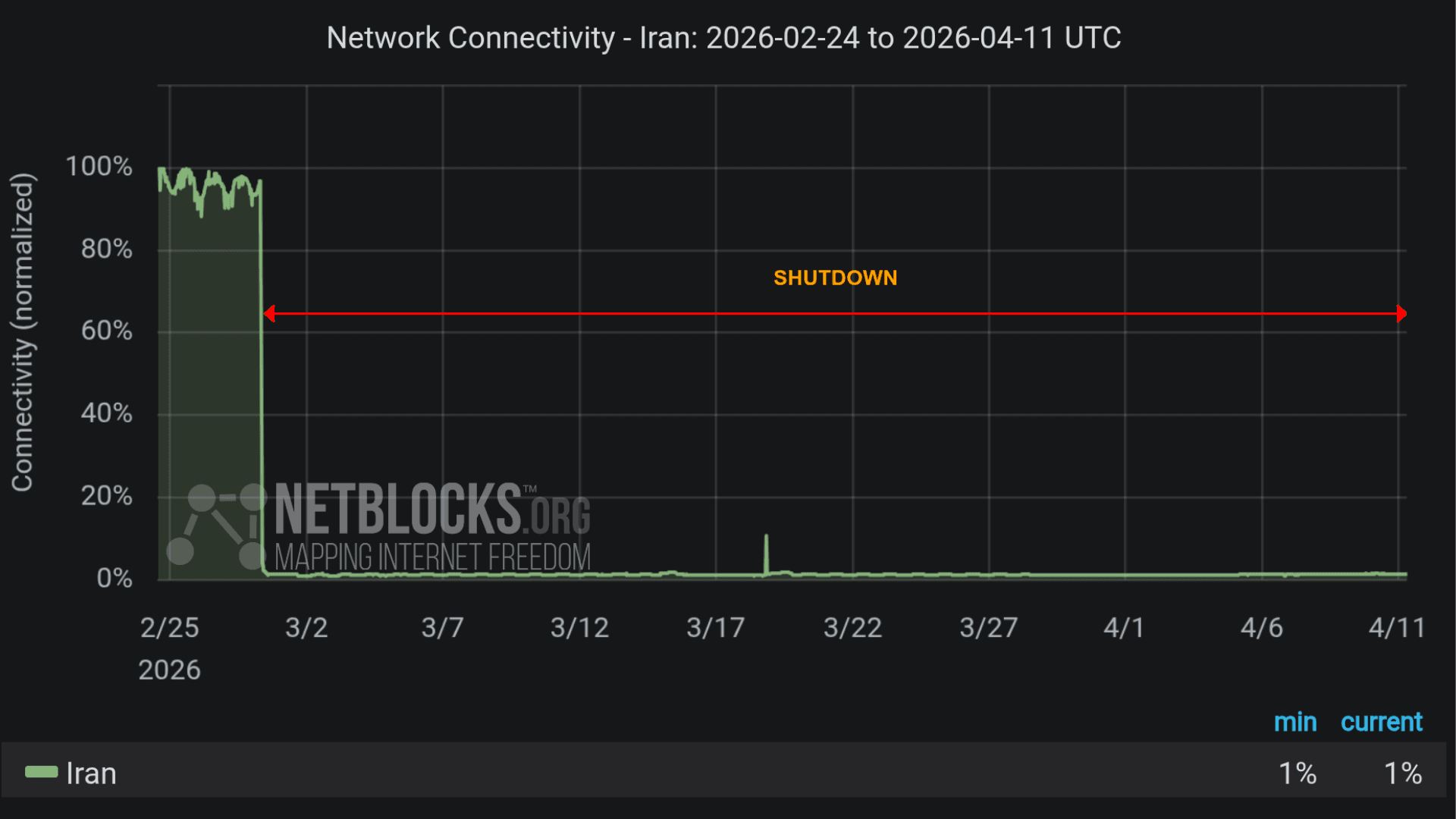
- Iran's internet blackout has exceeded 1,032 hours across 44 days, becoming one of the longest nationwide shutdowns ever recorded
- Possessing or operating a Starlink terminal in Iran now carries the death penalty under new legislation
- Military-grade jamming is being used to block Starlink satellite signals across the country
- Internet traffic remains at approximately 1% of pre-blackout levels
- Iran has threatened attacks on infrastructure owned by OpenAI, Nvidia, Apple, Microsoft, and Google
Read in Short
Iran just hit a grim milestone: over 1,000 hours of near-total internet blackout. The government isn't just cutting cables, they're jamming Starlink satellites with military equipment and have made owning a terminal punishable by execution. This is digital isolation on a scale we've rarely seen in modern history.
So here's the thing about living in 2026: we take internet access for granted. You're probably reading this on your phone while waiting for coffee or scrolling during a boring meeting. Now imagine 44 days without any of that. No messaging apps. No social media. No email. No video calls with family. That's the reality for roughly 87 million Iranians right now.
NetBlocks, the organization that tracks internet connectivity worldwide, confirmed the milestone on April 11. According to their data, this shutdown has broken records for any incident they've ever cataloged. And the really scary part? It's still going. There's no end in sight.
How Did We Get Here?
The blackout intensified dramatically on February 28, coinciding with joint U.S. and Israeli military strikes on Iran. Cloudflare Radar captured the moment it happened: a 98% collapse in Iranian HTTP traffic at around 07:00 UTC. Cities across the country went dark simultaneously. Tehran, Fars, Isfahan, Razavi Khorasan, Alborz. All of them, gone in an instant.
Some traffic is still trickling through. About 1% of normal volumes, according to NetBlocks. Cloudflare says this is happening over specific IPv4 routes, suggesting the government is running a whitelist system. Certain people and organizations can still get online. Everyone else? Completely cut off.
Starlink Won't Save You
When governments shut down the internet, Starlink usually gets mentioned as a workaround. Elon Musk's satellite network doesn't rely on ground infrastructure, so in theory it should work even when a country pulls the plug. But Iran found a solution to that problem too.

Death Penalty for Satellite Internet
Under legislation passed in 2026, possessing or operating a Starlink terminal in Iran now carries potential penalties including execution. The government has also deployed military-grade jamming equipment to block satellite signals.
You read that right. Own a Starlink dish in Iran and you could face execution. This isn't speculation or rumor. The Business and Human Rights Centre confirmed the legislation passed this year. The government is actively hunting for people with terminals.
And even if you somehow got your hands on a Starlink terminal and were willing to risk your life, it probably wouldn't work anyway. According to a researcher who spoke with IranWire back in January, Iran is using military-grade jamming to block satellite signals. They're not just cutting wires. They're building an electronic wall around the entire country.
The Human Cost Nobody's Talking About
It's easy to get caught up in the technical aspects of this story. The jamming equipment, the legislation, the traffic percentages. But behind all those numbers are real people whose lives have been turned upside down.
- Families can't contact relatives abroad or even in other parts of the country
- Businesses have effectively shut down without access to banking, suppliers, or customers
- Students can't access educational resources or communicate with universities
- Medical facilities are operating without access to online databases or telemedicine
- Journalists and activists have no way to document what's happening or call for help
The economic damage is staggering. Iran's economy was already struggling under international sanctions. Now add 44 days of businesses being unable to process transactions, communicate with partners, or serve customers online. Some estimates put the daily cost of internet shutdowns in the billions. Multiply that by 44 days and you start to understand the scale of destruction.
As Iran isolates itself technologically, other nations are racing ahead with massive tech investments. This piece on Japan's semiconductor push shows the other side of the global tech divide.
Is This Actually the Longest Blackout Ever?
NetBlocks says this is the longest incident they've ever cataloged. But there's some important context here. Libya's internet went dark for about six months during the Arab Spring. That was likely before NetBlocks started systematic monitoring, so it doesn't show up in their records.

Still, the comparison matters. Libya in 2011 was dealing with a full-scale civil war and the collapse of the Gaddafi regime. Iran in 2026 is a functioning state that has chosen to disconnect its citizens as a matter of policy. The deliberate, sustained nature of this blackout makes it arguably worse than shutdowns caused by conflict or infrastructure damage.
Iran's Threats Against Big Tech
But wait, there's more. Iran hasn't just been building walls around its own internet. The government has also made threats against infrastructure owned by major tech companies. We're talking OpenAI, Nvidia, Apple, Microsoft, and Google. The kicker? These are the companies that power basically everything online.
It's unclear what form these threats might take or how seriously to take them. But in the context of everything else happening, it paints a picture of a government that views the global internet as an enemy to be fought, not a resource to be used.
What Happens Next?
Honestly? Nobody knows. The blackout shows no signs of ending. The government has every tool it needs to maintain isolation indefinitely. Military jamming, death penalty threats, whitelist controls. They've thought of everything.
The international community has largely been silent. There's no mechanism to force a country to turn its internet back on. Sanctions are already in place and clearly aren't changing the government's calculus. The people suffering through this have been abandoned to wait it out.
The Precedent This Sets
Iran's blackout demonstrates that total digital isolation is technically possible for a nation-state willing to invest in jamming technology and enforce draconian penalties. Other authoritarian governments are almost certainly taking notes.
What we're watching in Iran right now isn't just a humanitarian crisis. It's a test case. A proof of concept that shows authoritarian governments exactly what's possible when they're willing to go far enough. The jamming technology, the legal framework, the systematic approach to hunting down workarounds. All of it can be replicated.
Security vulnerabilities can be exploited in hours, but Iran's blackout shows the flip side of cyber threats, when governments themselves become the attack vector against their own citizens' connectivity.
The Bottom Line
Iran has passed 1,000 hours of internet blackout. People are risking execution to try connecting via satellite. Military equipment is jamming signals from space. And there's no end in sight.
This is what digital authoritarianism looks like when the gloves come off. No half measures, no pretense of normalcy. Just complete, enforced disconnection from the rest of humanity. And 87 million people living through it, day after day, with no way to tell the world what's happening to them.
We'll keep tracking this story as it develops. But right now, there's not much hope to offer. The blackout continues into its 45th day.
Source: Latest from Tom's Hardware
Huma Shazia
Senior AI & Tech Writer
Produced with AI assistance and reviewed by the Logicity editorial team. Learn more in our Editorial Policy.