Key Takeaways
- Fathom uses diffusion models to generate tens of thousands of synthetic weather events for a projected 2030 climate
- AI hallucinations can produce disaster scenarios that violate basic physics, creating risk assessment blind spots
- Better models may clash with insurer incentives: some prefer models that produce lower loss estimates to write more business
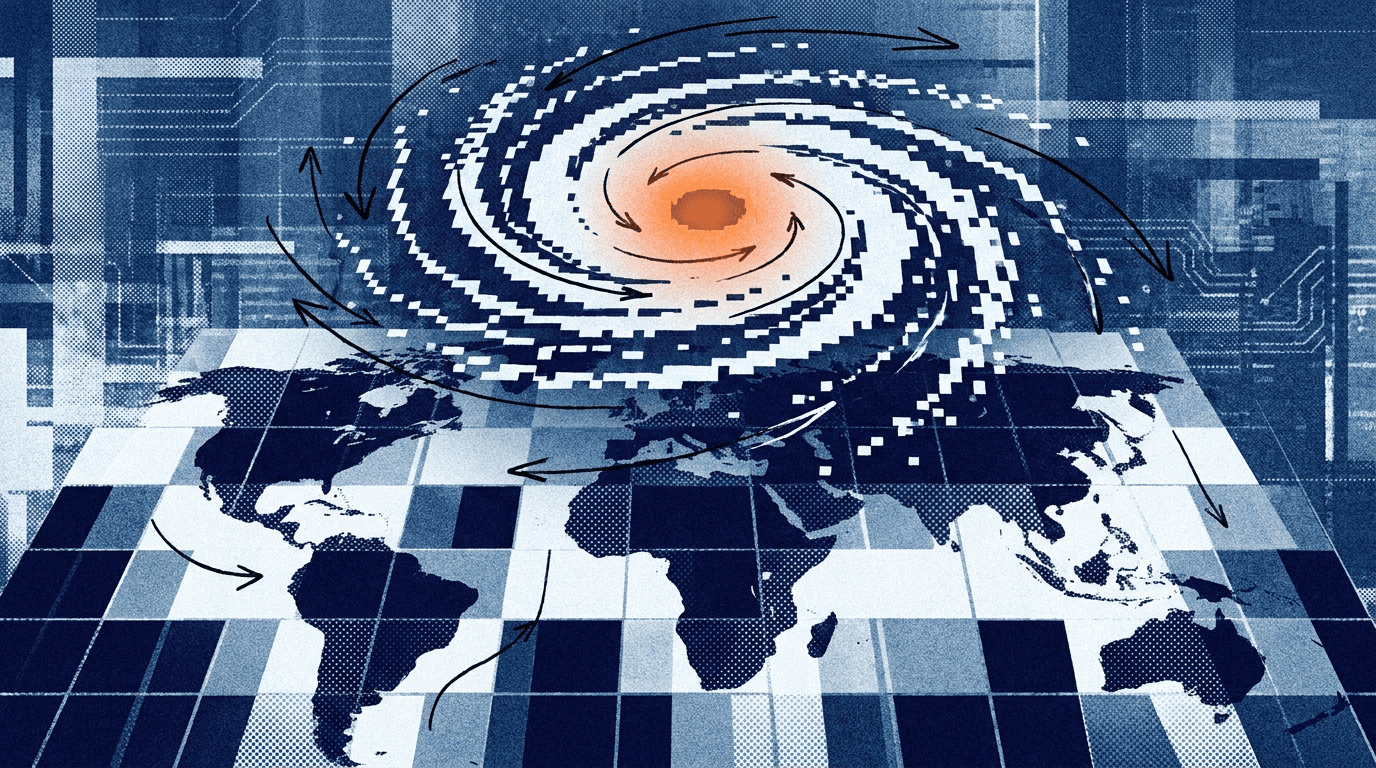
Insurers are feeding diffusion models climate data to generate tens of thousands of synthetic disaster scenarios. The goal: price risk in regions with little historical data. The catch: AI can hallucinate storms that break the laws of physics.
A Financial Times investigation reveals how reinsurers and catastrophe modelers are replacing 40-year-old physics simulations with generative AI. The technology promises finer geographic resolution at lower computational cost. It also introduces failure modes the industry has never faced.
How diffusion models simulate disasters
Traditional cat models divide the Earth into grid cells and solve equations for gravity, friction, and water flow. Finer grids mean better accuracy but exponentially higher compute bills. Insurers have lived with this tradeoff since the 1980s.
Fathom, a subsidiary of Swiss Re, took a different path. The company trained a diffusion model on roughly 1,000 years of existing climate simulations. The model then generated far more disaster scenarios than the original physics model could produce. A second neural network sharpens the output from 100 × 100 kilometer resolution down to 10 × 10 kilometers, enough to capture local precipitation patterns.
"AI has completely reframed what is possible," says Oliver Wing, Fathom's scientific director.
Competitor Verisk now models extreme wind and rain simultaneously instead of sequentially. Jay Guin, the company's research chief, says this captures spatial variability more precisely than older machine learning approaches. Moody's RMS uses AI to analyze satellite imagery after wildfires and hurricanes, estimating insured losses before adjusters reach the scene.
The hallucination problem in high-stakes modeling
Diffusion models learn patterns from training data. They do not understand atmospheric physics. When asked to extrapolate beyond their training distribution, they can produce events that look plausible on paper but violate fundamental constraints.
"You can hallucinate some absolute slop using these techniques," Wing warns.
For tail-risk events, the very scenarios insurers care most about, historical data barely exists. A once-in-500-year flood has, by definition, happened fewer than once in most measurement records. AI models filling this gap must extrapolate aggressively. That extrapolation is where hallucinations hide.
Firas Saleh, who leads flood and wildfire modeling for North America at Moody's, argues the technology remains valuable precisely for these rare events. The question is whether insurers can distinguish good synthetic scenarios from physically impossible ones.
Why better models might not lower your premium
Swiss Re reported that natural disasters caused $220 billion in damage in 2025. Only $107 billion was insured. More precise models could theoretically let insurers cover underserved regions like Bangladesh or Brazil, where major modeling firms have historically passed because of low asset values.
Whether policyholders benefit is another matter. Better models might reveal that potential losses are higher than previously assumed, forcing insurers to hold larger capital buffers. That cost flows through to premiums.
One modeler told the Financial Times that insurers "will generally purchase the model that allows them to do more business, that produces a lower loss estimate." Another added bluntly: "Underwriters just want to write more business."
The incentive structure creates a conflict. Better science can clash with sales logic, even when the objective risk picture looks worse.
What this means for AI product teams
Insurance is a $6 trillion global industry. Catastrophe modeling sits at its foundation. If diffusion models prove reliable, the same architecture could spread to adjacent domains: supply chain risk, infrastructure planning, agricultural insurance.
The technical challenge is grounding. Physics-based models are slow but verifiable. Neural networks are fast but opaque. Teams building AI for high-stakes decisions need hybrid architectures that constrain outputs to physically possible ranges.
Validation pipelines matter too. A generated hurricane that deposits 200 inches of rain in an hour should trigger a hard rejection, not slide into a risk pool. The tooling for this kind of constraint enforcement is still emerging.
Logicity's Take
This is a stress test for generative AI in regulated, high-liability industries. Insurers face auditors, actuaries, and regulators who demand explainability. A diffusion model that produces a hurricane violating the Clausius-Clapeyron relation is not just wrong; it is evidence of systemic model failure. For AI builders eyeing enterprise verticals, the insurance use case shows where guardrails must be non-negotiable. Hybrid physics-AI architectures and hard constraint layers are the path forward. Pure neural generation is not.
The commercial tension at the core
Cat models are not neutral scientific instruments. They are commercial products. Insurers pay for them. Modeling firms compete for that business.
A model that consistently produces higher loss estimates will struggle in the market, even if it is more accurate. This creates selection pressure toward optimism. The Financial Times suggests that better AI might expose this dynamic more starkly than ever. When a neural network can generate any scenario, the question of which scenarios count becomes a business decision as much as a scientific one.
Regulators have not caught up. No standard exists for validating generative catastrophe models. No requirement forces insurers to disclose which model they used or how it was trained. The gap between capability and governance is widening.
Frequently Asked Questions
What is AI catastrophe modeling?
AI catastrophe modeling uses machine learning, often diffusion models, to generate synthetic disaster scenarios for risk assessment. Instead of solving physics equations directly, these models learn patterns from historical climate data and extrapolate.
Can AI hallucinations affect insurance pricing?
Yes. If a generative model produces disaster scenarios that violate physical laws, those scenarios could distort risk pools and lead to mispriced premiums, either too high or dangerously low.
Which companies are using generative AI for catastrophe modeling?
Swiss Re's subsidiary Fathom, Verisk, and Moody's RMS are leading adopters. Each uses different AI approaches for flood, wind, wildfire, and hurricane modeling.
Why might better catastrophe models not lower insurance costs?
More accurate models may reveal higher true risk than previously assumed, requiring insurers to hold larger capital reserves. That cost gets passed to policyholders.
What are the limits of diffusion models for weather prediction?
Diffusion models do not encode physical laws. They learn statistical patterns from data. When extrapolating to rare events outside training distributions, they can produce plausible-looking but physically impossible scenarios.
Need Help Implementing This?
Building AI systems for high-stakes enterprise use cases? Logicity helps product teams design validation pipelines and hybrid architectures that meet regulatory scrutiny. Get in touch to discuss your specific requirements.
Source: The Decoder / Maximilian Schreiner
Huma Shazia
Senior AI & Tech Writer
Produced with AI assistance and reviewed by the Logicity editorial team. Learn more in our Editorial Policy.