Key Takeaways
- US commits $50M to develop PaxPass, a cargo verification system for expedited AI goods movement through Panama
- 30+ nations signed the Declaration on AI Opportunity, committing to pro-growth AI policies over restriction
- Stanford partnership launches Foundry School to train advanced manufacturing leaders across allied economies
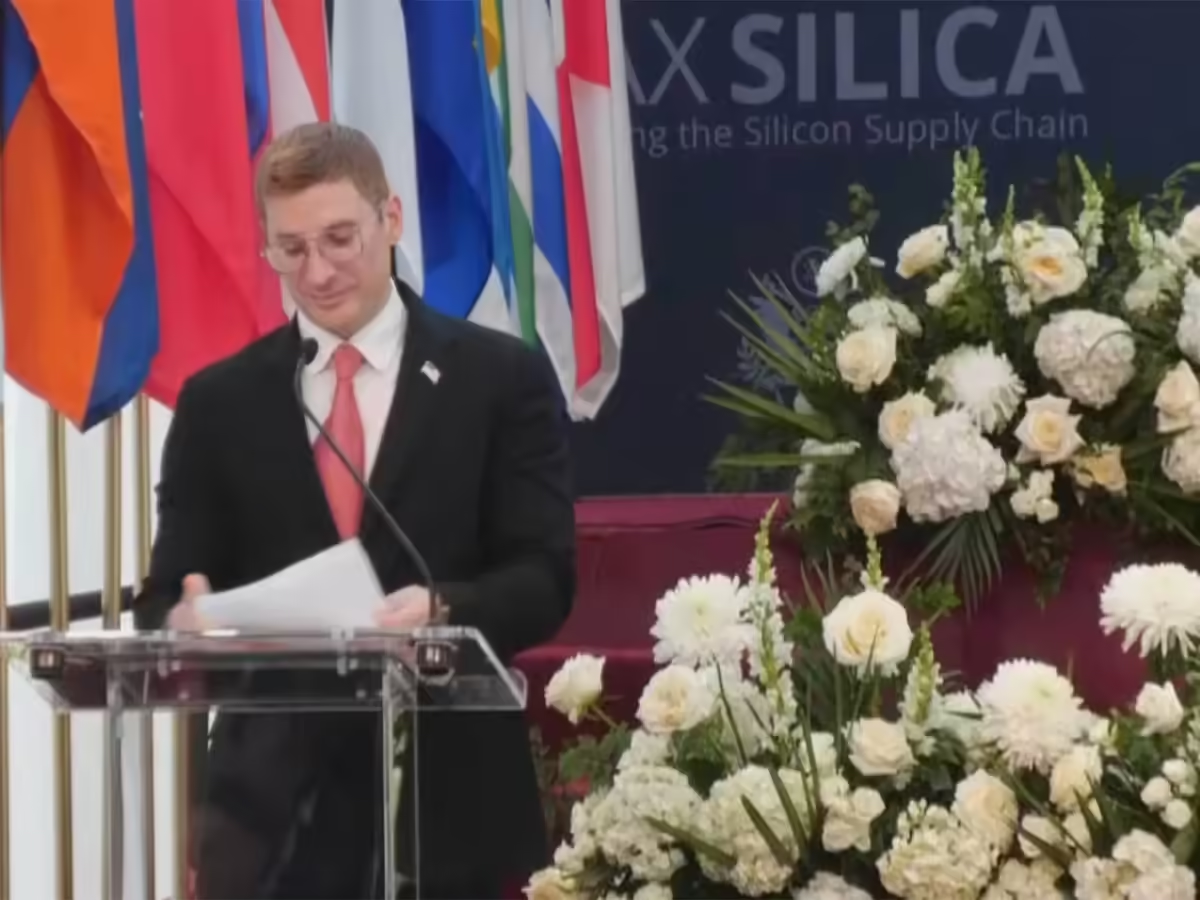
The United States announced PaxPass at the 2nd Pax Silica Summit in Washington on Thursday, a $50 million platform designed to expedite the movement of AI hardware, chips, and related goods between allied nations. The initiative combines cargo verification, AI-powered risk assessment, and pre-approved processing for trusted shipments moving through Panama.
More than 30 governments participated in the summit, signing the Declaration on AI Opportunity. The document commits signatories to what US Under Secretary of State Jacob S. Helberg called "pro-growth AI policies" rather than restriction-first approaches.
What does PaxPass actually do?
PaxPass targets a specific bottleneck: the friction of moving high-value AI components between trusted trading partners. The platform will provide pre-clearance for shipments that pass verification, creating a fast lane for semiconductor equipment, specialized chips, and other AI infrastructure goods.
Panama's role as a transit hub makes it the logical pilot location. A significant portion of global shipping passes through the Panama Canal, and AI hardware often moves in small, high-value shipments that face disproportionate customs delays.
“Pax Pass will reduce friction, strengthen supply chain resilience and accelerate trusted trade. To support this effort, the United States is committing $50 million in foreign assistance funding dedicated to the development and deployment of Pax Pass.”
— Jacob S. Helberg, US Under Secretary of State
The $50 million commitment signals this is not a white paper exercise. That funding covers development, deployment, and presumably the AI risk-assessment systems that will verify shipments. Whether $50 million is sufficient for a multi-nation cargo verification platform remains to be seen, but it is real money attached to a specific program.
Innovation sovereignty: the summit's central concept
Helberg introduced the term "innovation sovereignty" to distinguish the Pax Silica approach from protectionism. The argument: true technological independence comes not from recreating existing technology domestically, but from participating in frontier research with trusted partners.
“The real measure of sovereignty in the AI age is not the ability to recreate yesterday's technologies. It's not even the ability to recreate today's technologies. It is the ability to contribute to tomorrow's breakthroughs.”
— Jacob S. Helberg, US Under Secretary of State
This framing positions Pax Silica as the opposite of technology isolation. Countries join not to build independent supply chains but to specialize within a trusted network. A participating nation might focus on advanced packaging, another on substrate materials, another on testing equipment. The system depends on trust, hence the emphasis on vetting and verification.
Foundry School: training the workforce
The second major announcement was Foundry School, a workforce development initiative built with Stanford University. The program will train "entrepreneurs, engineers and advanced manufacturing leaders" from participating economies.
Foundry School starts with a seminar series at Stanford, bringing in what Helberg called "the greatest luminaries of advanced manufacturing." Stanford and the State Department will then develop a curriculum that institutions across Pax Silica economies can adopt.
This addresses a genuine constraint. TSMC, Intel, and Samsung can announce new fabs, but finding engineers who understand the physics of sub-3nm processes is a different problem. The US CHIPS Act has exposed this gap domestically. Foundry School attempts to scale that talent pipeline across allied nations.
Who signed the Declaration on AI Opportunity?
The summit included over 30 governments and economies, with new observer nations joining the coalition. The specific country list was not released in full, but the framing suggests it includes the usual semiconductor allies: Japan, South Korea, Taiwan, the Netherlands, and various European partners.
The declaration commits signatories to "trusted technology ecosystems, resilient supply chains and investment in the infrastructure needed to power the AI economy." It explicitly rejects the restriction-first approach to AI governance, positioning growth and security as compatible rather than competing goals.
US Deputy Secretary of State Christopher Lando described the summit's premise as "align public purpose with private capability." This suggests the coalition sees government's role as creating conditions for private investment rather than directing industrial policy top-down.
What this means for companies shipping AI hardware
If PaxPass works as described, companies moving GPU clusters, semiconductor manufacturing equipment, or AI accelerators between allied nations should see faster customs clearance. The "pre-approved expedited processing" suggests a trusted-shipper certification, similar to programs like C-TPAT for cargo security.
The Panama focus makes sense for trans-Pacific routes but leaves questions about European corridors. Whether PaxPass expands to other transit points will determine its practical reach.
For hyperscalers and AI companies, the immediate impact is limited. Most already have sophisticated logistics operations. The larger benefit may come for mid-sized equipment suppliers and component makers who lack the resources to manage complex export controls across multiple jurisdictions.
Logicity's Take
Pax Silica is the clearest articulation yet of US tech diplomacy strategy: build a bloc of allied nations with integrated supply chains and fast-track trade, while excluding adversaries from the network. PaxPass is the infrastructure layer of that vision. The $50M commitment is modest compared to the $280B CHIPS Act, but it addresses a real friction point. The risk is complexity. Thirty-plus nations with different customs systems, export controls, and political pressures will not integrate overnight. Still, this is more concrete than most international tech initiatives, with actual funding, a specific platform, and a training program attached.
Frequently Asked Questions
What is PaxPass and how does it work?
PaxPass is a US-funded platform that combines cargo verification, AI-powered risk assessment, and pre-approved processing to expedite shipments of AI hardware and components between trusted partner nations, initially focusing on goods moving through Panama.
How much is the US investing in PaxPass?
The United States committed $50 million in foreign assistance funding for the development and deployment of PaxPass.
What is the Pax Silica Summit?
Pax Silica is a US-led coalition of over 30 governments focused on building trusted AI supply chains and promoting pro-growth AI policies. The name combines 'Pax' (peace) with 'Silica' (silicon), suggesting cooperative development of semiconductor and AI technology.
What is Foundry School?
Foundry School is a workforce development initiative created in partnership with Stanford University to train advanced manufacturing leaders across Pax Silica member economies. It will offer curricula that participating nations can adopt.
What is innovation sovereignty?
Innovation sovereignty is a concept introduced at the summit that defines technological independence as the ability to contribute to future breakthroughs within a trusted partner network, rather than attempting to replicate existing technologies domestically.
Related advanced semiconductor manufacturing development
Need Help Implementing This?
If your organization ships AI hardware internationally or needs to navigate evolving export controls, Logicity can connect you with logistics consultants and compliance specialists. Contact our team for recommendations.
Source: Tech-Economic Times / ET
Manaal Khan
Tech & Innovation Writer
Produced with AI assistance and reviewed by the Logicity editorial team. Learn more in our Editorial Policy.